- Women’s share of South African news sources has doubled, from 19% in 2003 to 40% in 2026.
- South Africa ranks second in SADC for women’s news representation, behind Eswatini’s 47% and above the regional average of 29%.
- Women remain underrepresented as experts and on power beats, accounting for just 33% of experts, 31% of business sources, 30% of political sources and 29% of legal sources.
- Women now make up 52% of South African reporters, but representation varies sharply by platform: 77% of radio reporters versus just 23% online.
- Greater visibility has not delivered equal influence. Men and boys remained the main subjects in 55% of news images, compared with 22% for women and girls. *
Women’s share of news sources in South Africa has more than doubled over the past two decades, rising from 19% in 2003 to 40% in 2026, but significant gaps remain in whose voices are heard on issues of power and authority.
The findings, released today by Gender Links, place South Africa second among 16 Southern African Development Community (SADC) countries for the proportion of women used as news sources, behind Eswatini at 47% and well above the regional average of 29%.
Despite the progress, men still accounted for more than half of South African news sources. Women were also significantly underrepresented as experts and in coverage of politics, business, the economy and the law.
The findings come from the 2026 Gender and Media Progress Study (GMPS), which analysed 2 060 news items from more than 200 print, online, television and radio outlets across Southern Africa.
The study found that women’s increased visibility has not necessarily translated into equal authority in news coverage.
In South Africa, women were most likely to be featured when sharing personal experiences, accounting for 65% of such sources. Their representation fell to 42% among spokespersons and just 33% among experts and commentators.
Less visible on power beats
Women were also less visible on beats traditionally associated with power and decision-making. They accounted for 31% of sources in business and economy coverage, 30% in politics and government stories and 29% in legal coverage.
“No SADC country achieved parity,” the study found. Across the region, women’s share of news sources ranged from 47% in Eswatini to just 15% in Angola.
The research was released as South Africa marks Women’s Month and the 70th anniversary of the 1956 Women’s March to the Union Buildings. Its release on SADC Day also coincides with the 46th Ordinary SADC Summit and South Africa’s assumption of the SADC Chairship for 2026/27.
Gender Links said the findings provide a timely measure of progress towards Article 29 of the SADC Protocol on Gender and Development, which calls for the media to give women and men equal voice across all areas of coverage.
“Seventy years after women marched to claim their place in South Africa’s public life, whose voices are heard in the news remains an urgent equality issue,” said Colleen Lowe Morna, Gender Links special advisor.
“As South Africa assumes the SADC chairship, it has an opportunity to lead by example in advancing the region’s commitment to equal voice for women and men in the media.”
More women are reporting, but not necessarily setting the agenda
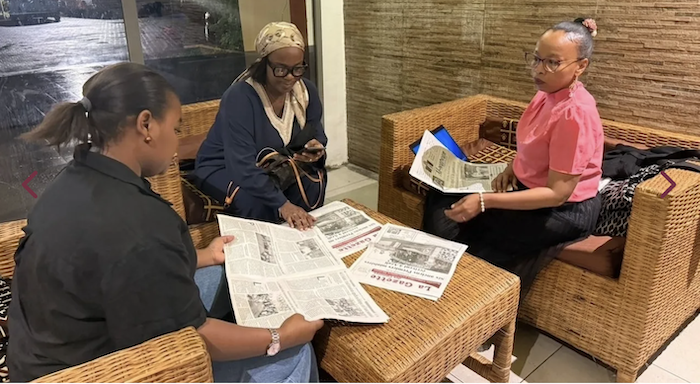
Women accounted for 52% of reporters in South Africa, compared with 42% across SADC, suggesting greater gender parity in reporting roles.
However, the picture varied sharply between platforms. Women made up 77% of radio reporters but only 23% of online reporters.
The study also found that South African journalism showed greater gender awareness than the regional average. Some 37% of stories were classified as gender aware, compared with 27% across SADC.
Most coverage, however, remained gender blind, accounting for 57% of South African stories and 59% across the region.
News imagery presented another mixed picture. While two-thirds of South African images challenged gender stereotypes, men and boys still dominated the visual landscape, appearing as the main subjects in 55% of images. Women and girls accounted for 22%, while 21% featured a gender-balanced mix.
Regionally, 58% of images mainly featured men and boys.
Renewed debate
The findings complement renewed debate about women’s experiences and advancement within South African journalism, including the 2026 Glass Ceilings research published by the South African National Editors’ Forum.
While that research focuses on women’s position and experiences within the media industry, the GMPS examines what audiences ultimately see and hear in news content.
“More women reporting the news is important progress, but it does not mean they have equal influence over editorial decisions — or that more women are heard,” said Tabetha Kanengoni, Gender Links Director of Programmes.
“Real change depends on who sets the news agenda, who is recognised as an expert and whose perspectives make it into the story.”
Conducted every five years since 2003, the GMPS provides more than two decades of comparable data on who reports the news, who is used as a source and how women and men are represented across Southern African media.
Just society
The 2026 monitoring was conducted on 28 May and, unlike previous studies that monitored media over a month, provides a one-day snapshot of gender representation in Southern African news. The findings also contribute to the 2026 Voice and Choice Barometer.
Gender Links is a Southern African non-governmental organisation working towards an inclusive, equal and just society for women and girls. The organisation was established in 2001 and operates across the SADC region through country offices and partnerships.
The Southern Africa Gender Protocol Alliance, coordinated by Gender Links, comprises 16 country focal networks and thematic clusters working to advance gender equality and women’s rights and monitor implementation of the SADC Protocol on Gender and Development.
* Summary created by AI
Launch: Whose News, Whose Views? Gender and Media Southern Africa Progress Study 2026
Date: Monday, 17 August 2026
Time: 14:00–16:00 SAST
Venue: Ubuntu Conference Centre, 30 Gill Street, Johannesburg
Online: Register here