- Horse race journalism can overshadow service delivery and municipal accountability in South Africa’s 2026 local government elections.
- Election reporting should assess parties’ governance records, manifesto promises and plans to address municipal service delivery failures.
- Fact-checking campaign claims against municipal budgets, audit outcomes and service delivery records supports informed voting.
- Polling trends reveal shifts in political support but do not explain municipal failures or validate campaign promises.
- Public interest journalism should prioritise municipal performance, coalition accountability, credible funding plans and the impact of political decisions on residents. *
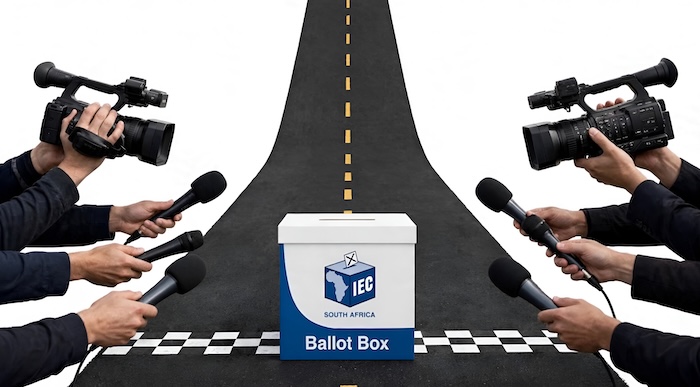
In an election shaped by public frustration over service delivery and municipal accountability, the news media needs to look beyond the competition for power and examine the substantive issues at stake. They must also consider what happens to democracy when the contest becomes more newsworthy than the public interests it should serve.
When politics becomes a scoreboard
This is the danger of ‘horse race’ journalism. Political communication scholar Frank Brettschneider defines ‘horse race’ journalism as reporting that uses sporting metaphors to frame political competition, particularly through opinion polling and campaign strategies.
It primarily focuses on shifts in public support and the growing competition among political parties to secure votes.
Although tracking which party is gaining ground in a specific municipality is a legitimate part of election reporting, an excessive focus on political fortunes can obscure a more fundamental question about what electoral victory will mean for citizens and the communities they live in.
In South Africa, local government affects people’s access to basic services, waste collection, infrastructure and local economic opportunities. Voters need more than predictions about which party will control their municipality.
They need to know whether parties can deliver on their promises and how they plan to address service delivery failures. They also need to see how parties have performed in government and whether their records support their claims.
When campaign tactics take precedence over local governance priorities and accountability, journalism risks turning citizens into spectators of an electoral contest. Instead, election coverage should help voters make informed choices and hold elected representatives accountable.
When competition becomes a political narrative
In a 2011 article for the Columbia Journalism Review, journalist Greg Marx examines the democratic value of “horse race” journalism. He argues that reporting on electoral competition can help citizens understand how political parties make decisions and choose their leaders.
Marx cautions against dismissing all “horse race” coverage as superficial, particularly when it reveals who holds influence within a party and which priorities shape its direction. However, he acknowledges that coverage focused on predicting electoral outcomes and speculating about campaign strategy offers limited public value.
This distinction is crucial. When electoral competition dominates news media coverage, it can produce political narratives about a party’s gains or losses. It can turn polling shifts and campaign momentum into a dominant story.
This risks voters receiving a distorted picture of political performance. It can divert attention from the tangible local government matters that affect voters’ everyday lives. Thus, narratives of a political party’s electoral gains or losses cannot fully explain the underlying causes of a municipality’s service delivery challenges.
Continuous reports of declining poll numbers can construct a narrative that a political party is losing public support. In contrast, rising poll numbers may be presented as evidence of growing momentum and electoral success. Yet neither trend, on its own, explains why public opinion shifts or whether a party’s manifesto promises are realistic and likely to address municipal problems.
This highlights the need for journalists to look beyond polling trends and examine the evidence behind the political narratives they help shape.
Fact-checking as democratic infrastructure
Fact-checking is essential to the process of challenging misleading political narratives and ensuring that election coverage is grounded in verifiable evidence rather than the perception of who is winning or losing.
But it should not be treated as an occasional corrective that’s reserved for viral falsehoods. Verification must be integrated into routine election reporting, including coverage of manifestos, campaign speeches, polling claims and allegations about municipal performance.
Fact-checking improves factual understanding. However, it does not guarantee that people will abandon their political loyalties. Its purpose is not to dictate electoral choices, but to strengthen the evidence on which those choices are made.
South African newsrooms can apply this principle by verifying campaign promises against municipal budgets, audit outcomes, service delivery records, together with independently sourced data.
Fact-checks should be timely. Where a claim is false, journalists should explain why. And where evidence is incomplete, they should say so.
Fact-checking must remain independent, transparent and non-partisan. Selective scrutiny undermines credibility and allows politicians to dismiss inconvenient findings as partisan attacks.
The Electoral Commission’s Disinformation Code for the 2026 Local Government Elections, introduced in September 2026, provides a further safeguard against the spread of false or misleading political information. It sets rules for political parties and candidates while protecting “lawful criticism, opinion, commentary, fair reporting, satire, parody or legitimate democratic debate”, provided that these constitute protected speech.
However, newsrooms bear the broader responsibility of ensuring that election coverage does not come at the expense of accuracy and the public’s interest.
Reclaiming the public interest agenda
Ideally, electoral competition spectacle shouldn’t dictate the news agenda. But it does. When electoral reporting is reduced to a scoreboard, democracy loses an important function.
The alternative to “horse race” journalism is not duller reporting. It is more consequential reporting.
The challenge for newsrooms is not to eliminate electoral competition and strategy from their coverage, but to restore balance. Polls and coalition negotiations can help explain political developments, but they should be complemented by rigorous reporting on the issues that shape governance and affect citizens’ everyday lives.
This requires more than a change in headlines. It demands editorial decisions that allocate reporting time and investigative resources to cover weighty municipal concerns. Journalists should ask what each party proposes to do about dire municipal concerns such as water interruptions and electricity infrastructure.
They should also examine whether campaign promises are supported by realistic cost estimates and credible funding plans. Comparing governance and service delivery across municipalities can reveal differences in performance and help identify recurring weaknesses.
Investigating why parties have repeatedly failed to fulfil their commitments can help explain entrenched municipal problems. Coverage should also examine how coalition arrangements affect political accountability, municipal budgets and the continuity of service delivery.
When reporting combines analysis of municipal service-delivery plans, fact-checking and a critical understanding of political narratives, it gives voters something more valuable than just predictions. It gives them the information and agency needed to hold power accountable.
South Africa’s 2026 Local Government Elections offer journalism an opportunity to reaffirm its democratic purpose by placing greater emphasis on how parties govern and fulfil their commitments.
Election victories make headlines, but accountability and the consequences of political decisions shape people’s lives long after the results are declared.
* Summary created by AI
Banathi Mgqoboka is an award-winning, Cape Town-based multi-platform journalist, writer and researcher working at the intersection of contemporary social realism and critical media analysis, bridging academic and non-academic critical discourse. He holds a Master’s Degree (MA) from Rhodes University’s School of Journalism and Media Studies, where he was a research scholar in the National Research Foundation (NRF) ‘Licence to Talk’ Project. Most recently, he was a participant in the Truth Lab programme (August–September 2026), a multidisciplinary Franco-German initiative of the French Institute of South Africa (IFAS) and the Goethe-Institut South Africa, which focuses on critical media literacy, mis/disinformation, verification, and the development of reliable and inclusive knowledge systems.