

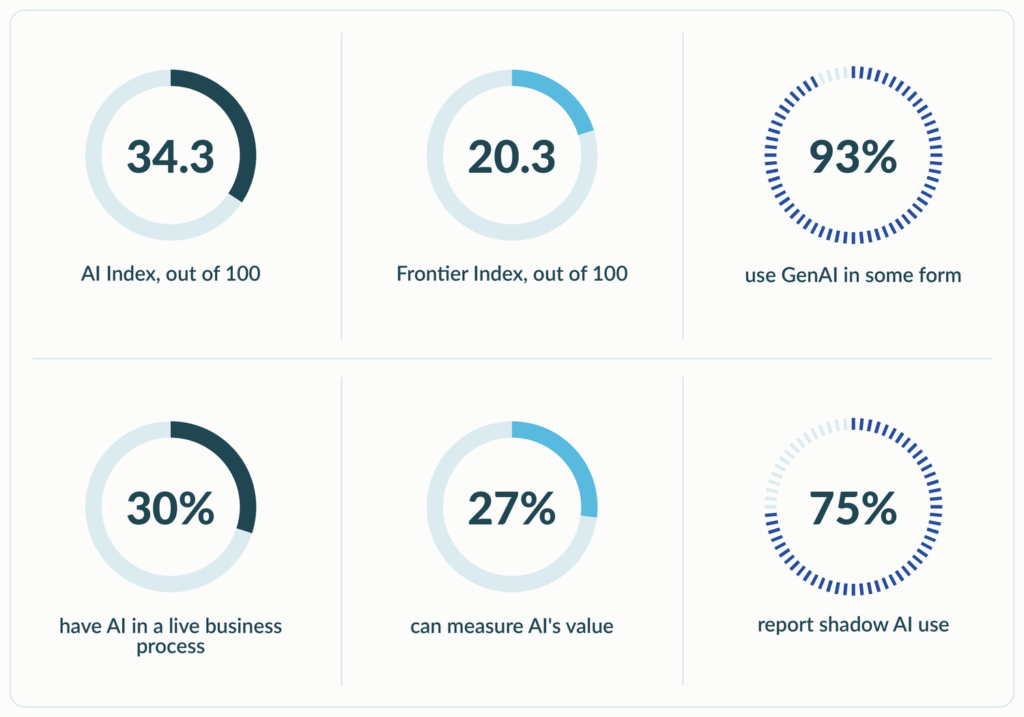
- AI adoption among large South African organisations increased from 45% in 2024 to 93% in 2026, according to the SA AI Index 2026.
- Despite increased adoption, the proportion reporting a positive productivity impact fell to 51% in 2026, from 96% in 2024.
- More than half (52%) of organisations remain at the AI experimentation stage, while only 30% have AI operating in live business processes.
- Some 73% of organisations lack tools to measure AI’s business value, and 71% cannot quantify AI-related cost savings.
- The average SA AI Index score is 34.3 out of 100, while the SA AI Frontier Index averages 20.3, highlighting limited progress in using AI to develop new products, services and business capabilities. *
AI adoption among large South African organisations has doubled in two years, but confidence in its impact on productivity, competitiveness and customer service is declining, according to the SA AI Index 2026.
Nine in 10 large South African organisations now use artificial intelligence (AI), but significantly fewer believe it is delivering measurable business value.
That is the central finding of The SA AI Index 2026, a study by World Wide Worx in partnership with Altron Digital Business, released on 13 November. Now in its third edition, the annual study tracks AI adoption and its impact across South African businesses.
More than doubled
The research shows that AI adoption among large organisations has more than doubled in two years, rising from 45% in 2024 to 67% in 2025 and 93% in 2026. However, perceptions of its business impact have moved in the opposite direction.
The proportion of organisations reporting a positive impact on productivity fell from 96% in 2024 to 83% in 2025 and just 51% this year. Positive assessments of AI’s contribution to competitiveness dropped from 86% in 2025 to 37% in 2026, while positive ratings for customer service declined from 66% to 38%.
The study introduces the SA AI Index, a score out of 100 designed to measure how deeply organisations have integrated AI into their operations. It looks beyond the use of AI tools to assess whether the technology is embedded in core business processes, supported by formal governance, measured for value and reflected in workforce development.
The average score among large South African organisations is 34.3, indicating that most have made only limited progress towards full integration.
From novelty to normal
“AI has gone from novelty to normal in South African business in just two years,” says Arthur Goldstuck, CEO of World Wide Worx.
“But using AI and getting value from it are very different things. The early adopters were enthusiasts who went looking for gains. Today almost everyone uses AI, often in a shallow way, and many organisations are discovering that a language model on every desk does not automatically translate into business results.”
The findings suggest that the depth of implementation is a critical factor in determining whether AI delivers tangible benefits. Among the 30% of organisations with AI operating in a live business process, 80% report a positive productivity impact. This compares with 44% of those still experimenting with the technology and just 6% of organisations using it on an ad hoc basis.
More than half of the organisations surveyed (52%) remain at the experimental stage.
Five pillars
The Index measures progress across five pillars: deployment, adoption, workforce, governance and value. Organisations score highest on deployment (43.8) and adoption (41.8), followed by workforce (37.2) and governance (32.0). Value is the weakest area, with an average score of just 16.6.
A significant obstacle is the lack of measurement. Some 73% of organisations have no tools to assess whether AI is delivering value, while 71% cannot quantify the cost savings generated by its use.
“Every boardroom is talking about AI, and the interest is real,” says Craig Stewart, managing director of Altron Digital Business.
“But this research shows the gap between having AI and having it at the heart of the business. The organisations seeing real gains have taken AI into production, built it into their processes and put measures in place to track what it returns.”
Frontier Index
The study also introduces the SA AI Frontier Index, which measures how far organisations are using AI to create new capabilities and ways of working, rather than simply making existing tasks faster.
The average score is 20.3 out of 100, with only 8% of organisations scoring 50 or more.
While many are experimenting with advanced technologies such as predictive AI and machine learning, just 17% have AI operating in functions that fundamentally change what the business produces or how it operates. These include developing new products, software development, quality control and supply chain management.
Only 14% have configured or fine-tuned an AI model for their own requirements, while 7% have built their own models.
“The AI Frontier Index shows where the next opportunity lies,” says Stewart. “Most organisations are using AI to make existing work faster, and that has real value. But the organisations that will pull ahead are those using AI to create new products and services, run their operations and supply chains differently, and build AI capability of their own.”
The findings also reveal a relationship between organisational size and AI maturity. Businesses with more than 1 000 employees achieve an average AI Index score of 42.6, compared with 33 among those employing between 501 and 1 000 people, and 28 among organisations with 201 to 500 employees. Only 13% of all organisations surveyed score 60 or more.
A benchmark
Goldstuck says the Index provides South African businesses with a benchmark against which they can measure future progress. “A score by itself means little, but we can now measure movement off the 2026 baseline,” he says.
Goldstuck will present further findings at an AI Masterclass during the Africa Tech Festival in Cape Town on 17 November, alongside Doug Woolley, Altron Digital Business executive for sales, and Theo Spickett, executive for data and AI.
The full report is scheduled for online release on 23 November. Organisations can pre-register to receive the report when it becomes available: https://digitalbusiness.altron.com/adb-sa-ai-index-report-pre-registration
* Summary created by AI.