-
TV news is going digital-first: Declining TV audiences are forcing South African broadcasters to integrate television and digital news operations.
-
ZiMoja Daily blends news, entertainment and commentary: The Moja Love show reflects a new hybrid format shaped by social media and short-form video.
-
Short-form, multilingual storytelling boosts reach: Two-minute episodes use vernacular languages and Facebook distribution to engage younger audiences.
-
The format is powerful but controversial: Opinion-driven political commentary has sparked criticism over accuracy, fairness and verification.
-
Popular journalism is reshaping news consumption: ZiMoja Daily shows how emotional, accessible storytelling is changing how South Africans engage with current affairs. *
Traditional television news audiences in South Africa are steadily drifting away, signalling a profound shift in how people consume news. Media roles are increasingly converging, creating a growing need to seamlessly integrate TV and digital operations for a more agile and efficient newsroom.
In early August 2026, eMedia, the parent company of eNCA, e.tv and eNuus, began a restructuring process that could place 171 of its 309 employees at risk of retrenchment as it moves toward a smaller, “digital-first” newsroom.
Amid all this angst, ZiMoja Daily exists at the intersection of entertainment TV and political commentary, reflecting a broader transformation in South African media culture. It is neither a conventional news programme nor straightforward infotainment.
Instead, it represents a hybrid format shaped by the pace of social media, the style of reality TV, and the emotive tone of everyday conversation.
Emerging approach to TV journalism
Situated within the black-owned Siyaya Media Network’s Moja Love ecosystem (on DStv channel 157), ZiMoja Daily, which began airing in the third quarter of 2025, exemplifies an emerging approach to TV journalism in which traditional journalistic pedigree takes a back seat.
Framed by the slogan, ‘Your window to Mzansi’s most topical stories’, the programme sets the agenda through commentary on politics, crime and social issues, largely prioritising emotional resonance over complexity and nuance. It essentially reframes the traditional journalistic duty of ‘holding power to account’.
When Moja Love launched in February 2018, it initially centred its programming on themes of love and relationships, with women as its primary target audience. It soon evolved into a platform that positioned itself as an authentic voice of the people, centring black working-class experiences that are largely ignored by elite media institutions in post-democratic South Africa.
Unlike polished commercial broadcasters that often catered to middle-class sensibilities such as social mobility and financial stability, Moja Love entered homes and communities marked by social instability.
It spoke in vernacular languages, foregrounded township life, and embraced confrontational realism. For many viewers, this felt culturally affirming because mainstream South African media had historically marginalised or sanitised black working-class realities.
Growing audience
Although the channel has attracted criticism for its controversial on-air talent, its growing audience suggests that such controversy has not necessarily undermined its appeal. By May 2019, the channel was reportedly reaching more than six million viewers each week.
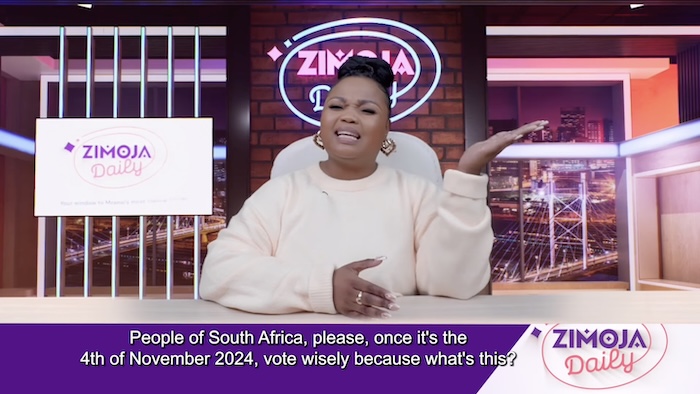
Anchored by Karabo Isaiah against a green-screen backdrop that shifts to distinctive fuchsia-coloured graphics on-screen, ZiMoja Daily is built around a short-form structure designed for ubiquity and digital circulation. The two-minute-and-one-second episodes are brief and are scheduled to air between Moja Love’s prime-time programming.
Extending its reach beyond linear TV, the episodes are further distributed primarily on Facebook, where the channel has amassed more than two million followers. The programme functions mostly as a source of viral moments.
It operates less like traditional TV and more like a content engine built for the attention economy. Isaiah functions more as a commentator than a news anchor, adopting a conversational, multilingual approach that seamlessly moves between English and South African vernacular languages such as isiZulu, Sesotho and Setswana.
Linguistic choice
The word ‘ZiMoja’ draws on the colloquial South African slang use of ‘moja’, which, as described by the channel, conveys the idea that “everything is good”. This linguistic choice reinforces the channel’s emphasis on reflective honesty, communal hope, shared experiences and cultural connection.
The familiar South African lingo gives ZiMoja Daily an informal identity that differs from the more formal cadence that’s traditionally associated with TV news.
Isaiah’s role on ZiMoja Daily reflects her unconventional transition into journalism, a journey she says began when content creation during the Covid-19 pandemic revealed her “natural gift for storytelling”.
As she told The Citizen, “journalism perfectly aligns with my life’s purpose”, while her use of social media allows her to “celebrate resilience, highlight community voices and connect with younger audiences.”
This positions Isaiah and ZiMoja Daily within a more popular and accessible media culture, where audience connection, community voices and relatable storytelling can challenge the conventions of traditional news.
This approach explains much of the programme’s appeal. It connects with audiences who have increasingly disengaged from conventional news formats.
Replacing distance with familiarity
For many South Africans, mainstream journalism still feels institutionally distant, defined by formal language and reliance on expert authority. ZiMoja Daily replaces that distance with familiarity. Its tone resembles the ‘informal spaces’ where political discussion already takes place: family dining room tables, taxi ranks, taverns, salons, and increasingly, social media threads and comment sections.
That familiarity also underpins its populist appeal. The programme (and arguably the channel as well) often positions itself, implicitly or explicitly, as a voice for ‘ordinary people’ against political elites. In doing so, it narrows the gap between commentary and conviction.
Opinions are delivered with certainty, as emotional clarity often takes precedence over analytical depth. But of course, this is not incidental. It is part of what makes the format effective in a crowded media landscape where attention is limited, and competition for engagement is intense.
This approach resonates with the scholarship of Herman Wasserman, a leading media scholar and Professor of Journalism at Stellenbosch University. In the 2011 book, Popular Media, Democracy and Development in Africa, Wasserman posits that popular media can challenge the dominance of elite-oriented journalism by providing a platform that actively listens to the voices, experiences and concerns of ordinary and marginalised audiences.
Popularised journalism
Wasserman also argues that popular media should not simply be dismissed as sensationalist or lacking in journalistic pedigree, because their appeal can stem from their ability to connect with audiences through familiar language, everyday concerns and accessible storytelling.
In this sense, ZiMoja Daily represents a form of popularised journalism, where relatability and audience connection become just as important as the traditional markers of journalistic authority.
The 9 May 2026 episode of ZiMoja Daily featured unfiltered commentary on Economic Freedom Fighters (EFF) leader Julius Malema’s response to the Constitutional Court’s judgment on the Phala Phala matter, while also discussing allegations involving EFF councillors and tenders in Tshwane and Ekurhuleni, as well as the party’s position on illegal immigration.
The EFF issue
On 11 May 2026, the EFF lodged a complaint with the Broadcasting Complaints Commission of South Africa (BCCSA), accusing the programme of misleading and politically biased commentary, alleging that it presented unverified claims, misrepresented facts and failed to provide the party with a right of reply.
The EFF called for the episode to be pulled, an apology issued, and an opportunity to respond on the same platform. In response, Moja Love offered the party an opportunity to participate in a special discussion addressing the concerns.
This controversy illustrates that the backlash was not only about the content itself, but also about ZiMoja Daily’s growing role in shaping political interpretation and public discourse. As with popular media more broadly, controversy can become part of the visibility cycle, with both positive and negative attention generating relevance and public engagement.
The dispute also highlights the tension between ZiMoja Daily’s informal, reaction-driven style of political commentary and the conventional journalistic expectations of accuracy, fairness, verification and fact-checking.
Less an outlier
What distinguishes ZiMoja Daily is its understanding of changing media consumption habits. It is less an outlier than a sign of where TV ‘news’ is heading in a digital environment. The rise of short-form video has transformed audience expectations around pacing, tone, and the delivery of information.
Increasingly, people encounter news as fragmented moments rather than complete narratives. In ZiMoja Daily’s format, emotional immediacy often proves more effective than detailed explanation, and the programme is seemingly carefully designed to meet that demand. Its success points to a deeper disconnect from traditional news institutions, a gap that it undoubtedly fills.
Yet this efficiency comes with significant trade-offs. Complex political and social issues are compressed into simplified narratives that reproduce the broader process of ‘tabloidisation’ in news discourse.
Reactive commentary can yield public discourse that is highly provocative and engaging, but often comes at the expense of analytical depth. A broader concern, however, is how the convergence of populism, entertainment, and short-form media reshapes public understanding.
At the same time, dismissing ZiMoja Daily as a purely sensationalist programme would overlook the reasons for its popularity. The more pressing question is what may be lost when the boundaries between news, entertainment and commentary become increasingly blurred, potentially leaving audiences with less context, nuance and clarity about what constitutes journalism and what constitutes opinion.
* Summary created by AI
Banathi Mgqoboka is an award-winning, Cape Town-based multi-platform journalist, writer and researcher working at the intersection of contemporary social realism and critical media analysis, bridging academic and non-academic critical discourse. He holds a Master’s Degree (MA) from Rhodes University’s School of Journalism and Media Studies, where he was a research scholar in the National Research Foundation (NRF) ‘Licence to Talk’ Project.