

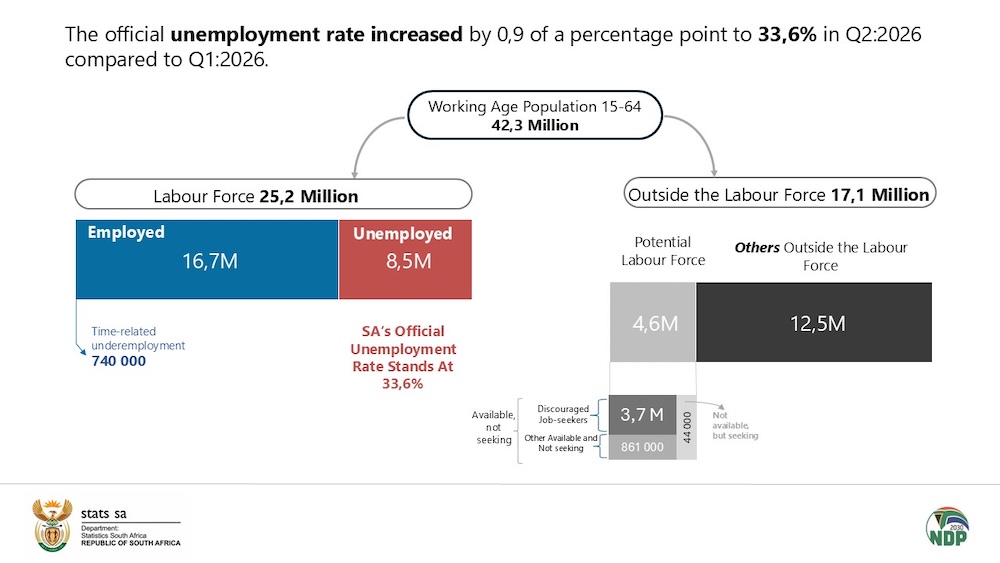
- South Africa’s unemployment rate hit 33.6% in Q2 2026, with 8.5 million people unemployed, intensifying scrutiny of corporate recruitment practices.
- Fair recruitment requires genuine merit-based opportunity, with structured criteria and consistent assessment, not preferential treatment through personal connections.
- Unemployment carries a psychological cost, as repeated rejection, financial pressure and uncertainty can erode confidence and wellbeing.
- Employer reputation is shaped by candidate experience, including how companies communicate, assess and reject applicants, not just what their corporate values claim.
- Companies cannot solve unemployment, but they can protect recruitment integrity: candidates may not be owed a job, but they are owed fairness, dignity, honesty and a genuine opportunity. *
South Africa’s unemployment crisis should force corporate South Africa to examine the human cost of recruitment
On 11 August 2026, Statistics South Africa reported that South Africa’s official unemployment rate had risen to 33.6% in the second quarter of 2026. There are 8.5 million unemployed people.
Let that sink in.
Behind every application is a person. Behind every CV is a story. Behind every interview is a human being who has decided, sometimes after months of rejection, to believe again.
Somebody is opening a laptop late at night to tailor a CV, researching the company and rehearsing answers. Somebody is walking into an interview carrying more than a CV.
They are carrying hope.
Uncomfortable questions
And this is where I have started asking an uncomfortable question: what exactly is a recruitment process supposed to be?
Not what the careers page tells us it is. What does a recruitment process look like when it is genuinely fair?
A structured recruitment process should begin with a clear understanding of the role, followed by sourcing, screening against predetermined criteria, relevant assessments and structured interviews. Professional HR guidance recommends consistent evaluation because standardisation can reduce subjectivity and bias.
I am not arguing that every candidate deserves the job. They do not. Recruiters do not owe us employment. Companies are entitled to choose the person they believe is best suited to the role.
But surely candidates are entitled to the integrity of the opportunity?
Preferential treatment
There is nothing inherently wrong with referrals or professional networks. The uncomfortable question begins when proximity becomes preferential treatment: when who knows whom, who has someone’s ear, or who is already close to a decision-maker becomes more influential than the merit-based process presented to everyone else.
What happens when a candidate experiences a process as open and competitive, but cannot see what ultimately influenced the decision? What happens when informal relationships carry greater weight than the formal process?
These are not accusations about any particular company. They are questions about institutional culture.
This matters because unemployment is not simply an economic condition. It can become a psychological one.
Mental health and unemployment
The South African Depression and Anxiety Group has addressed the impact of unemployment on mental health, highlighting the emotional effects of job loss, financial strain and uncertainty and providing support for unemployed people and jobseekers.
Spend enough time on LinkedIn and this reality becomes visible. Beneath announcements of promotions and new appointments is another stream of posts: people saying they are not okay after another rejection; people asking their networks for help; young professionals explaining that an internship is ending and time is running out.
This is the psychological choreography of job seeking: you are disappointed, but must remain professional; rejected, but still enthusiastic; exhausted, but expected to try again; uncertain, but required to present yourself with confidence in the next interview.
Repeated rejection can make the jobseeker wonder whether the problem is no longer the market, but them.
And this is what 33.6% cannot show us.
Is the system working?
The modern jobseeker is increasingly told to optimise: improve the CV, master the Applicant Tracking System, strengthen the LinkedIn profile, build a personal brand and become more visible.
But at what point do we stop asking the person outside the door to become more attractive to the system and start asking whether the system itself is working as it should?
At 33.6%, we cannot turn a structural labour-market crisis into an endless self-improvement project for the unemployed. There are simply more people seeking opportunities than there are opportunities available.
Corporate culture and reputation enter the conversation here. Companies invest heavily in employer brands, telling prospective employees about their values, purpose, culture and people. But reputation is also created in the recruitment inbox, the rejection, the silence and the way a candidate is treated when nobody is watching.
The gap
The story people tell about an organisation when corporate communications is not in the room is part of its reputation too.
Carl Jung’s concept of the persona offers an interesting psychological lens. The persona is the face we present to the world; the shadow contains what sits outside that preferred identity. Organisations have personas too: integrity, transparency, people first, fairness.
But do those values survive contact with actual behaviour?
The corporate persona says, “We value people.” The candidate asks, “Did you value me?” It says, “We believe in fairness.” The candidate asks, “Was I genuinely assessed fairly?”
That gap between stated identity and lived experience is where trust fractures.
This is where South Africa’s broader conversation about institutional accountability becomes relevant. The Madlanga Commission is a Judicial Commission of Inquiry established to investigate allegations of criminality, political interference and corruption in the criminal justice system, including alleged infiltration by criminal syndicates, while examining oversight mechanisms and making recommendations.
Integrity of the processes
The Commission is dealing with a completely different subject from corporate recruitment. The comparison is not about the subject matter. It is about the discipline of questioning institutional power: What actually happened? Who exercised influence? Whose interests were being served? What was the mandate? Was it respected? Who knew? When did they know? Who had proximity to power? Where did accountability fail?
Hypothetically, if we borrowed that same discipline and applied it to corporate recruitment, what would we find? When an organisation says it values merit, does merit determine who gets the opportunity? And at what point does professional proximity become preferential treatment?
South Africa does not need corporations to employ everyone. That is impossible. Recruiters do not have the power to solve unemployment, and candidates cannot expect every application to become an offer.
But organisations do control the integrity of the processes through which they invite people to compete.
Nobody owes an applicant a job. But surely an institution owes a person entering its process honesty, dignity and integrity.
Genuine opportunity
This is not about demanding a guaranteed outcome. It is about asking whether the opportunity itself was genuine.
Because behind every application is a life.
A family. A responsibility. A dream. A person trying to hold themselves together and still finding the courage to press ‘Apply’.
That person is not asking for pity. They are asking for the integrity of the opportunity.
If you invite someone into a recruitment process, make the process worthy of the person who entered it.
* Summary created by AI

Lerato Mapitsa is a media professional with 19 years in the industry. Her most recent position was campaign and media manager at the MultiChoice Group. She holds an IAB Digital Marketing Certification.
Sources/fact-checking references
- Statistics South Africa — Quarterly Labour Force Survey, Q2 2026.
- South African Depression and Anxiety Group (SADAG) — Unemployment & Mental Health; support for unemployed people and jobseekers.
- Society for Human Resource Management (SHRM) — A Step-by-Step Guide to the Recruitment Process; structured recruitment and assessment.
- Department of Justice and Constitutional Development — Judicial Commission of Inquiry into Alleged Criminality, Political Interference and Corruption in the Criminal Justice System (Madlanga Commission).
- Carl G. Jung — Man and His Symbols; concepts of persona and shadow.