

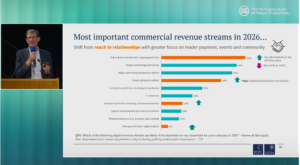
- News publishers are shifting their focus from reach to relationships, prioritising audience loyalty, subscriber retention and stronger connections with readers.
- Subscription growth is reaching a plateau, prompting publishers to explore new ways of delivering value, including bundled news and lifestyle content and premium subscription tiers to increase average revenue per user (ARPU).
- Fandom and talent-led media businesses are creating new revenue opportunities. Goalhanger demonstrates how publishers can build businesses around influential hosts, combining podcasts, video, newsletters, memberships, licensing, brand partnerships and live events.
- Revenue diversification does not mean abandoning advertising. Subscriptions, memberships, events and advertising can work together, with brand advertising remaining an important component of publishers’ revenue strategies.
- AI content licensing is an emerging revenue opportunity, with 69% of publishers surveyed expecting it to generate at least a minor income stream over the next few years. *
“Any discussion about monetisation needs to recognise that the way people are accessing news these days is changing. And what people value is also changing,” says Nic Newman.
Today, many traditional news publishers are “really rethinking a lot of fundamental things and less about pure reach and more about relationships – about how you build loyalty,” said Newman, senior research Associate at Reuters Institute for the Study of Journalism at Oxford University.
News publishers as a whole have seen substantial growth in their subscription businesses during the past decade, and subscription revenue remains a top priority for many. However, “now, we’re in this what you might call a ‘subscription shelf,’ and many publishers are feeling this,” he noted.
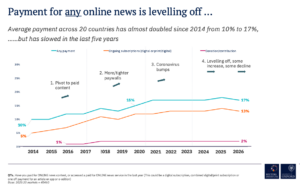
As a result, today, the focus is increasingly about delivering value, he said, and the questions are along the lines of “how do you build that value in different ways? How do you retain your subscribers by putting more value in? That’s why we’re seeing more bundling, combination of news and lifestyle content being one strategy for that.”
Likewise, if publishers are now reaching their likely peak subscriber numbers, then how can they get more out of those subscribers?
“One of the things that we see is putting in more premium layers, and trying to increase that average revenue per user (ARPU),” Newman said.
WAN-IFRA Members can replay this session and others from Digital Media Europe on our Knowledge Hub.
The rise of aggregators and fandom
When looking at the overall market of what subscribers are paying for, there are some areas that are clearly increasing, Newman noted.
“Firstly the rise of aggregators. And I think that with AI, we will probably see more aggregators as well. Things like Apple News playing an increasingly important role in countries like the UK, Canada, the United States and Germany as well,” he said.
A lot of the growth that Reuters Institute is seeing now is around products like video podcasts and newsletters “as businesses in their own right,” such as ones coming from individual Substackers.
In addition, “some of the new models are more about fandom. They’re more about shows, putting the talent at the heart and then around that core proposition, you can then build out these different out-puts.”
Take Goalhanger for example.
“Goalhanger started as a podcast company. It doesn’t call itself a podcast company any more: it does audio, it does video, it does TV. They’re investing in text. They’re investing in newsletters. And then around that, all of these different revenue models: Membership, licensing, brand partnerships. And it’s not an either-or, it’s all of those things together, including ticket sales,” Newman said.
In September, Goalhanger organised a large festival at the Southbank Centre in London. Nearly two dozen sessions featured the company’s “hosts coming together and really building those relationships. And making significant amounts of money, too.”

Originally a podcast company, Goalhanger has evolved to working in a variety of ways, including events: “They’re really building around that talent and the outputs,” Newman said.
Such diversification is also being embraced by many legacy news publishers, of course, and while reader revenue through subscriptions, memberships and events has been getting more attention, advertising remains vital.
“It’s not subscription replacing advertising, it’s how you can combine these things. Advertising is really important, and brand advertising has become a bit more important over time,” Newman said.
Licensing revenue expected to rise
Another growing diversification realm is licensing: “This is the area that has increased the most,” Newman said. “Publishers believe that there will be something coming from licensing. The funding from platforms primarily was relatively small scale around innovation until a few years ago. And increasingly now, this is publishers feeling that there are opportunities in this world to build new kinds of licensing revenue.”
While pointing out that most publishers are not thinking this licensing revenue is going to be their main source of income, or even a significant one, nevertheless, 69 percent of those they talked with, “felt that there would be a source of income, a minor source of income, over the next few years.”
Asked by moderator Kevin Anderson, of WAN-IFRA, about the market for AI licensing and publishers’ expectations, Newman noted the future will likely be different than some of the headline grabbers, like News Corp’s deal with OpenAI for 250 million over five years.
While the figures in some of the early deals can sound huge, Newman said the reality is that 250 million across all of the News Corp properties over five years, “it’s not really the main source of income.”
He added, “I think it’s clearer now that a lot of the value is not necessarily in the licensing of the training data. It’s much more about the grounding data, the real-time data and that’s obviously things that the AIs and the LLMs don’t have. So, over time, what we need to build is a mechanism to allow that value to be clear and then to be paid-for and we’re starting to see some of those.”
* Summary created by AI
This story was first published by the World Association of News Publishers (WAN-IFRA).
Brian Veseling is a senior editor at WAN-IFRA and specialises in reporting about reader revenue, advertising and general management topics for our website and reports.
Join the World Association of News Publishers here.