I have been witnessing and enjoying the growing, stimulating debates among audiences around creating better creative economies. However, I am still plagued by how we are conjuring and supporting African storytelling.
I must preface this with a confession: I have not seen Netflix’s The Polygamist. Indeed, I have not seen a single episode of the show produced by South African multi-award-winning production house Stained Glass TV, despite all the attention the production, cast and storyline have received.
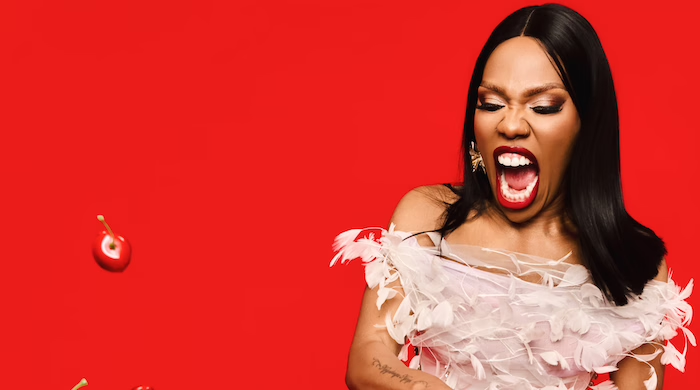
I saw all the billboards and viral posts on social media around Jonasi, and learned that the 22-episode telenovela tells the story of a self-made businessman, his philandering conquests and the destructive emotional upheaval that follows.
Albeit this may be a recurring theme in African societies, and seemingly a series that has triggered global interest, I couldn’t help but move to the discursive question: ‘Whose story is this really?’ This has been a persistent internal probe I wish to pose to the reader, not from a place of judgement or belittling audiences, but to use this point of contention around African films to move the conversation forward.
Stereotypically negative caricatures
Apart from Jonasi’s notoriety, I use The Polygamist as a reference due to the recent acclaim the show has received globally. Although delighted by the prospects and exposure this may bring to black-owned shows and African productions like theirs, I am disturbed by the continuity of the same narratives and stories when depicting black families.
Without shying away from the lived realities of black people, there are social ills within black communities and Global South countries that need acknowledgement. But the common depiction is skewed and unbalanced.
There is a tendency we must reject of overwhelmingly portraying stereotypically negative caricatures of black men and women in mainstream media as having stronger associations with instability, criminality, dysfunction, poverty and hyper-sexual behaviour than their white counterparts.
We should be more enraged and vocal about this persistent distortion. Mainstream media, productions and online platforms have a responsibility to prioritise demystifying biases and framing that has negative implications for communities over choosing stories that are more readily marketable.
Deep dissonance
It creates a deep dissonance for black audiences and players in the industry when we are grateful for the opportunities and recognition we receive, yet are given prescriptions on how to depict ourselves. Black life is inventive, futuristic and nuanced.
Beyond having more nuanced stories to tell, entertainment industries on the continent suffer from using the same faces and a culture of patronage. Viewers are hungry to see industries make a real, concerted and consistent effort to create opportunities for young talent and more versatile roles as a way of enhancing industry growth.
Kenya has also had a burgeoning film sector, with many exciting previews and new films that have just hit the market, including Anam’s Wake, Tides and Memory of Princess Mumbi, among others. Although demand has been evident, with patrons participating and showing support, these releases have been shrouded by audiences critiquing the industry for bypassing their vocalised desires in favour of decisions influenced by funders.
A worthy mention is the simultaneous release of films on the same weekend, with screenings running for a limited period. This is possibly driven by funding bodies competing and lacking consideration for better coordination, which would give audiences more time to appreciate the films on circuit.
Beyond the preview
What does the life of a film look like beyond the preview? These shortened film runs enable films to qualify for festivals, but leave audiences not knowing where they can savour these films. This is surely a missed opportunity to create a film culture that is circular, vibrant and responsive.
Beyond commercial purposes, we could be doing more to keep viewership numbers up and multiply audiences without overstimulating them. African streaming platforms like ours were born from the motivation to create more access to films made by independent filmmakers and close the gap between the growing demand for African stories and the high-calibre bodies of work being created.
Whether for profit or as a non-commercial endeavour, I wish we were doing more to actively fight for African films to take up more space. YouTube and other alternative forums also host channels committed to showcasing films that represent African creative practitioners well.
Perhaps this content needs stronger curation to keep African films on viewers’ watchlists, as it is currently scattered. The algorithm has often served me well, recommending selections from channels such as Plot Twist Picks, which offers a shortlist of some of the best films, and Gravel Road TV, which curates a phenomenal archive of classic South African cinema.
Showmax shockwaves
The closing down of Showmax in South Africa by French media giant Canal+, due to its alleged poor performance, sent shockwaves through the industry for small players like our platform, which has a significantly smaller market share.
By mere observation, Showmax appeared to be one of the major players in a capital-intensive and competitive African streaming service sector. At first glance, the readjustment may create a gap for more collaborative projects with foreign institutions, allowing fringe players such as ourselves to reshape the market.
But it also presents a conundrum around how the halting of funding for local productions that were previously commissioned will be resolved going forward.
It makes me wonder if it is getting progressively harder to be funded.
One such case is the Afreximbank African Film Fund, launched to finance content production, digital distribution and infrastructure across the continent, and the concerns raised around the fundamental reliance on foreign players as decision-makers in African economic activity.
It sparks a realisation of whether we really want to reshape our funding models, or whether there are parties that benefit more from compromised funding systems that keep others on the margins and perpetuate an air of exclusivity and scarcity.
African media is future-ready
PwC’s Africa Entertainment and Media Outlook for 2025-2029 provides a less bleak outcome for media practitioners, with its projections suggesting that the African media sector is future-ready. It depicts South Africa, Kenya and Nigeria as African markets showing the persistence of an admirable growth story and signs of outperforming global benchmarks.
I am immediately flooded by images of my grandmother in Soweto, who has never been to Nigeria but religiously and immersively watches Nollywood movies. According to the report, an emerging audience of younger, tech-savvy consumers and better mobile connectivity are encouraging this momentum, recording growth rates of 11.2%, 7.1% and 6.2% in Nigeria, Kenya and South Africa respectively.
African markets are positioned as major determining markets that influence trends and shape engagement and creativity. It still, however, proves difficult to further expand value chains due to obstacles around regulation, tariffs, intellectual property rights and broader internet access.
Real obstacle
Truthfully, another real obstacle is the painstaking endeavour of convincing African consumers to allocate a larger portion of their disposable income to streaming when there are other competing expenses, and where some face economic uncertainty as a reality of living and working on the continent.
As an insider, it can be a gruelling and punishing experience when you attempt to reconcile the numbers reflected in reports and projections with what you may be facing internally. The capital and effort required to achieve visibility and promote the ethical dissemination of African films does not always result in visible, tangible consumers and converted leads.
This brings me to my next question: is there really a nuanced audience, or is that a political guise and sideshow that distracts us from the damaging issue at hand?
In closing, it is critical to acknowledge the economic and regulatory issues that act as deterrents to a more progressive landscape for audiences and players.
Authoring our own stories
However, there is a big elephant in the room that we have denied long enough: how do we strengthen Africa’s consciousness without external interference and influence? How do we understand ourselves, our nuanced vernaculars, stories, products and knowledge beyond the moment of colonial contact?
Perhaps we need to disassociate ourselves from the Western project that tells us its ideas of progress, civilisation and modernity are the standard. It is common for people to expect audiences to understand an international film, yet go into watching an African one with expectations already formed.
We must reject the colonial imaginary that these narratives produce and inscribe on black life. We also need to continue the project of authoring our own stories and articulating the full spectrum of black life without being censored as to what is and what isn’t ‘authentically African’.
As industry actors, players and custodians, we must be genuinely curious about the pursuit of unravelling nuanced realities and safeguarding African stories.
Yours in art,
Thobile Dlamini
Customer acquisitions specialist, NWPlus TV
Thobile Dlamini is a brand strategist, creative consultant and scholar with 10+ years of experience, possessing notable expertise in brand marketing, communications and consultancy producing high-impact campaigns, and building purpose-driven brands. She is currently the Customer Acquisitions Specialist for NWPlus TV.