
• Subscribe to our newsletter
The Media Online
  • Home
  • MOST Awards
  • News
    • Awards
    • Media Mecca
  • Print
    • Newspapers
    • Magazines
    • Publishing
  • Broadcasting
    • TV
    • Radio
    • Cinema
    • Video
  • Digital
    • Mobile
    • Online
  • Agencies
    • Advertising
    • Media agency
    • Public Relations
  • OOH
    • Events
  • Marketing
    • Thought Leaders
    • Campaigns
    • Research
    • Media Education
      • Media Mentor
  • Press Office
    • Press Office
    • TMO.Live Blog
    • Events
    • Jobs
No Result
View All Result
  • Home
  • MOST Awards
  • News
    • Awards
    • Media Mecca
  • Print
    • Newspapers
    • Magazines
    • Publishing
  • Broadcasting
    • TV
    • Radio
    • Cinema
    • Video
  • Digital
    • Mobile
    • Online
  • Agencies
    • Advertising
    • Media agency
    • Public Relations
  • OOH
    • Events
  • Marketing
    • Thought Leaders
    • Campaigns
    • Research
    • Media Education
      • Media Mentor
  • Press Office
    • Press Office
    • TMO.Live Blog
    • Events
    • Jobs
No Result
View All Result
The Media Online
No Result
View All Result
Home Advertising

Advertising is coming to AI chatbots — and it could influence the answers you get

by The Conversation
September 18, 2026
in Advertising
0 0
0
Advertising is coming to AI chatbots — and it could influence the answers you get

AI systems are increasingly being used to search for information and make decisions, creating new questions about how commercial incentives may shape the answers users receive. (Unsplash)

Share on FacebookShare on Twitter
Advertising is moving into AI chatbots like ChatGPT and Gemini. Researchers Carlos Diaz Ruiz, Hanken School of Economics; Broderick Turner, Virginia Tech; Erick M. Mas, University of South Florida, and Zeynep Arsel, Concordia University warn sponsored AI conversations could affect trust, search results, misinformation and the future of the zero-click internet.

When Google founders Sergey Brin and Larry Page were still university researchers, they warned that advertising could undermine the trustworthiness of search engines. In their landmark paper presenting Google, they also wrote:

“The goals of the advertising business model do not always correspond to providing quality search to users[…]We expect that advertising-funded search engines will be inherently biased toward the advertisers and away from the needs of the consumers.”

More than two decades later, a similar question is emerging around artificial intelligence. As companies race to commercialize AI systems to offset the amount of cash they are burning through, advertising is becoming an increasingly attractive source of revenue.

But advertising within AI systems presents a new challenge. Unlike online ads, which generally appear alongside information as banners or sponsored links, AI advertising is being integrated into the conversation itself, potentially changing the answers you receive.

AI’s advertising model

Today, around half of consumers report using AI conversations for search. Indeed, conversations with AI are becoming so common that some even develop dependencies with AI companions. As advertising merges with AI, it could reshape these conversations.

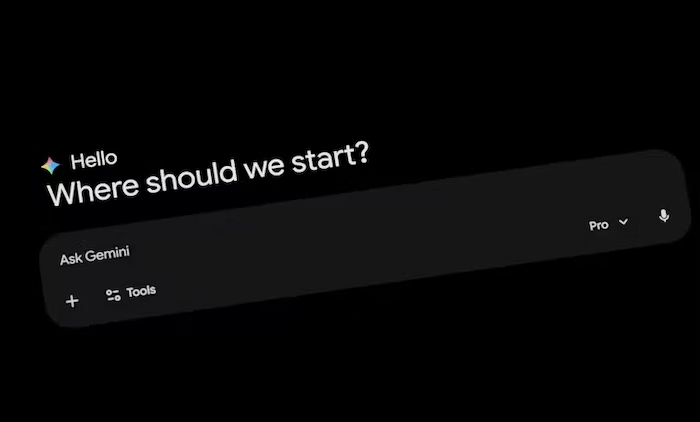
OpenAI has introduced ChatGPT ads designed around the way people interact with AI assistants, while Google is testing sponsored answers within Gemini conversations. Both approaches appear to follow closely how advertising technologies currently work, including real-time bidding and micro-targeting users, which allow advertisers to reach individual users based on behavioural data.

Organizational theorist Henry Chesbrough has argued that “technology by itself has no inherent value; that value only arises when it is commercialized through a business model.” His insight suggests that emerging technologies can only be examined as commercial systems shaped by financial incentives.

AI companies say advertising will not change answers. Yet advertising technology is difficult to audit because outsiders often lack access to the data, and AdTech companies weaponize complexity to prevent oversight.

Preventing paid influence from shaping AI-generated answers remains largely voluntary and depends on AI companies honouring their promises.

Some AI providers have already raised concerns about the impact of advertising on trust. Perplexity, an AI-powered answer engine, tested sponsored conversations but discontinued the program.

Even with clear labels, users may struggle to distinguish advertising from organically generated information when both appear within an AI conversation.

New risks in the zero-click internet

What happens when advertising no longer directs traffic to a website, but instead becomes part of a monetized AI conversation?

Commercial AI systems are heading towards a “zero-click internet” in which users make purchases within a corporate-controlled AI environment, not independent websites.

This represents a new form of e-commerce where advertising and transactions are integrated directly into AI chats. As a result, valuable user attention and commercial opportunities remain under the control of AI providers.

Our research explores the implications of merging advertising into AI environments. It identifies risks for free speech and free markets. AI-generated answers compress competing perspectives and may make alternative viewpoints less visible. This could create challenges for minority voices and dissenting perspectives.

It also raises questions about whether large corporations could purchase preferential visibility within AI systems. Smaller firms may face pay-to-play barriers, potentially increasing market concentration.

AI and disinformation

Another concern is the amplification of disinformation through AI. The United Nations warns that embedding micro-targeted adverts into AI-generated content could amplify misinformation and polarizing material.

We know that AI answers can be steered by their controlling corporations. One example is SpaceXAI’s Grok chatbot, which generated false “white genocide” claims in response to unrelated prompts and produced other extremist content reportedly due to an unauthorized code change an employee had made.

A CBS News segment on Elon Musk’s AI chatbot, Grok, which made several antisemitic posts in 2025.

Merging advertising with AI adds another layer of risk. Existing digital advertising technologies allow messages to be targeted at specific users based on their personal data.

If similar techniques are integrated into AI conversations, misleading or manipulative messages could be delivered privately, without the public scrutiny that accompanies traditional political advertising.

This is one concern associated with “dark money” in AdTech: when third-party entities use digital advertising technologies for illegitimate purposes, such as election interference.

Why current defences fail

Current defences against disinformation were not designed for AI conversations.

Some of the most advanced legislation to counter disinformation, such as the European Union’s Digital Services Act, was designed for social media and search engines, not chatbots. ChatGPT falls under the act’s scope if it works as a search engine. However, the act’s rules do not guarantee the accuracy of each chat.

The principle responses to disinformation, namely fact-checking and media literacy, were developed in an information environment where misleading claims were public and persistent.

Fact-checkers assess claims with public relevance, such as statements from politicians or hoaxes circulating widely on social media. AI conversations, by contrast, are personalized and ephemeral, meaning misleading claims made to individual users may never enter the public information environment where they can be examined.

Imagine a chatbot repeating a fabricated allegation about a candidate in a private conversation with a voter. The practical challenge is that a personalized falsehood may remain invisible to fact-checkers, leaving the voter misled.

Media literacy faces similar limitations. Users are encouraged to examine sources and compare evidence. However, while search engines presented users with ranked sources, AI systems increasingly provide a single generated response: not simply “an” answer, but “the” answer.

For example, a company may flood the web with fabricated reports. The reports can poison or taint the sources an AI system retrieves. When a consumer asks about the product, the AI turns those planted claims into an authoritative answer, complete with citations.

Setting boundaries

Advertising-funded social media is addictive and often rewards conflict. Because controversy attracts attention, platforms can turn it into engagement metrics that advertisers value. Advertisers are also not limited to commercial brands; anyone willing to pay can attempt to increase their reach.

While policymakers are increasingly focused on the governance of digital platforms, there are still few guidelines for sponsored AI conversations.

Policymakers should establish clear boundaries preventing sponsors from shaping the evidence and substance of AI-generated conversations. A label alone is unlikely to be enough.

AI companies promise that advertising revenue will not influence the substance of their answers. However, such promises may come with a “for now” qualification.The Conversation


Carlos Diaz Ruiz, Associate Professor of Marketing, Hanken School of Economics; Broderick Turner, Assistant Professor of Marketing, Virginia Tech; Erick M. Mas, Assistant Professor of Marketing, Muma College of Business, University of South Florida, and Zeynep Arsel, Professor, Management, University of Bath and Concordia University Chair in Consumption, Markets, and Society, Concordia University

This article is republished from The Conversation under a Creative Commons license. Read the original article.



 

Tags: AdTechAI advertising ethicsAI chatbot advertisingAI governanceAI misinformationAI regulationAI searchAI search enginesAI trustChatGPT adsdigital advertisinggenerative AIGoogle Gemini sponsored answersmicro-targeted advertisingonline misinformationOpenAI advertisingsearch advertisingsponsored AI conversationsThe Conversationzero-click internet

The Conversation

The Conversation is a collaboration between editors and academics to provide informed news analysis and commentary that’s free to read and republish. The Conversation Africa launched as a pilot project in May 2015. It is an independent source of news and views from the academic and research community, delivered direct to the public. Our team of professional editors work with university and research institute experts to unlock their knowledge for use by the wider public. Access to independent, high quality, authenticated, explanatory journalism underpins a functioning democracy. Our aim is to promote better understanding of current affairs and complex issues. And hopefully allow for a better quality of public discourse and conversation. We aim to help rebuild trust in journalism. All authors and editors sign up to our Editorial Charter. All contributors must abide by our Community Standards policy. We only allow authors to write on a subject on which they have proven expertise, which they must disclose alongside their article. Authors’ funding and potential conflicts of interest must also be disclosed. Failure to do so carries a risk of being banned from contributing to the site.

Follow Us

  • twitter
  • threads
  • Trending
  • Comments
  • Latest
Awards Wrap: Radio Workshop nominated for Podcast of the Year, Bar & Beverage Awards 2023 winners announced, grab those MOST Awards tickets now

Awards Wrap: PRISM Awards honours PR professionals, Euphoria Telecom launches No Bull Prize, Red & Yellow students thrive at The Loeries

October 21, 2025
MMA SA opens retail media measurement standards for public comment

MMA SA opens retail media measurement standards for public comment

September 14, 2026
South Africa’s R159-billion online retail market enters its biggest peak-season test

South Africa’s R159-billion online retail market enters its biggest peak-season test

September 15, 2026
Entries open for the 2026 Telkom Radio Awards

Entries open for the 2026 Telkom Radio Awards

September 1, 2026
Advertising is coming to AI chatbots — and it could influence the answers you get

Advertising is coming to AI chatbots — and it could influence the answers you get

0
The mind-state holding South Africans together

The mind-state holding South Africans together

0
While others talk, dentsu builds creators 

While others talk, dentsu builds creators 

0
Media Moves: TASTE turns 20, Anele, Lira and Janine van Wyk are FEARLESS in new campaign; Alex Okosi new MD for Google Africa, Accenture Song wins Telkom business

Media moves: Filmmakers build Motion Story studio, Magdaleen Krüger bids farewell to RSG, PRISA partners with Nedbank IMC

0
The mind-state holding South Africans together

The mind-state holding South Africans together

September 18, 2026
Advertising is coming to AI chatbots — and it could influence the answers you get

Advertising is coming to AI chatbots — and it could influence the answers you get

September 18, 2026
AI can write words but it cannot replace communications judgement

AI can write words but it cannot replace communications judgement

September 17, 2026
Whose story is it anyway?

Whose story is it anyway?

September 17, 2026

Recent News

The mind-state holding South Africans together

The mind-state holding South Africans together

September 18, 2026
Advertising is coming to AI chatbots — and it could influence the answers you get

Advertising is coming to AI chatbots — and it could influence the answers you get

September 18, 2026
AI can write words but it cannot replace communications judgement

AI can write words but it cannot replace communications judgement

September 17, 2026
Whose story is it anyway?

Whose story is it anyway?

September 17, 2026

ABOUT US

The Media Online is the definitive online point of reference for South Africa’s media industry offering relevant, focused and topical news on the media sector. We deliver up-to-date industry insights, guest columns, case studies, content from local and global contributors, news, views and interviews on a daily basis as well as providing an online home for The Media magazine’s content, which is posted on a monthly basis.

Follow Us

  • twitter
  • threads

ARENA HOLDING

Editor: Glenda Nevill
nevillg@themediaonline.co.za
Sales and Advertising:
Tarin-Lee Watts
wattst@arena.africa
Download our rate card

OUR NETWORK

TimesLIVE
Sunday Times
SowetanLIVE
BusinessLIVE
Business Day
Financial Mail
HeraldLIVE
DispatchLIVE
Wanted Online
SA Home Owner
Business Media MAGS
Arena Events

NEWSLETTER SUBSCRIPTION

 
Subscribe
  • About
  • Advertise
  • Privacy & Policy
  • Contact

Copyright © 2015 - 2026 The Media Online. All rights reserved. Part of Arena Holdings (Pty) Ltd

Welcome Back!

Login to your account below

Forgotten Password?

Retrieve your password

Please enter your username or email address to reset your password.

Log In

Add New Playlist

No Result
View All Result
  • Home
  • MOST Awards
  • News
    • Awards
    • Media Mecca
  • Print
    • Newspapers
    • Magazines
    • Publishing
  • Broadcasting
    • TV
    • Radio
    • Cinema
    • Video
  • Digital
    • Mobile
    • Online
  • Agencies
    • Advertising
    • Media agency
    • Public Relations
  • OOH
    • Events
  • Research & Education
    • Research
    • Media Education
      • Media Mentor
  • Press Office
    • Press Office
    • TMO.Live Blog
    • Events
    • Jobs

Copyright © 2015 - 2026 The Media Online. All rights reserved. Part of Arena Holdings (Pty) Ltd

Not enough quota to unlock this post
Unlock left : 0
Are you sure want to cancel subscription?