- Creators lack formal support: Many have little training in ethics, media literacy, journalism or legal responsibilities.
- Demand for guidance is high: 88% want ethical guidelines and 87% want ethics and free-expression training.
- AI use is rising: Nearly a quarter use AI regularly, but only 33% consistently disclose it.
- Misinformation remains a risk: 36% do not consistently verify information before sharing it.
- Online abuse is widespread: 75% have experienced or witnessed technology-facilitated gender-based violence, while 72% have encountered xenophobia. *
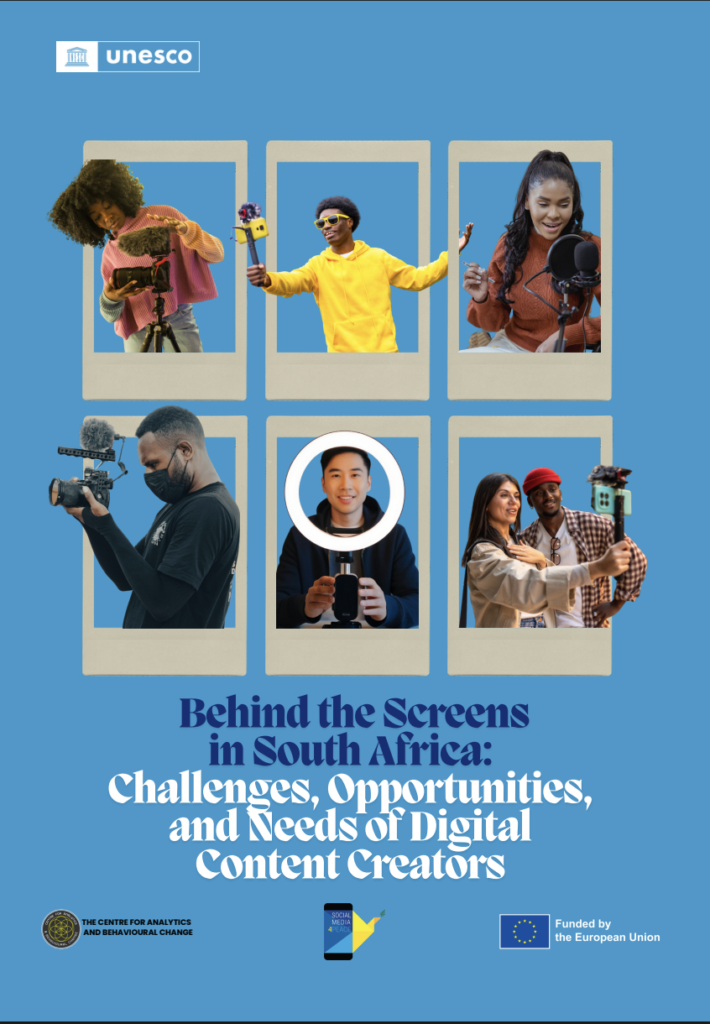
A new UNESCO-backed study has found that South Africa’s digital content creators are navigating a rapidly evolving creator economy with little formal training, limited understanding of legal obligations, growing reliance on artificial intelligence and widespread exposure to online abuse.
The research, conducted by the Centre for Analytics and Behavioural Change (CABC) as part of UNESCO’s global Behind the Screens project, surveyed 48 creators across South Africa and interviewed 11 creators working across multiple platforms and content genres. It concludes that while creators increasingly shape public discourse, the support systems needed to help them operate ethically and safely have failed to keep pace.
“What struck us most wasn’t that creators lack good intentions. They want to be trusted, they want to do right by their audiences. But we’re asking people to shoulder the same responsibilities as journalists without any of the training, legal grounding or support structures journalists have built up over decades. That gap is where the real risk sits. Not with the creators, but with the ecosystem around them,” said Jesse Cann, researcher director at the Centre for Analytics and Behavioural Change.
One of the clearest findings is creators’ appetite for guidance. Nearly 88% of respondents said ethical guidelines for content creation would be valuable, while 87% said they wanted training on ethics and freedom of expression.
Creators are motivated by more than money
The study found that creators are driven as much by civic participation as commercial ambition. More than a third said their primary motivation is sharing knowledge or expressing opinions on issues they care about, while about one in five identified making money as their main goal.
Although income is not always the starting point, three-quarters either already earn money from content creation or hope to monetise their platforms. However, almost 30% said they want to monetise their content but do not know how, highlighting gaps in professional development within the creator economy.
Confidence in media literacy does not match reality
Many creators believe they are skilled at identifying misinformation and assessing credible information. Respondents rated their own media and information literacy competencies highly and more than half believed they actively encourage critical thinking among followers.
However, their everyday practices tell a different story.
The report found that 36% do not consistently verify information before sharing it, while 34% use likes and views as a signal that information is credible. Only 30% prioritise supporting evidence and documentation when judging credibility.
Researchers describe this as a significant disconnect between creators’ confidence and their actual information practices, particularly in an online environment increasingly vulnerable to misinformation.
AI is everywhere, but transparency is not
Generative AI has become a routine tool for many South African creators, primarily for writing captions, generating ideas, editing content and conducting research. Nearly a quarter use AI regularly, while another third use it occasionally.
Yet disclosure remains rare.
Only 33% consistently tell audiences when AI has been used in creating content. Interviews revealed creators worry that admitting AI use could damage perceptions of authenticity and weaken audience trust.
Many creators said AI should be used to speed up creative work rather than replace original thinking, arguing that audiences still want authentic personalities rather than AI-generated content.
Platform algorithms shape what gets created
The research argues that creators’ ethical decisions cannot be separated from the platforms they depend on.
Interviewees described recommendation algorithms, trending sounds, hashtags and engagement metrics as powerful editorial forces influencing what they post and how often they post it. Some admitted producing content designed for algorithms rather than personal values because visibility depends on platform performance.
At the same time, creators expressed frustration with opaque moderation systems, saying content is sometimes removed, demonetised or restricted without clear explanations. Algorithmic recommendations received the lowest satisfaction rating of all platform features measured in the survey.
Online abuse is widespread
The report paints a troubling picture of the harms creators face online.
Three-quarters of respondents said they had experienced or witnessed technology-facilitated gender-based violence, including cyber harassment, impersonation, reputational attacks and image-based abuse. Four in ten never reported these incidents because they lacked confidence that reporting mechanisms would help.
Hate speech is also common. Forty-three percent said they had personally experienced identity-based harassment, while 72% had experienced or witnessed xenophobia online. More than a third reported real-world violence connected to online attacks, illustrating how digital abuse increasingly spills into offline life.
Researchers identify xenophobia as a particularly distinctive feature of South Africa’s online environment, reflecting broader social tensions around migration and inequality.
A creator economy without infrastructure
Despite creators’ growing influence, the study found almost no professional infrastructure supporting them.
Only 10.4% had received media and information literacy training, half had no journalism background, and fewer than one in five belonged to a professional association relevant to digital creators. Existing organisations largely serve journalists or marketers rather than creators, while the South African Content Creators Union was only established in late 2025.
The report concludes that South Africa needs creator-focused media literacy programmes, practical AI ethics guidance, peer learning networks, stronger support for online safety and wellbeing, and clearer education on the legal rights and responsibilities governing digital content creation.
Researchers argue that as creators become increasingly influential intermediaries between information and the public, strengthening ethical support, safety mechanisms and digital literacy is now essential for building a healthier online information ecosystem in South Africa.
* Summary created by AI