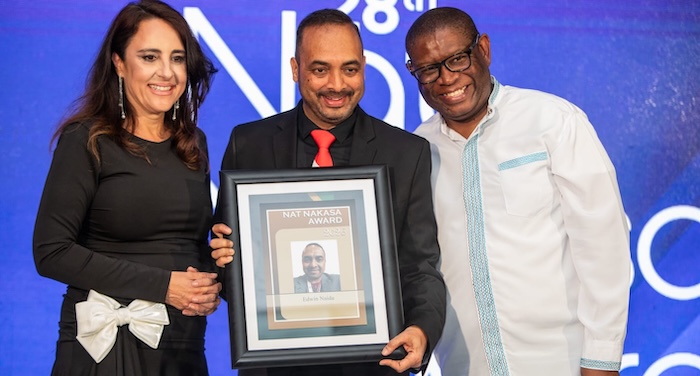
- Edwin Naidu wins the 2026 Nat Nakasa Award: SANEF honoured the director of Higher Education Media Services and editor of ednews.africa for bravery in journalism and public-interest reporting.
- SANEF cited Naidu’s investigations into corruption and maladministration at the University of South Africa (UNISA) as examples of fearless journalism that speaks truth to power.
- Education journalism at the centre: Naidu says ednews.africa was launched to fill a gap in sustained, evidence-based reporting on education, governance, research and youth development across Africa.
- A bootstrapped independent newsroom: HEMS launched without grants, investors or advertising subsidies and is building a diversified funding model while maintaining editorial independence.
- Naidu says ednews.africa aims to grow into a continent-wide network of education journalists focused on accountability, equity and the future of African education.
Edwin Naidu’s recent investigations into corruption in education show the “fearless commitment to truth that the Nat Nakasa Award was created to honour”, the South African National Editors’ Forum (SANEF) said in announcing him as the winner of the 2026 Nat Nakasa Award.
Naidu, director of Higher Education Media Services (HEMS) and editor of ednews.africa, was recognised for “bravery in journalism, work that speaks truth to power, confronts wrongdoing and places the public interest above personal comfort”.
“His work has consistently served the public interest with integrity, courage and independence. Through his reporting on education, including his recent investigations into corruption and maladministration at UNISA, he has shown the fearless commitment to truth that the Nat Nakasa Award was created to honour,” SANEF said in a statement.
“His journalism reflects not only professional excellence, but also the bravery and public-mindedness that makes a lasting difference in our media sector.”
Holding power to account
For Naidu, the award “is not a finishing line but a challenge to continue telling important stories, asking difficult questions, and holding power to account”.
He said: “Nat Nakasa died at 28, leaving a lasting impact on journalism that continues to this day. At 28, I was at Oxford on a Reuter Foundation Fellowship. Decades later, receiving the 28th Nat Nakasa Award reminds me how people like Nakasa paved the way for us as journalists during apartheid so that we can write freely and, in many ways, ironically, still face apartheid-like persecution in a democracy.
“We face many challenges, but truth is empowered by our Constitution. I am grateful to the South African National Editors’ Forum for this recognition and encourage journalists to stay true to the facts and the truth, like Nakasa and many journalism heroes.”
In its citation, SANEF said the Nat Nakasa Award recognises bravery in journalism, work that speaks truth to power, confronts wrongdoing and places the public interest above personal comfort.
“For many years, Edwin Naidu has demonstrated these qualities through his reporting on education, exposing wrongdoing and informing the public on policies that affect society.
“His recent investigations into corruption and maladministration at UNISA further reflect his integrity, courage and commitment to the truth.”
Building a specialist education newsroom
At just under eight months old, ednews.africa was launched to tell the continent’s education stories that were not being told. Naidu says that while South Africa has excellent journalists, “education has long been treated as a secondary beat, covered reactively during crises rather than through sustained, evidence-based reporting”.
What is missing, he says, is “consistent scrutiny of the systems that shape the country’s future: schools, universities, research, governance, youth development, and academic wellbeing. We launched ednews.africa because the stories most critical to the continent’s long-term development” needed a dedicated platform.
Naidu argues that journalism has shifted away from specialised, issue-driven reporting towards event-based coverage.
Access to credible education reporting
“As a result, investigative journalism in education has weakened. The sector’s most urgent issues – governance failures, academic burnout, research impact, student welfare, and the political use of education – rarely receive the rigorous attention they require,” he says.
“Many young journalists entering the field are not equipped to cover education meaningfully, largely because media houses do not prioritise it. Yet education is a global grand challenge: societies need journalism that holds institutions accountable and provides the critical lens through which the public understands the education sector’s role and responsibilities.”
He believes that when mainstream media retreats, “the public loses access to credible, expert reporting on the systems that shape national development. Education is not a ‘nice-to-have’ beat; it is the backbone of Africa’s competitiveness”.
“The collapse of specialist beats has created a vacuum: fewer journalists with deep subject knowledge, less investigative scrutiny, and a growing reliance on shallow, event-driven coverage. That gap is dangerous. Education is increasingly a political instrument, and without independent journalism interrogating governance, performance, equity, and accountability, the sector operates without meaningful public oversight.”
A bootstrapped newsroom with continental ambitions
Higher Education Media Services (HEMS) is a specialist media organisation focused on higher education, public health, governance and science communication.
Naidu says it operates as both a newsroom, producing independent journalism through ednews.africa, and a strategic communications hub that mentors academics, supports researchers and convenes public dialogues.
“Our work spans reporting, capacity-building, and sector-wide engagement,” he says. “HEMS is broader than a traditional newsroom. It is a continental platform designed to strengthen public understanding of education, research, and governance, ensuring that African knowledge systems are visible, accessible, and meaningfully connected to society.”
Funding, however, remains one of journalism’s biggest challenges.
Naidu says HEMS was “fully bootstrapped at launch, with no grants, no investors, no advertising subsidies”. It was built through personal commitment, professional networks and the belief that Africa deserves a dedicated, credible education news platform.
“Crossing 100 000 site views is a strong early signal that the niche we serve is real and growing,” he says.
The organisation is now exploring a diversified revenue model that includes sponsored content partnerships, training programmes, syndication, donor support, events and membership models.
“The strategy is simple: sustainability through diversity, not dependence on a single revenue stream. This model ensures that ednews.africa can grow while maintaining editorial independence and serving the continent’s public-interest needs.”
Keeping education at the centre
The platform covers education, youth, democracy, gender equality, lifestyle and innovation. Naidu says those themes are connected by a single editorial principle.
“All these themes intersect with education. Education is not a silo; it touches democracy, public health, gender equality, youth development, and innovation. Universities are microcosms of society. They reflect its strengths, tensions, inequalities and aspirations,” he says.
“Our editorial coherence comes from a simple principle: if it shapes the future of Africa’s young people, it belongs on ednews.africa.”
Naidu says the publication’s core audience is the entire school and higher education ecosystem, while increasingly attracting a broader public seeking credible, evidence-based reporting on issues affecting national development.
Lean and agile
ednews.africa started with what he describes as “a lean, agile model” — a team of four led by Naidu and Zingisa Mkhuma, with Nicole Martin handling the website and social media, and Prashirwin working on content.
The publication also works with freelance contributors across South Africa, partners with academics and researchers, provides multimedia support on demand, and places student interns through work-integrated learning programmes.
“This allows us to scale without compromising quality. We want to eventually create a newsroom across Africa,” Naidu says. “We already have about 15 to 20 journalists from across Africa who want to contribute. However, we did not want to rush and engage them until we can afford to pay them.”
As he puts it: “Education is a continental story. Africa’s future depends on how its universities evolve, how it supports its youth, and how it communicates its research. A pan-African network is essential to telling that story properly.”