
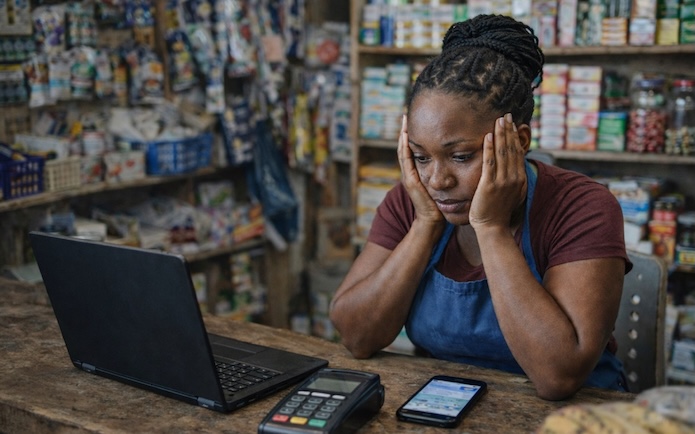
Picture the owner of an independent hardware store in Brackenfell, or a family-run butchery in George. On their phone: a POS app from one provider, an inventory tracker from another, a loyalty platform they signed up for at a trade show, a payment gateway the bank insisted on, and a WhatsApp marketing tool a supplier recommended. Forty-seven apps. Perhaps five in regular use. The rest: a graveyard of good intentions.
This is the daily reality for thousands of South African SME retailers – and it is costing them more than they realise. Despite near-universal smartphone penetration, 95% of retail in emerging markets remains offline. The reason is not tech aversion. It is tech exhaustion.
The skills gap is real but it’s not the whole story
Recent research from PKF South Africa indicates that more than 60% of South African businesses cite skills shortages as a barrier to digital transformation [1] – while the FinScope MSME South Africa 2024 Survey highlights that the cost and complexity of adopting new platforms remains a critical obstacle, particularly for businesses operating in the informal economy[2].
But framing this purely as a skills problem misses the point. These are not businesses that have rejected the digital economy. They are businesses that have been sold the wrong version of it – one built around vendor convenience rather than operator reality. Every new tool promises transformation. Most deliver complexity.
Each additional app means another login, another dashboard, another training curve, another monthly fee. For an owner running a high-pressure retail operation with no IT support and real cash flow constraints, the rational response is to stop adopting. And that is exactly what is happening.
Unpacking digital fatigue: Fragmentation is the problem
The failure mode is always the same. An SME owner adopts a POS system, only to find it doesn’t speak to their inventory tracker. Loyalty data sits in a separate platform. Promotions generate stats no one reads. Payments require yet another dashboard. Without the time or resources to stitch these systems together, manual workarounds become the default – and the tools get quietly abandoned.
World Bank research tracking SME digital adoption found that while initial uptake is often high, usage rates collapse within months, with fewer than 35% of businesses still actively using a platform 18 months after adoption[3]. [4]
The UK Government’s SME Digital Adoption Taskforce has identified fragmented technology stacks as the primary culprit, finding that businesses juggling multiple disconnected tools consistently struggle to integrate them, justify the cost, or sustain meaningful use. The consequences are tangible: spoiled stock from poor tracking, missed sales from clunky checkout experiences, and stunted growth from insights that never get acted on.
Digital inclusion does not fail because retailers are resistant. It fails because the tools add complexity rather than remove it. The real barrier is not the absence of technology – it is the gap between trust and transaction. Between what a platform promises, and what it actually delivers on a Tuesday morning when the queue is out the door.
From app proliferation to app consolidation
The consolidation thesis is already being proven in the market. The platforms gaining real traction among SME retailers are not the ones with the most features – they are the ones that collapse the stack.
Flood, a digital commerce platform built specifically for emerging market retail, has taken this approach: rather than adding to the app graveyard, it replaces it. By embedding POS, inventory, loyalty, payments, marketing, and logistics into a single no-code ecosystem – deployed inside banking or telco apps that merchants already use and trust – Flood removes the adoption barrier entirely.
The results are instructive. Across deployments in South Africa, India, and the Maldives, Flood onboarded 8 000 merchants in just three months. Daily platform usage reached 28% of the target population. Merchants discovered new capabilities organically – without a new download, a training session, or a single additional login. Commerce embedded itself into existing behaviour, rather than demanding new behaviour.
As I have argued for some time now: for the last 15 years, the internet has been built around single-purpose apps. One app for transport. One app for shopping. One app for payments. But this model is breaking — not because the apps are bad, but because the user experience is fragmented. Consumers don’t want more apps. They want less friction.
For an SME retailer, this means auto-syncing supplier deliveries to inventory, WhatsApp stock alerts, seamless loyalty at checkout, and AI-driven promotions – all in one interface, inside a platform they already open every day. Features get discovered, not deployed. Engagement builds without fatigue.
Why big institutions hold the winning hand
The businesses best positioned to solve the digital fatigue problem are not niche fintechs. They are banks and telcos – institutions with daily user engagement, embedded trust, and distribution that no startup can replicate.
When commerce is embedded inside a banking app or an airtime platform, the adoption question disappears. The merchant is already there. The consumer is already there. The infrastructure – payments, identity, compliance – is already in place. What is needed is a commerce layer that slots in without disruption.
This is precisely what consolidation platforms enable: white-label, API-driven commerce infrastructure that turns a banking app into a local marketplace, compliant with POPIA and SARS requirements, capable of geo-targeted discovery, in-store pickup, and real-time analytics – without asking the merchant to learn anything new.
The average smartphone user has 80 apps installed but actively uses fewer than 10. The winning platforms for the next decade will not be the ones that add to that number. They will be the ones already embedded in the 10.
Why 2026 is the turning point
My argument is simple: 2026 is the year the Superapp goes global.
Three trends are converging to make this moment decisive. Mobile payments infrastructure has matured — 2.8 billion digital wallets are now in circulation globally. AI has dramatically reduced the cost and complexity of building integrated platforms.
And consumer patience with fragmentation has run out. After a decade of downloading more and more apps, people – and businesses – are asking why it isn’t all just one place.
A Superapp brings together commerce, payments, discovery, logistics, loyalty, and communication inside a single digital ecosystem. Instead of ten apps, one platform that connects the real economy around you. It succeeds not just on product merit, but on economics: more consumers attract more businesses, which attract more consumers, creating a self-reinforcing digital economy.
WeChat’s 1.3 billion users did not happen by accident. Neither will the next generation of emerging market platforms.
The next great digital platforms won’t just come from Silicon Valley. They will emerge where real economies need them most.
The path forward for SME retailers
South Africa’s independent retailers – the hardware stores, the butcheries, the corner spaza operators who have graduated into formal retail – are not waiting for a digital revolution. They are waiting for tools that actually fit their lives.
As consolidation platforms scale their partnerships with banks and telcos, those retailers stand to gain the most: formalised operations, fewer errors, better data, and ultimately stronger margins. Digital fatigue does not end with another app. It ends when the right platform makes all the others unnecessary.
For South Africa’s SME retailers, that moment is arriving.
André de Wet is founder & CEO of Flood. For more information on Flood, visit www.flood.finance.
[1] PKF South Africa (2025) — pkf.co.za
[2] FinScope MSME South Africa 2024, FinMark Trust — finmark.org.za
[3] World Bank Finance for Development Blog, Bruhn, Tan & Tran (2023) — blogs.worldbank.org
UK SME Digital Adoption Taskforce Final Report (2024) — intelligentsme.tech