

- Original journalism is AI’s competitive advantage: Investigation, verification and exclusive reporting are the strongest differentiators in an AI-driven content landscape.
- Serve communities, not just audiences: Build trust by understanding community needs, encouraging engagement and making complex issues relevant.
- Trust depends on transparency: Ethical reporting, clear sourcing, corrections and accountability distinguish journalism from AI-generated content.
- Human judgement creates value: Journalists provide context, prioritise important stories and explain why they matter, capabilities AI cannot replicate.
- Adopt creator techniques, not creator standards: Embrace engaging storytelling and audience interaction while maintaining rigorous editorial standards. *
Journalism’s top thinkers on newsroom innovation unpack what sets journalism apart in a corrupted information ecosystem.
“Technology now changes exponentially, but organisations change quite slowly” – Gard Steiro’s warning, delivered during a recent webinar on the Future Newsrooms Study 2026, sums up the tension facing the news industry today. As generative AI makes generic content trivial to produce, a panel of senior editors and strategists argue the real opportunity lies elsewhere: in what journalism alone can still do.
The Future Newsrooms Study 2026, published by FT Strategies in partnership with WAN-IFRA and Arc XP, looks at how newsrooms are facing disruption. It identifies what separates publishers achieving their goals from those who are not, with solutions and case studies to close that gap between them.
A follow up webinar hosted by Lisa MacLeod, Director at FT Strategies, brought together three newsroom innovators: Gina Chua, Executive Director at the Tow-Knight Center CUNY and executive editor-at-large for Semafor; Gard Steiro, Editor-in-Chief and CEO at Norway’s VG; and Phoebe Connelly, former senior editor, AI strategy and innovation, and director of Next Gen Audiences at The Washington Post, now a student at the London School of Economics.
Their discussion Q&A kept returning to one point: AI’s disruption gives the news industry an opportunity to unlock journalism’s real value.
As MacLeod put it: “The thesis here is that when generic content becomes much easier to produce, the advantage that we have shifts to what is harder to replicate, and that is original journalism and trusted relationships and communities…”
While AI can enhance, expand and accelerate the systems and processes behind our output, the human element brings capabilities that automation, algorithms, platforms and even digital creators cannot easily replace. The panel identified five core areas of enduring value – each one also plugging a key future-proofing gap.
1. Double down on distinction
The study finds many newsrooms lack strategic clarity about “who the newsroom is reporting for… and what is the distinctive editorial value,” noted MacLeod.

“The most important thing right now is to understand what kind of unique content is most important for us. What is distinct for our brand? And double down on that,” advised Steiro. “You have to know what you can do that really serves your audience’s needs, and be really good at that, instead of just doing a lot of stuff.”
How journalism adds value
- Original reporting and verification – journalists can investigate, verify and contextualise information rather than simply react to or repackage it.
- Accountability and public-interest focus – professional newsrooms can sustain investigative and public-service work that’s often costly, slow and risky, at a scale most individual creators, search engines or LLMs simply can’t match.
2. From ‘audience’ to ‘community – redefining who we serve
“I think the word audience goes slightly out of style, because I think you’re going to serve communities rather than audiences,” said Gina Chua. “The other strategy, I think, is to know your audience so well – to know your community so well – that you’re actually serving them with what they need.”

It’s worth noting, added Phoebe Connelly, that healthy communities are made up of both active participants and silent observers: “We often are so focused just on the talkers, that we forget that the lurkers are there to listen to the talkers.”
How journalism adds value
- By moderating, framing and sustaining constructive dialogue – not just posting content.
- By learning specific community needs and surfacing under-represented voices.
- By translating complex policy into “what this means for me.”
3. Ethical judgment and trust
The report highlights gaps in audience trust and a broader shift “from institutions to individuals” – the rise of successful creators shows that audiences are increasingly seeking credible people, not just brands.
How journalism adds value
Journalists uphold:
- Verification, fairness and corrections.
- Clear sourcing and conflict-of-interest rules.
- Transparent separation – or disclosure – of news, opinion and commercial content.
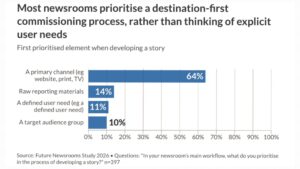
To build trust as a relationship rather than a metric, journalists can be visible and accountable, explaining their process, decisions and limitations as they work. Yet the study found that only 11% of newsroom time is spent on post-publication activities – despite this being seen as highly important – with the majority of time still going into production.

4. From information supply to meaning and relevance
The panel also discussed the emerging “layers” of information. As Chua explained: “I think there’s going to be two types of news. One is where voice and authenticity really matter, but I don’t know that you can just create it — some people have charisma, some people don’t. Then there’s another economy where information is created using a fair amount of AI assistance — that’s much more of a service layer. There’s a star layer and a service layer, and how those two tie together from a business model point of view is really complicated.”
How journalism adds value
Journalists determine:
- Which questions to prioritise.
- How to structure information for real-world decisions.
- Where human judgment must override automated output.
In practice, this means newsrooms may need to think deliberately about which content benefits from a distinct human voice, and which can be supported – but not replaced – by AI-assisted production.
5. Translating creator lessons into newsroom practice
Steiro noted that creators often “use our content… just presenting it in better ways than we are able to do” – and framed this not as a threat, but as a learning opportunity: “a new way of connecting with the audience.”
How journalism adds value
Journalists can:
- Adopt creator-style clarity, personality and responsiveness.
- Keep rigorous standards and reporting depth intact.
- Create clear, open channels for direct audience engagement.
Automation and generative AI have impressive capabilities that have already changed the way we live and work; roles and processes may change. But the ability to keep asking the right questions – and to pursue original, accountable reporting grounded in ethics – is something no algorithm can replicate.
* Summary created by AI.
This story was first published by the World Editors Forum, a leading global community of editors, which is an integral part of the World Association of News Publishers (WAN-IFRA).
Lucinda Jordaan is WAN-IFRA’s correspondent in Africa.