
- Brand-level AI visibility scores can hide poorly performing individual locations.
- AI search results are increasingly shaped by local context, competitors and location data.
- Multi-location brands need to measure AI visibility at both store and brand level.
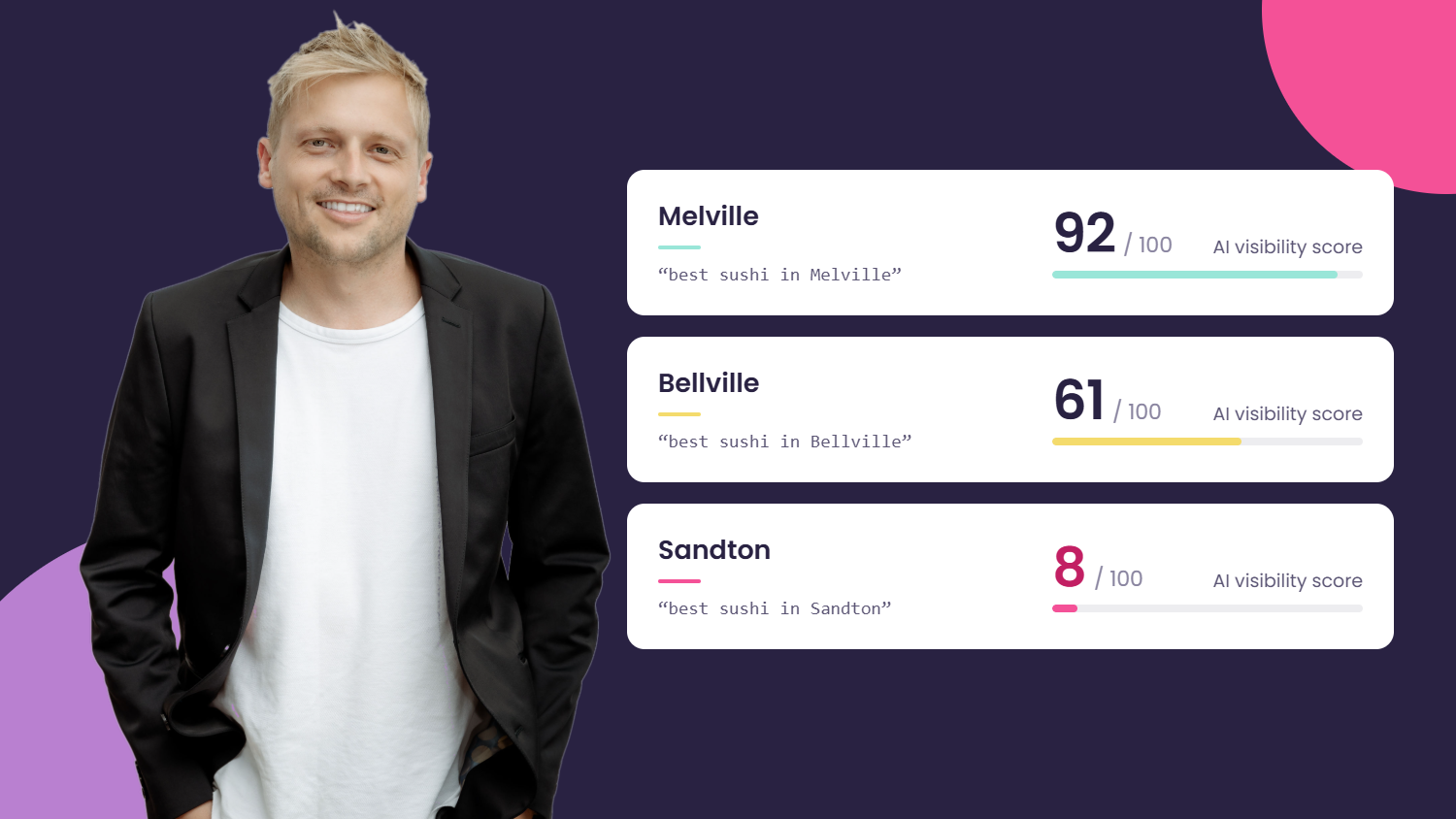
- Local queries such as “best sushi in Melville” provide more actionable insight than generic searches.
- Reviews, trading hours, local content and structured data can affect whether AI assistants recommend a location *
[PARTNER CONTENT] Your brand can look visible in AI while some of your stores are effectively invisible.
That is the problem with measuring AI visibility at brand level. A single score can look healthy while hiding the locations losing out where customers are actually searching.
Search used to be easier to measure. Position. Impressions. Click through rate. Everyone understood what a ranking meant and roughly what it was worth.
AI search changes that. When someone asks an assistant where to eat, shop or bank, there is no page of results to work through. The assistant gives an answer. Your location is either part of it or it is not. More than 900 million people now use ChatGPT every week, according to OpenAI, and Gartner expects brands to lose half their organic search traffic by 2028.
So adding AI visibility to the dashboard makes sense. The problem is how that visibility is measured.
Most AI visibility scores report at brand level: one number showing how often assistants mention the brand. That works if you operate one site. It becomes misleading when you operate many locations, because assistants do not answer nationally.
Beyond reporting
Ask where to eat in Durbanville and the model builds an answer from what it can verify around Durbanville. Ask in Sandton and it works from different location data and a different competitive set. There is no single national AI result. There are as many local results as you have trading areas.
That means a brand with 200 outlets can report a respectable average while the reality underneath looks very different. A third of stores could be the top recommendation in their suburb while another third do not appear at all. The strong locations carry the average, and the invisible ones remain invisible to head office too.
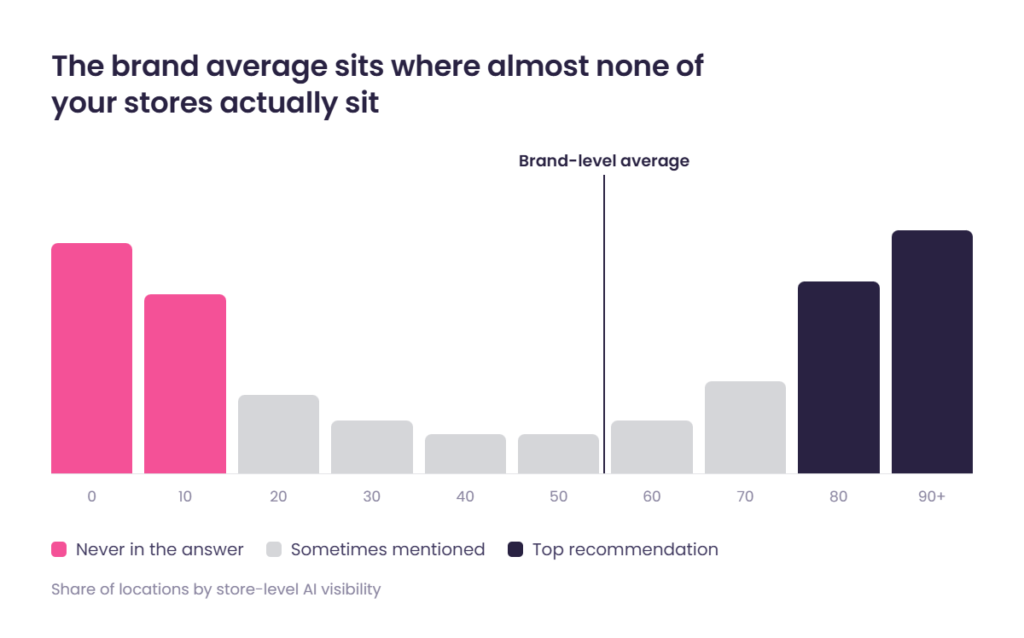
The issue goes beyond reporting. If a store is missing from the answer, it may also be missing out on customers nearby, while a healthy brand-level score can make it difficult to see where those gaps are.
Useful AI visibility measurement needs to answer two questions at once: how is each location performing in the market around it, and what does that performance look like across the brand as a whole?
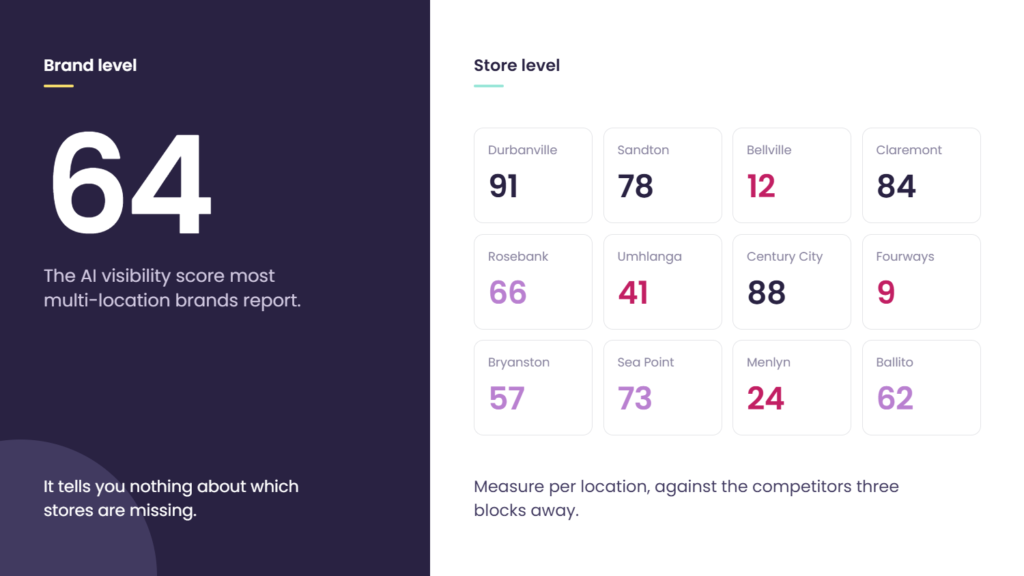
At location level, each store should be measured against the competitors it actually faces in its own catchment. This shows local teams where they are visible, where they are missing and which markets need attention.
The searches themselves also need to reflect what customers actually ask. Best sushi in Melville tells a business something it can act on. A generic best sushi near me query does not tell an operations team which local market needs attention.
AI visibility tracking
At brand level, those location results can then be brought together for each important search term. This gives marketing teams a wider view of how consistently the brand is appearing across its footprint, while still making it possible to see the individual stores that need attention.
We built AI visibility tracking into our own platform around this need, because clients wanted both views: what is happening at each location and what that means for the brand overall. But measurement is only half the job.
Knowing a store is invisible in Bellville does not fix the wrong trading hours, unanswered reviews or missing structured data that contributed to the problem. Assistants rely on the same location data, reviews and local content that have long formed the foundation of local search, and they are less likely to recommend businesses they cannot verify.
For companies managing hundreds or thousands of locations, this is exactly the problem we believe AI visibility measurement needs to solve. At Social Places, working with multi-location brands means we see first hand how quickly a single brand score can hide local gaps.
That is why we built visibility tracking at both location and brand level: to help teams understand where individual stores are appearing, where they are missing, and what those patterns mean for the brand as a whole.
Because knowing that a location is invisible is only useful if you can do something about it.
* Summary created by AI
Ryan Haworth is CEO and co-founder of Social Places, working with multi-location brands managing anywhere from fifty to several thousand locations across more than eighty countries. His work focuses on local search, reputation, location data and how AI-driven discovery is changing the way customers find businesses at both brand and location level.
Social channels
| linkedin.com/company/social-places | |
| @socialplacesSA | |
| @socialplacessa | |
| X | @SocialPlacesSA |
| TikTok | @social.places.sa |
| YouTube | @socialplacesSA |
| Author | linkedin.com/in/rhaworth |
For more information, visit socialplaces.io