- Cultural relevance helps brands build lasting connections by understanding and participating in the communities they serve.
- Ford’s Tarryn Knight says cultural meaning is accumulated over time through people, shared experiences and consistent brand relationships.
- Boundless creative leaders Fran Luckin and Roanna Williams identify five principles of creative courage, including embracing constraints, outside influences and unconventional ideas.
- Communication expert Tiffany Markman argues that human, distinctive and occasionally unexpected writing helps brands stand out as AI makes content increasingly generic.
- Music, particularly its connection to African cultural identity, offers marketers a powerful social-first storytelling opportunity, as demonstrated by Siya Metane (Slikour). *
Culture shapes how we tell, understand, and remember stories. Through music, real-world experiences, distinctive language and creative bravery, the conference explored how brands can communicate in ways that resonate with audiences.
These community relationships give stories meaning and build shared experiences over time. Marketers understand that cultu./ral interpretation becomes valuable when they understand audiences.
Tarryn Knight, head of marketing at Ford, shared that “cultural meaning doesn’t happen overnight; it is accumulated.” She also said that the “automotive industry is experiencing the most change” and that a resilient marketer must be able to consider, “What do people value?”
Amplify humanity
Humanity should be amplified, not ignored, because sustainable relationships build sustainable businesses. Knight said that behind each Ford brand are people responsible for sustaining the brand’s reputation, craftsmanship and longevity. “Behind a brand are the contractors, the memories, the constants…”
People remain the constants, ensuring the brand remains viable for generations to come.
“A creative idea and a monster have the same job. They both have to get the audience’s attention and make them feel something in seconds,” said Fran Luckin, co-chief creative officer at Boundless, who, together with Roanna Williams, co-chief creative officer and co-founder at Boundless, showed creative bravery as a gateway to storytelling in advertising.
In their creative attire, they showed delegates how cinema creativity mirrored advertising creativity.
Five lessons on creative courage
- Constraint is a gift. When your resources break, force your imagination to get braver. Half of great creativity is turning a limitation into a gift: Optimise the tools you have to create impactful work.
- Bring in an outside voice. Explore influences from outside the category. Make the idea simple. Not the execution safe: There is value in simplified ideas coupled with brave executions.
- Trust your audience’s stomach. Don’t smooth off the strangeness. A powerful human truth can anchor even the wildest idea: Give audiences room to connect with your storytelling.
- Don’t wait for permission or technology. Invent it as you go. Pioneers make the tools: Make the adaptations that keep marketers at the forefront of creative ideas.
- Brave creativity uses metaphor inventory to say what’s hard to put into words. Protect the thing that makes the ideas enormous: Marketers need to protect their ideas through critique and maintain the original spark behind the why.
According to Luckin, “Sometimes the biggest monster is the fear inside of us,” and films and brands have to overcome it to make great work. “Every brave idea looks like a little monster before it becomes a hero.”
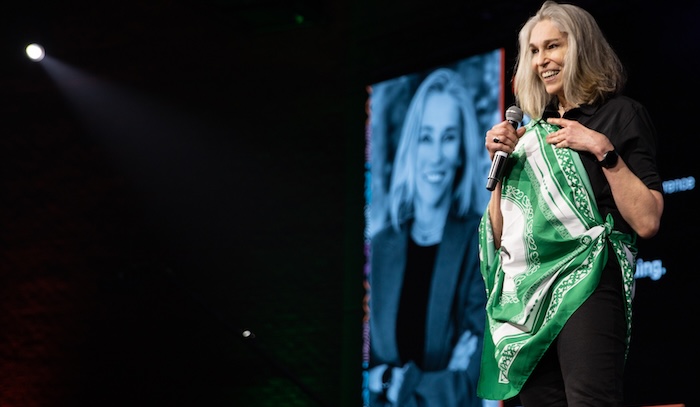
Creatives must protect the story they are creating. Storytelling doesn’t need to be perfect. In fact, “perfectly acceptable is not acceptable,” according to Tiffany Markman, communication expert, speaker and founder of Tiffany Markman Writing & Training (TMWT).
Five senses
Behind every story shared with our audiences is an opportunity to immerse them in the five senses. This matters for marketers. As she put it, “Business communication is just communication, and all communication is human communication.”
Markman stated that for business communication to be ‘human’, it must be specific, detailed, unexpected, sticky, flawed and occasionally nonsensical. Marketers should bring character into their writing and brand communication.
As AI makes writing “beige”, Markman urged all marketers to be enthusiastically weird in their communication, to “find the sentence that only you could have written” and let it be “specifically odd”.
Music is a form of communication that connects community members through the unique memories it taps into. Siya Metane (Slikour), founder of SlikourOnLife, created a vibrant Amapiano song, The Sound of the Shift, using sound bites captured throughout the day. He brought speakers’ words together through music.
Role of music
Rarely is deep consideration given to “What triggers social-first behaviour, and music plays a huge part in that.” In the final stages of crafting his piece, he tapped into the emotional connections that delegates held toward African culture.
He brought the delegates back to a marketing opportunity: “Why isn’t music considered a social-first strategy?”
The shift in five points
- Brands anchored in local culture can connect deeply with the community and contribute to the local culture, becoming part of the communal story.
- Cultural context enriches creativity and must be protected through the creative process.
- Marketers must keep pursuing cultural understanding to sustain relevance.
- AI must not be allowed to steal the unique human voice, and oddity may be a key distinguisher from technological content.
- When it feels relatable on a human level, it allows storytelling to touch consumers’ hearts.
What this means for marketers
Bring cultural voices into the process early, not only when the campaign is being executed. Creatives must shift from observing communities to participating in them. Brief for specific, sensory detail, push back on generic AI-written copy, and test the work with the communities it is meant to speak to.
* Summary created by AI
NEDBANK IMC WHITE PAPER: WHY AFRICAN MARKETERS MUST THINK BEYOND MARKETING
The Nedbank IMC, Africa’s Biggest Marketing Conference™, has released its 2026 White Paper, examining how marketers can strengthen their contribution to business growth.
Published in partnership with dentsu and researched and written by Red & Yellow Creative School of Business, the paper draws on the Nedbank IMC 2026, held on 17 September under the theme SHIFT HAPPENS™. ARE YOU READY? The 2026 white paper explores five shifts shaping the future of marketing and business in Africa.
The Nedbank IMC 2026 White Paper is available to download here.