

- AI won’t replace journalists: Adeyeye Joseph stresses that human judgement, ethics, and context remain irreplaceable
- Trust is the differentiator: Credibility will define the value of news brands like Punch Newspapers in an AI-driven information landscape
- AI as a newsroom tool: Automation, data analysis and workflow efficiency are key opportunities for adoption
- Misinformation is a growing threat: Deepfakes and AI-generated content require stronger verification and editorial oversight
- Journalism’s purpose endures: Holding power accountable and informing the public remains unchanged despite technological disruption
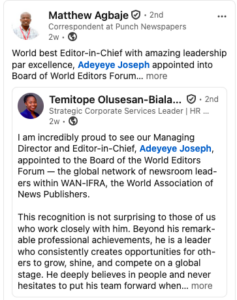
Last month, when it was announced that Adeyeye Joseph had been elected to the Board of WAN-IFRA’s World Editors Forum, the accolades and acknowledgements from colleagues and peers on social media gave a glimpse into a career shaped as much by conviction as by credentials.
From beat reporter to editor of Nigeria’s biggest-selling newspapers to architect of Punch Newspapers‘ digital strategy and now, managing director and editor-in-chief – his 25-year career trajectory speaks of a media leader who has consistently chosen depth over breadth, and public interest over commercial convenience.
To wit: He is currently completing a PhD examining digital disruption’s impact on public-interest journalism – studying, in real time, the very crisis he is managing.
Adeyeye Joseph spoke to the World Editors Forum about leading through disruption, the battle for fair compensation from big tech, and why he still sees himself as a reporter.
…On identity and leadership
Joseph is clear about where he locates himself, even at the top of Nigeria’s largest media group: “At heart, I see myself as a reporter, first and foremost. Reporting is at the core of what journalism is all about – it gives me a constant reminder of why I am in journalism.
“Every other role I’ve taken after starting out as a reporter – that sense of being a reporter has always been central to my understanding of my role.”
That reporter’s instinct informs how he leads. At Punch, he holds quarterly “village meetings” – open forums where, as he puts it, everyone “from the housekeeper to the director can debate policy, air grievances, give positive and negative feedback and suggest new ideas”.
His leadership philosophy, he says, is “open, curious, service-driven, ethical and solution-focused.”
Leaders, in his view, “should aim to be replicable – not by design, but by example: Be fair, humane, open-minded, accountable and tough,” advises Joseph.
…On Punch – and the state of news media
Punch Newspapers publishes four print newspapers – a daily, weekend papers and a sports paper – operates high-traffic websites and social platforms, and reaches approximately 12 million social media followers daily.
“The group treats every platform as a title in its own right, with dedicated teams for social and digital,” notes Joseph.

Last year, Punch won more than 30 awards at the Nigerian Media Merit Awards and Diamond Award for Media Excellence – the highest tally ever achieved by a Nigerian newspaper. Punch nextGEN, a print-digital product for students, and a medical app are both currently in development.
But the commercial picture is more complex. “The pace at which digital revenues are growing is slower than the rate at which legacy revenues are declining,” notes Joseph. The cause, he argues, lies with the technology platforms that distribute news content without fairly compensating its producers.
“Sadly, in the media, there is a lack of technological sophistication required to determine that compensation, and a lack of will to build the coalition to get what’s due to the media. Tech platforms claim they are our partners in progress, but this is only partly true: they are both partners and competitors, in reality.
‘A fraction of the billions that big tech makes off the back of publishers would reinvigorate struggling media ecosystems in several parts of Africa and other parts of the world.’
AI’s growing encroachment on the media’s traditional role as society’s trusted information providers presents another significant hurdle, notes Joseph, pointing to AI tools now delivering information directly to readers, without them ever needing to visit a publisher’s website.
“That is a significant challenge, because it has implications for eyeballs – and whatever has implications for eyeballs will have implications for your other important metrics and, ultimately, for your revenue.”
…On AI tools: paradox and pragmatism
That said, Joseph is candid about his own relationship with AI tools, and draws a parallel between its advent and internet adoption.
“About two decades ago I had a seminal moment – how did we live before the internet? That thought never returned again, until recently, when it occurred to me again while reflecting on AI and the endless possibilities these tools generate.”
He uses large language models – including ChatGPT, DeepSeek and Claude: “With AI, humanity has taken a huge leap into the unknown. It is an interesting paradox that we also have to rely on AI derivatives to understand this new unknown world.”
…On adapting – not just adopting
For newsrooms navigating this disruption, Joseph’s advice departs from the conventional playbook. Rather than wholesale adoption of new systems – the default response in better-resourced markets – he advocates for improvisation and adaptation.
“In sub-Saharan Africa, media organisations grapple with inadequate resources, burdensome regulation, and weak institutional capacity. Look at your environment, assess what is available to you, and have the flexibility of thought to adapt and improvise. Adapt rather than adopt. Improvisation and adaptation, not wholesale adoption, is the critical key.”
For journalists, he offers a simpler formulation: “Do two things unfailingly: One, be skeptical of all things, but not cynical; and two, read broadly but think deeply.”
For editors facing an era of misinformation and authoritarian pressure, he calls for “professional maturity”. “At this time, there are malevolent forces assailing the ideals of good journalism; the situation now is that the judgement calls made by editors can be more consequential than before. So, editors must be more discerning than ever: separating the wheat from the chaff, making sound judgment calls that do not create or compound existing problems, while remaining competitive.”
…On journalism’s purpose – and future
Underlying everything is a strong conviction about what journalism is ultimately for. “Journalism is not an end in itself but a means of empowering citizens with the information required to make informed decisions,” says Joseph.
In Nigeria – where public institutions are often, as he puts it, “either lacking resources or beholden to powerful, privileged forces” – the press has historically carried that weight alone. “When the policing system fails, the government refuses to be accountable and the wheel of justice turns slowly, people turn to journalism for help.”
On print’s future, he is clear-eyed rather than nostalgic: it will not die in the next fifteen years, but will become a niche product. On journalism’s future broadly, he is more optimistic: “Society’s need for processed, factual, actionable information will not change. In fifty years, the tools will be unrecognisable. The need will not.”
This story was first published by the World Editors Forum, a leading global community of editors, which is an integral part of the World Association of News Publishers (WAN-IFRA).
Lucinda Jordaan is WAN-IFRA’s correspondent in Africa.