Entertainment basics taught me to avoid three things: sex, religion and politics. And yet, here I am: Writing about a local election campaign.
This piece is NOT to tell you who should run Johannesburg, but to point out something more structural: the quiet but decisive shift in how political campaigns are being built – and more importantly, distributed.
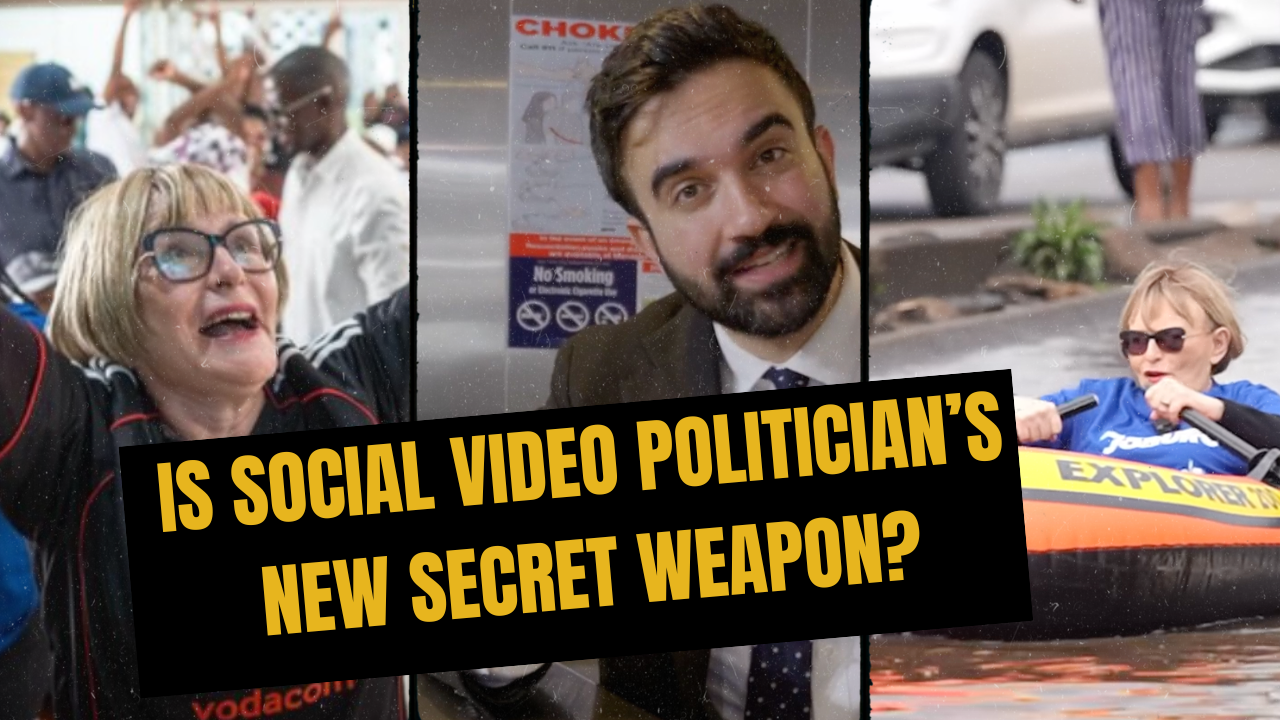
Take Helen Zille’s current mayoral campaign.
@helenzille This is one of Joburg’s many public facilities for swimming. No opening hours and no maintenance plan, yet somehow it keeps expanding… 🏊♀️🚧 #BelieveInJoburg
Kayaking through flooded Soweto streets. Fishing in a derelict public pool. Swimming in a pothole that hadn’t been fixed in years. On the surface, it reads as spectacle and performative – engineered for reaction, designed for virality. And in many ways, it is.
In most digital awards contexts, this would not be controversial – it would be case study gold. So reducing it to a gimmick misses what’s happening underneath.
Each of these moments is conceived as social video first: shot vertically, built for mobile, and structured to be shared. The press release no longer leads the narrative. The video does. And if the news cycle headlines of the last week are anything to go by, traditional media, in turn, follows.
This is not at all a Zille innovation – we’ve seen this playbook before.
@zohran_k_mamdani This Marathon Sunday, we’re going to break the record…for the most doors knocked in a single day. But only if you sign up at the link in bio.
In New York, Zohran Mamdani’s mayoral campaign rewrote expectations by turning policy into story-led video: running marathons while talking affordability, explaining rent economics over street food, even staging a Valentine’s-style subway video that blurred the line between campaign messaging and entertainment.
What makes this significant is not the content itself, but the inversion of sequencing. The campaign is no longer adapted for external media. The media is adapting to the social video-led campaign.
As Olivia Becker, Mamdani’s director of video, puts it, the work was approached less like political communication and more like independent filmmaking – with a defined point of view and trust in the audience’s intelligence.
Much like Zille’s campaign, it is built for mobile, and structured to be shared.
As Olivia put it herself, her videos didn’t win the campaign, but they did something just as important: They demonstrated what’s possible when political storytelling stops talking at people and starts treating them as an essential part of the story.
Not just a support act
Social video is no longer distributing political messaging. It is producing it.
PR has evolved and social video is becoming the first draft of public narrative – not the supporting act. Campaigns no longer wait to be covered; they create moments designed to be picked up, debated, and redistributed.
Of course, there’s a trade-off. Critics are right to question whether this compresses complex issues into digestible, and sometimes superficial, clips. The algorithm rewards emotion (positive or negative) far more than nuance – we know that. And yes, this type of visibility can come at the cost of depth.
The above I’ll leave to the political analysts to address, but dismissing this shift as mere theatrics is short-sighted.
What we’re really witnessing is that social video doesn’t just control narrative – it sets the agenda for what gets discussed at all and that has implications far beyond politics.
For brands, the lesson is uncomfortable but clear: PR is no longer about placement. It is about production and video is now the primary unit of that production.
Renaldo Schwarp is a senior content and creative strategist working at the intersection of broadcast, digital platforms and culture. With over a decade in media, he specialises in video strategy, audience behaviour and multiplatform storytelling, with a focus on how content moves across ecosystems – from social feeds to mainstream media.