- Broadcast media lacks structured mentorship
- Talent development is underinvested
- Access drives career success
- Mentorship is mostly informal
- Future careers require strategic guidance
I spent a period zipping in and out of court building, government offices and law firms across Pretoria and Johannesburg in the early 2000’s. I was an article clerk at a law firm. To save time and money I drove a yellow scooter and had a helmet with a Mamelodi Sundown’s sticker on the back.
At times I look back at the responsibility that was given to us as clerks and marvel that more things didn’t go awry! If the legal profession contributed anything of lasting value to my broader world of work, it was the structured, sustained concept of candidacy.
For the duration of my five years as a clerk, I had access to professionals, to a network, to guidance and to honest, sometimes stern, professional counsel. I had mentorship, even if it was not called that. It shaped how I think, how I work and how I understand the responsibility that experience carries.
Where’s the mentorship in radio?
It is a framework that is almost entirely absent from the broadcast media industry. And that absence, across three decades of working in South African radio and media, has always struck me as both surprising and costly.
Talent development is an area that is widely acknowledged as a critical area of concern but is consistently underfunded, under-executed and poorly prioritised. Growing people takes time. It is resource intensive. And the uncomfortable truth is that investing in a person does not guarantee that your organisation will be the one to benefit from their skills.
Coupled with freelance contracts and below average per hour rates it is not surprising to see broadcast talent lured to the commercial world of work.
My own experience of mentorship in this industry has been, at best, fragmented and, at worst, actively discouraging. Early in my career as a programme manager in campus radio, I reached out to a senior colleague at a commercial station for guidance on navigating some unfamiliar professional territory.
The response was underwhelming. It became obvious that their interest was not in developing or nurturing talent, but what the commercial giant could gain in the short-term.
Valuable conversations
There were however two conversations that were valuable.
The first, in 2005, was with Darryl Ibury. Daryl was doing the breakfast show on East Coast Radio at the time and was writing and publishing his thinking about radio and talent from a South African perspective, something that was genuinely rare in the local industry.
We met and spoke for more than two hours. He shared his ideas on continuous learning, career positioning and on taking a bigger picture view of where one was headed. It is a conversation I have returned to many times in my career.
The second was with Omar Essak, on the streets of Los Angeles after the Worldwide Radio Summit in 2015. Over a period of ninety minutes, we walked and talked. I was at a career crossroad considering a move from the public broadcaster into a larger commercial group but was also toying with the idea of going independent.
Omar shared his journey, his experience and some of the pitfalls he had encountered. It was exactly the kind of grounded, experience-led input that I needed at precisely the right moment.
Both conversations were informal. Neither was structured. Both invaluable.
Close encounter
The contrast came from an encounter at the public broadcaster where I worked in the commercial radio portfolio as a programme manager. I approached the then CEO, requesting their recommendation on a suitable mentor within the organisation.
I was told that there was no one they could recommend for a mentorship role and that they did not believe any of the leaders in the building would add value to my journey. It was one of the most deflating professional moments I can recall, not because of the outcome, but because of what it revealed about the culture of development.
If you didn’t have the drive, the reading habit, the natural ability to connect or to map your future, you were very much on your own.
When I recently posed the question of mentorship to my network, asking whether people had experienced formal or structured guidance in their media careers the responses were revealing and consistent.
Lived experiences of radio talent
Gabriel Sithole, a commercial radio presenter and voice-over artist with two decades in the industry stated that he has never had a mentor and had to find his own way, learning through informal conversations with welcoming senior colleagues but nothing formal.
Broadcaster and content strategist Gareth Jenkinson described his learning as largely a product of absorbing what he could from more talented people around him.
Charis Apelgren-Coleman, a content strategist with a background in broadcast, commented that she had been entirely self-taught on the radio side and that when she later lectured at Boston Media House her own students asked the same question about mentorship that she wasn’t able to answer from personal experience.
Former broadcaster, Ona Peteke offered a nuanced view in her reply. Formal mentorships are rare not because there is no appetite for them, but because senior practitioners simply do not have the capacity to take them on in a structured way. Her sense was that mentorship in this industry is less a programme and more a relational, ongoing conversation.
Martin Sims, a technical professional put it most directly saying he is regularly asked to teach what he knows but is too busy doing the work to also explain it.
Khwezi Madlala, an Honours Communication Science student at the University of the Free State, captured what this looks like for the next generation entering the industry. Mentorship has meant different people giving her opportunities and insight at different times.
Structured mentorship
Informal, scattered, reliant on luck rather than any deliberate system. Her observation: South Africa could benefit enormously from more structured mentorship programmes, and as someone trying to find her footing, she would be deeply grateful for one.
What emerges from these accounts is a picture of emerging professionals that are talented, passionate but fundamentally under-supported in their development. Broadcast media is a small business. Notoriously opaque, difficult to access and often confusing to navigate without an internal map.
Emerging professionals are frequently left to decode it on their own, picking up whatever they can from whoever is willing to share a moment of their time. Careers are often built on instinct and improvisation rather than strategy and clarity.
This matters because the industry is changing at a pace that demands more than technical adaptation. The skills that got someone through the door in 2020 are not the same that will sustain a career in 2030. Career positioning, personal reputation, strategic self-awareness, and the ability to think about your professional trajectory rather than your next role, are not nice to haves, they are essential competencies.
A catalyst
The concept of mentorship has followed me since the days of my yellow scooter. With more experience, exposure and contextual understanding, I believe it is an opportune time to launch a mentorship programme.
My hopes are that overtime this initiative will act as a career catalyst to the mentees, it will highlight the need for more structured and intentional intervention by broadcast groups, and it will assist in opening-up the industry.
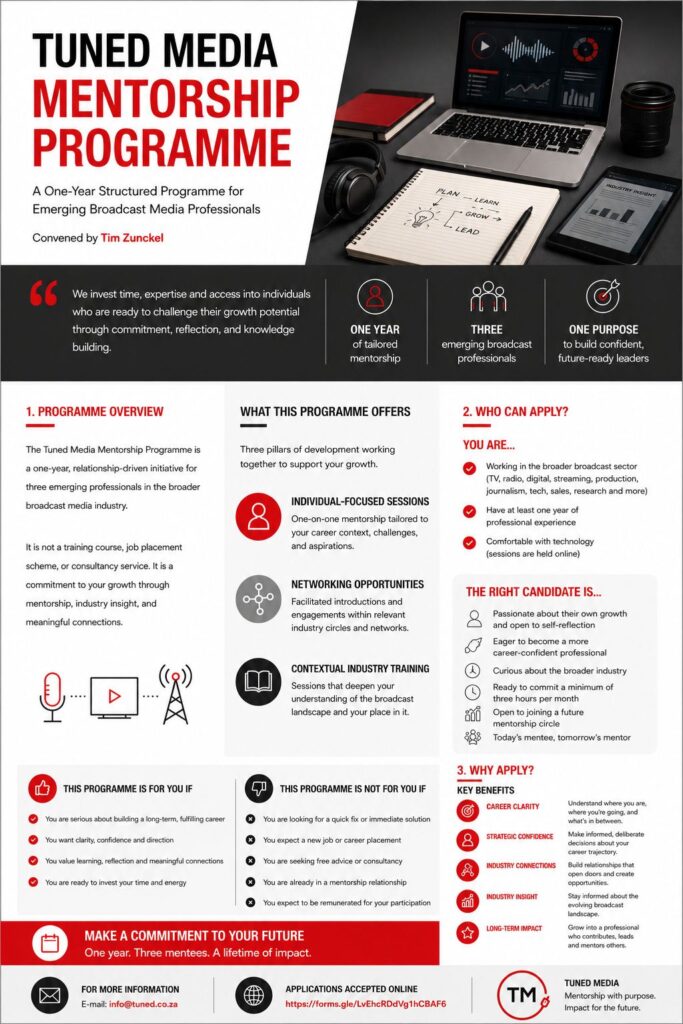
The programme is a carefully structured one-year initiative designed to support three emerging broadcast professionals. It is not a training course, a job placement scheme or a free consultancy. It is a committed, relationship-driven process built around strategic career evaluation, professional growth and access to meaningful industry networks.
The mentorship runs across four phases. The first two months focus on onboarding, career review and establishing the mentorship relationship. From months three through nine, the work shifts to strategic development: career positioning, personal brand, industry landscape and contextual training sessions delivered by practitioners from across the media industry.
Passing it on to the next mentee
Alongside this, a structured networking methodology is built into the programme. Not incidental networking, but deliberate introductions and the gradual transfer of outreach confidence to the mentee. The final three months focus on integration, forward planning and preparation to give back.
Every mentee is expected to become a contributor to the next cohort, closing the loop and extending the benefit forward.
Applications for the 2026 cohort are now open, with a closing date of 20 June 2026. If you are working in broadcast media — television, radio, digital, streaming, production, journalism, media sales, audio or any adjacent space — and you have been looking for the kind of structured, sustained guidance that this programme offers, I encourage you to read the full mentorship overview and consider applying.
I’ve been fortunate to work in broadcasting for 30 years. In this time, I’ve seen exceptionally talented people not reach their full potential, not because they lacked skill, but because they lacked access. Access to honest guidance, to the right conversations and someone willing to invest time in their potential.
That is what this programme is and that’s why mentorship matters.
To apply, click to the Tuned Media Mentorship Programme online application form. For more information contact info@tuned.co.za.

Tim Zunckel is an audio ambassador and lead consultant at Tuned Media.
CLICK ON THE IMAGE TO APPLY