
- AI assistants are becoming a new discovery channel for media and marketing businesses.
- Generative Engine Optimisation (GEO) helps businesses get found and recommended by AI tools.
- Clear services, specialisms, case studies, credentials and client information can improve AI visibility.
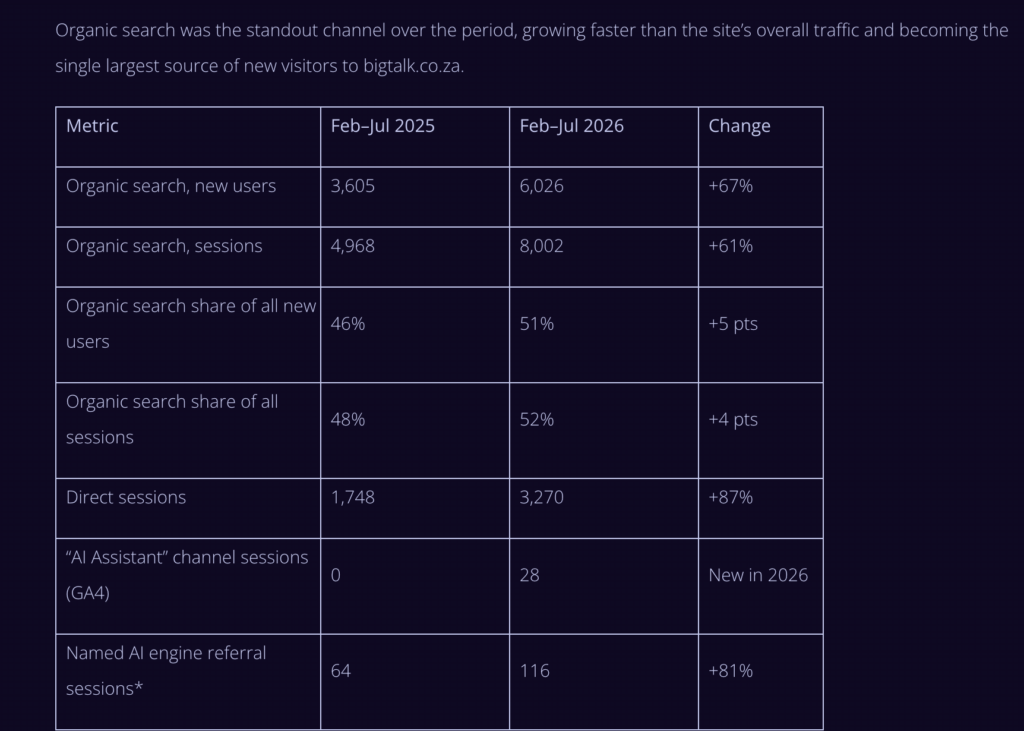
- Big Talk Entertainment recorded 28 website sessions from AI assistants between February and July 2026, compared with none in the same period in 2025.
- AI-driven traffic remains small, but its emergence signals a changing way clients research agencies, publishers and creative partners. *
A year ago, AI assistants sent this business no visitors. Now they do. For media and marketing businesses, the way clients and advertisers find agencies, publishers and creative partners is changing too.
IMS‘s work with Big Talk Entertainment shows how AI search is starting to influence how South African businesses are found. The lessons apply across the sector, from advertising, PR and digital agencies to publishers, broadcasters and production houses.
Between February and July 2026, Big Talk Entertainment recorded 28 website sessions from AI assistants such as ChatGPT, Gemini and Perplexity. Over the same period in 2025, Google Analytics 4 recorded none. The Cape Town entertainment agency worked with Johannesburg-based digital agency IMS to make its website easier for search engines and generative AI tools to find, understand and cite.
The numbers are still small, and IMS is candid about that. “The direction is what matters,” says IMS’s chief disruptor, Francois Vorster. “A way of finding customers that did not exist a year ago now does.”
Over the same six months, new visitors from Google search rose 67%, and people typing the website’s address directly into their browser, often a sign that someone remembers a brand, rose 87%.
Why this matters for media and marketing
Big Talk sits close to this sector, and its buyers behave like yours. Brand managers and marketing directors rarely brief the first agency or production house they find. They build a shortlist, look at the work and check credentials before they get in touch.
More of that research now starts with a question put to an AI tool, such as ‘Which PR agencies in Johannesburg specialise in tech?’ or ‘Who are the best corporate video production houses in Cape Town?’
“Marketing and media buyers judge a supplier on its work and reputation before they get in touch, and more of that research now starts in an AI tool and not a Google search,” says Vorster. “We can’t say for certain how much of the improvement came from traditional search work and how much from the AI-focused work.
“What we can say is that AI tools have become a measurable new source of visitors for a business that had none a year ago.”
What IMS did
IMS combined traditional search work with making the business easier for AI tools to find and recommend: improving the website’s technical foundations, rewriting pages to answer the questions customers ask and keeping the business’s details consistent everywhere AI tools look.
For a media or marketing business, that means clearly explained services and specialisms, verifiable case studies, awards and credentials, audience information for publishers and answers to common client questions.
“A few years ago, nobody asked ChatGPT to recommend a band for their wedding. Now many people do,” says Deon Schlebusch, managing director of Big Talk Entertainment. “We are not walking away from the channels that have always worked for us, but we’d be foolish to ignore a new one that’s starting to send us business leads.”
A word of caution
The results come from Big Talk’s own analytics, comparing 1 February to 31 July 2026 with the same period in 2025. Because traditional and AI-focused work ran together, the growth cannot be credited to the AI work alone, and any link between AI recommendations and direct visits cannot be proven from the data.
“We would rather show what we can actually measure than overclaim,” says Vorster.
Media and marketing businesses should also make sure claims about results, reach, awards and client work are accurate and verifiable and comply with the Advertising Standards Authority code.
What is GEO?
Generative Engine Optimisation, or GEO, is the practice of making a business easier for AI tools to find and recommend. Where SEO is about ranking on Google, GEO is about being the answer an AI tool gives.
The full case study is available here.
* Summary created by AI.