
• Subscribe to our newsletter
The Media Online
  • Home
  • MOST Awards
  • News
    • Awards
    • Media Mecca
  • Print
    • Newspapers
    • Magazines
    • Publishing
  • Broadcasting
    • TV
    • Radio
    • Cinema
    • Video
  • Digital
    • Mobile
    • Online
  • Agencies
    • Advertising
    • Media agency
    • Public Relations
  • OOH
    • Events
  • Marketing
    • Thought Leaders
    • Campaigns
    • Research
    • Media Education
      • Media Mentor
  • Press Office
    • Press Office
    • TMO.Live Blog
    • Events
    • Jobs
No Result
View All Result
  • Home
  • MOST Awards
  • News
    • Awards
    • Media Mecca
  • Print
    • Newspapers
    • Magazines
    • Publishing
  • Broadcasting
    • TV
    • Radio
    • Cinema
    • Video
  • Digital
    • Mobile
    • Online
  • Agencies
    • Advertising
    • Media agency
    • Public Relations
  • OOH
    • Events
  • Marketing
    • Thought Leaders
    • Campaigns
    • Research
    • Media Education
      • Media Mentor
  • Press Office
    • Press Office
    • TMO.Live Blog
    • Events
    • Jobs
No Result
View All Result
The Media Online
No Result
View All Result
Home News

Stop feeding the news machine: Slow news movement takes off

by Ingrid Cobben
August 17, 2016
in News
0 0
0
Stop feeding the news machine: Slow news movement takes off
Share on FacebookShare on Twitter

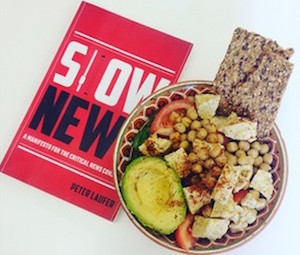
Inspired by the Slow Food Movement, which aims for quality food, produced in a way that doesn’t harm the environment, is accessibly priced, and gives a fair return to its producers, Peter Laufer, an award-winning author, journalist, and broadcaster launched his Slow News Movement – a “healthier approach to journalism”, offering the audience a balanced and nutritious news diet.

‘Yesterday’s News Tomorrow’ is what slow news is all about, eliminating the sense of urgency to allow both readers and journalists some valuable time to ruminate.

The approach is a push-back against the speed-up that crept up on the industry, as news organisations figure out how to deal with the disruption to traditional revenue models, Laufer told the World Editors Forum.

In many newsrooms, journalists have to juggle many things at once: social media posts, videos, podcasts, blogs, TV and radio reports – all aimed at satisfying the hunger for more content that appears to be news.

“Just doing more noise on more platforms doesn’t serve the journalist at all,” said Laufer, who believes that forcing reporters to work at an “all but accommodatable speed” led to the checks and balances of journalism getting lost in the shuffle.

A conversation with a journalist friend stuck in his head. He told Laufer that he had to do so much these days that he no longer had time to write. “That probably means he doesn’t have time to think, and barely has time for actual reporting,” Laufer said.

Cut down on empty-calorie news

Newsrooms should stop burdening their resources to provide continuous breaking news updates that the audiences don’t need, Laufer said.

“If your house is on fire, you will need to know about it immediately so that you can leave. But if someone else’s house is on fire, and he or she is on another continent an ocean away, you do not need to know about it right away.”

There is no point bringing our audience moment-by-moment updates about firefighters and ambulances arriving on the scene, according to Laufer. “Reporting in such incremental fashion only leads to a waste of emotion and creates a sense of constant anxiety in the audience.”

It is not news, but superficial, redundant “mindless chatter” that is usually completely unnecessary to our existence, but used to fill up time and space, to grab eyes and keep them there, whether it is on TV, online or other platforms.

How to offer a balanced and nutritious news diet?

If all journalists are at the fire, Laufer suggests, you could make an effort to go somewhere else and find an enterprise story that is of consequence.

“Obviously, that is not an easy thing to do when you work within the ‘what-just-happened model,’ but that model breaks down when it doesn’t matter to you,” he said.

What journalists need is for their management to pull them away from such “eye-candy stories” and allow them to exert some of the creativity that has been anaesthetised because they’ve just been jumping for the latest sirens, Laufer said.

Taking a step back from the current rushed reporting approach allows journalists to produce stories that are more consequential and of value to the consumer, which appeal to the audience’s desire to be entertained while informed.

A week’s news for the price of a cafe latte

In his book Slow News, he invites the audience to slow down their news consumption, applying Michael Pollan’s ‘Food Rules‘ – principles for better eating – to the news. Laufer sees an integral connection between food and news.

The “you-get-what-you-pay-for” metaphor is particularly relevant. “Better food costs more because it has been grown or raised less intensively with more care,” Pollan wrote. Equally, it is important on the consumer side that there is a recognition that we need to pay for news. “It’s frowned upon to eat in a restaurant and not pay the bill,” Laufer writes. So why does the audience not see news as another commodity, just like food, water, or gas?

Readers are an active ingredient

The audience is increasingly pushing back against vacuous, erroneous material that gets posted too quickly, which is a good thing, according to Laufer, who encourages consumers to pro-actively opt-out of such pseudo-newscasts.

He wants readers to be participatory, educated, and taking responsibility to seek – and pay for – quality news. There has to be a core of journalists and news organisations dedicated to doing the work. And the Slow News Movement aims to represent just that – promoting journalism of substance that aims for fairness, accuracy and clarity.

“It has to be conceptual, and we have to recognise as a society and as professionals working in that society that we have a job to do: which is to educate ourselves and our employers and the greater society, that this is going in the wrong direction,” Laufer said.

This story was first published by the World Editors Forum and is republished here with permission from the World Association of Newspapers and News Publishers, WAN-IFRA.

Tags: journalismPeter Lauferquality newsSlow Foodslow newsSlow News MovementWorld Editors Forum

Ingrid Cobben

Ingrid Cobben Media Editor at WAN-IFRA Producing content for the Editor’s Weblog around the future of journalism, newspapers and newsroom technology. Monitoring industry focused publications, newsletters and events. Using social media to promote WAN IFRA. Coordinate intern activities.

Follow Us

  • twitter
  • threads
  • Trending
  • Comments
  • Latest
Awards Wrap: Radio Workshop nominated for Podcast of the Year, Bar & Beverage Awards 2023 winners announced, grab those MOST Awards tickets now

Awards Wrap: PRISM Awards honours PR professionals, Euphoria Telecom launches No Bull Prize, Red & Yellow students thrive at The Loeries

October 21, 2025
Beyond girlboss: Women shaping the creative industry

Beyond girlboss: Women shaping the creative industry

August 12, 2026
Media Moves: TASTE turns 20, Anele, Lira and Janine van Wyk are FEARLESS in new campaign; Alex Okosi new MD for Google Africa, Accenture Song wins Telkom business

Media moves: MultiChoice Group and FAME Week Africa launch drama commissioning opportunity, Retroviral appoints Koketso Masisi as ECD, Primedia+ launches Apple CarPlay and Android Auto

August 13, 2026
The great advertising divorce

The great advertising divorce

August 11, 2026
The Shards transforms Bret Easton Ellis’s 1980s LA nightmare into a warning for the present

The Shards transforms Bret Easton Ellis’s 1980s LA nightmare into a warning for the present

0
Heineken backs South Africa’s next generation of creative talent at Cannes Young Lions 2026

Heineken backs South Africa’s next generation of creative talent at Cannes Young Lions 2026

0
Behind every application is a life

Behind every application is a life

0
Philipstown WireCar dominates Bookmarks as Accenture Song and Ogilvy tie for top agency prize

Philipstown WireCar dominates Bookmarks as Accenture Song and Ogilvy tie for top agency prize

0
Philipstown WireCar dominates Bookmarks as Accenture Song and Ogilvy tie for top agency prize

Philipstown WireCar dominates Bookmarks as Accenture Song and Ogilvy tie for top agency prize

August 14, 2026
The Shards transforms Bret Easton Ellis’s 1980s LA nightmare into a warning for the present

The Shards transforms Bret Easton Ellis’s 1980s LA nightmare into a warning for the present

August 14, 2026
Heineken backs South Africa’s next generation of creative talent at Cannes Young Lions 2026

Heineken backs South Africa’s next generation of creative talent at Cannes Young Lions 2026

August 14, 2026
Behind every application is a life

Behind every application is a life

August 14, 2026

Recent News

Philipstown WireCar dominates Bookmarks as Accenture Song and Ogilvy tie for top agency prize

Philipstown WireCar dominates Bookmarks as Accenture Song and Ogilvy tie for top agency prize

August 14, 2026
The Shards transforms Bret Easton Ellis’s 1980s LA nightmare into a warning for the present

The Shards transforms Bret Easton Ellis’s 1980s LA nightmare into a warning for the present

August 14, 2026
Heineken backs South Africa’s next generation of creative talent at Cannes Young Lions 2026

Heineken backs South Africa’s next generation of creative talent at Cannes Young Lions 2026

August 14, 2026
Behind every application is a life

Behind every application is a life

August 14, 2026

ABOUT US

The Media Online is the definitive online point of reference for South Africa’s media industry offering relevant, focused and topical news on the media sector. We deliver up-to-date industry insights, guest columns, case studies, content from local and global contributors, news, views and interviews on a daily basis as well as providing an online home for The Media magazine’s content, which is posted on a monthly basis.

Follow Us

  • twitter
  • threads

ARENA HOLDING

Editor: Glenda Nevill
nevillg@themediaonline.co.za
Sales and Advertising:
Tarin-Lee Watts
wattst@arena.africa
Download our rate card

OUR NETWORK

TimesLIVE
Sunday Times
SowetanLIVE
BusinessLIVE
Business Day
Financial Mail
HeraldLIVE
DispatchLIVE
Wanted Online
SA Home Owner
Business Media MAGS
Arena Events

NEWSLETTER SUBSCRIPTION

 
Subscribe
  • About
  • Advertise
  • Privacy & Policy
  • Contact

Copyright © 2015 - 2026 The Media Online. All rights reserved. Part of Arena Holdings (Pty) Ltd

Welcome Back!

Login to your account below

Forgotten Password?

Retrieve your password

Please enter your username or email address to reset your password.

Log In

Add New Playlist

No Result
View All Result
  • Home
  • MOST Awards
  • News
    • Awards
    • Media Mecca
  • Print
    • Newspapers
    • Magazines
    • Publishing
  • Broadcasting
    • TV
    • Radio
    • Cinema
    • Video
  • Digital
    • Mobile
    • Online
  • Agencies
    • Advertising
    • Media agency
    • Public Relations
  • OOH
    • Events
  • Research & Education
    • Research
    • Media Education
      • Media Mentor
  • Press Office
    • Press Office
    • TMO.Live Blog
    • Events
    • Jobs

Copyright © 2015 - 2026 The Media Online. All rights reserved. Part of Arena Holdings (Pty) Ltd

Not enough quota to unlock this post
Unlock left : 0
Are you sure want to cancel subscription?