The latest World Press Trends Outlook reveals a critical state of affairs, made even grimmer by the White House’s attacks on the press, last week’s FBI raid of a Washington Post journalist’s home, and this week’s killing of three Egyptian journalists in Gaza. How to safeguard press freedom.
“The past year has seen the media assistance sector’s most urgent crisis in decades following the significant reduction in funding and capacity support to media in many of the most challenged markets globally. Combined with a rise in authoritarian attitudes, an increase in legal assaults, and the ongoing dangers and attacks witnessed across both physical and digital spaces (and that target women journalists in particular), press freedom remains extremely fragile throughout the majority of the world.” ~ Andrew Heslop, executive director media freedom, WAN-IFRA
Only a few weeks in to 2026, and global trackers report of broadcasting bans in Sudan and Uganda; the BBC seeking dismissal of Trump’s $10bn lawsuit over edited video clips; ailing pro-democracy media mogul Jimmy Lai awaiting sentencing on conspiracy charges in Hong Kong; 14 journalists detained in Venezuela; a media blackout in Iran; the FBI raided a Washington Post reporter’s home and, just this week, three Egyptian journalists were killed in Gaza.
Press freedom under threat
These echo examples and case studies shared by respondents to WAN-IFRA’s new World Press Trends (WPT) Outlook survey, released this week, which confirms that, worldwide, press freedom is “predominantly eroding or stagnating, rather than improving”.
WPT Outlook references data from various global studies, indices and trackers and the lived experience of newsroom leaders from within 5 continents (66 countries) to outline the landscape.
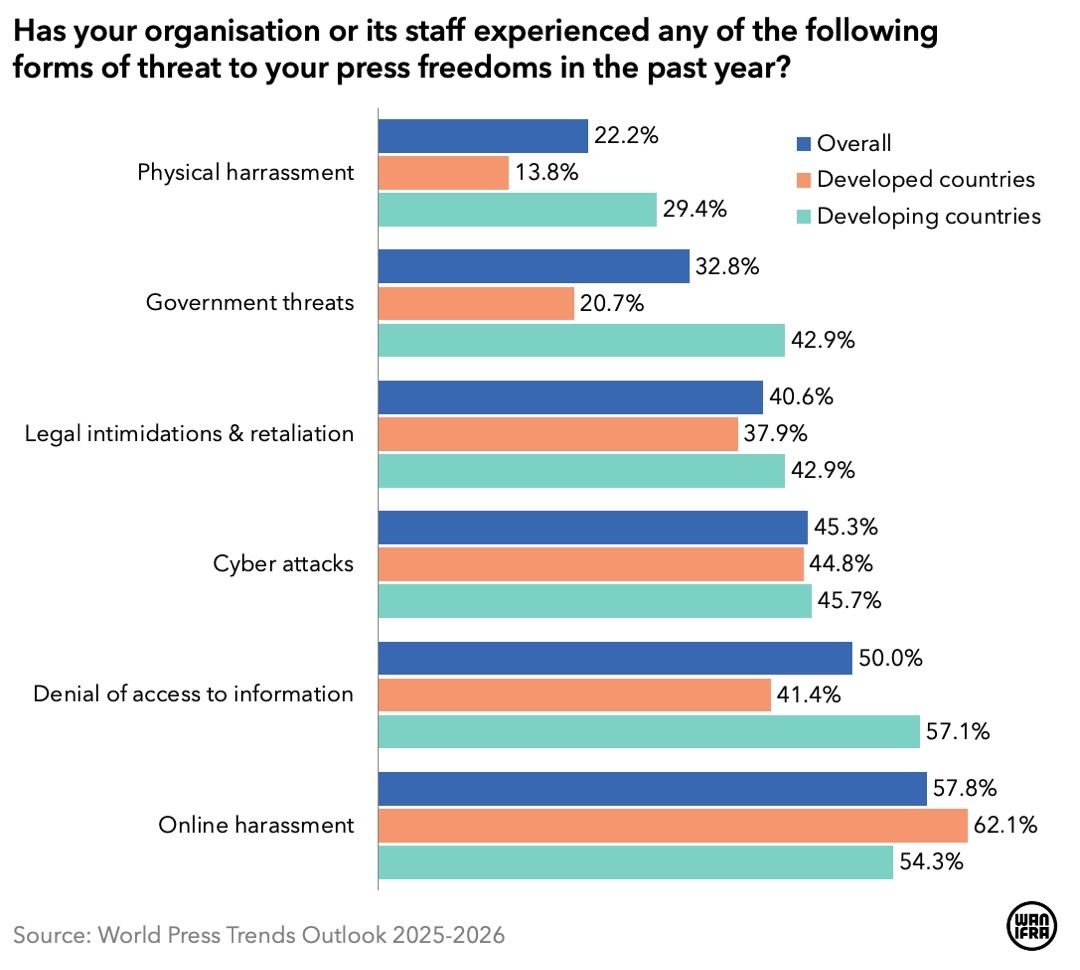
It’s bleak: Attacks against journalists are increasing in scope and variety – and while physical harassment, threats, retaliation and lawfare by authorities are increasing, it is the online space, where cyberattacks (45.3%) and harassment (57.8%) loom large for newsrooms and journalists.
“Globally nearly six in 10 participants (57.8%) told us that their organisation, or someone within it, had experienced online harassment in the previous 12 months. That figure was higher in developed markets (62.1 % vs. 54.3 %), although both numbers are significant.”
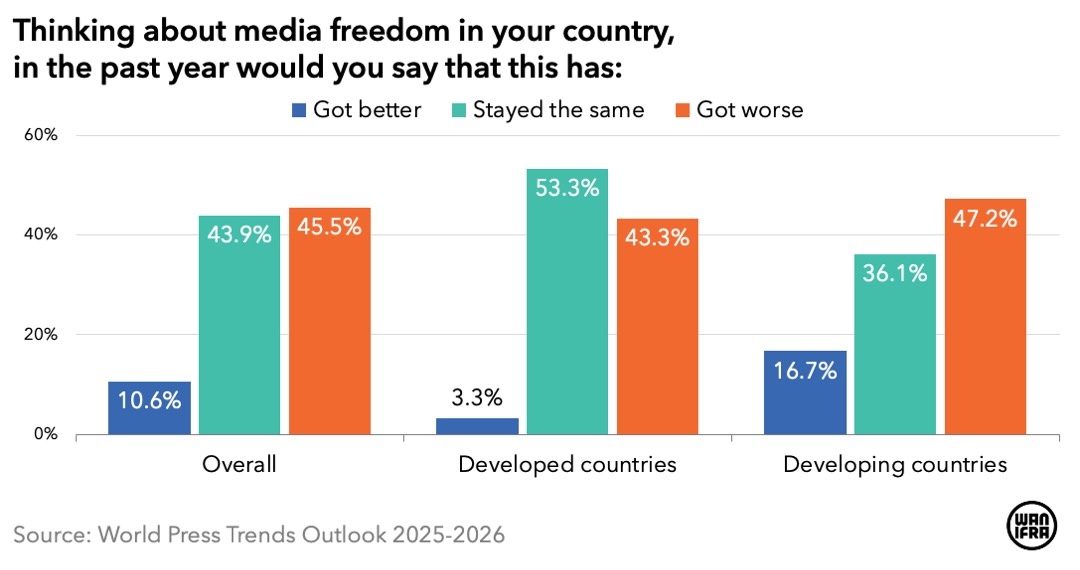
Almost half (45.5%) of those surveyed said that media freedom had worsened in their country over the past year. Just over one in ten (10.6%) reported improvements in this area.
 Universal pressures, regional variance
Access to information is largely being curtailed – and while “more acute in developing markets,” the first year of Donald Trump’s second term resulted in an ongoing escalation of threats, attacks and retaliation that point directly to decline.
Notable: the ongoing First Amendment lawsuit filed by the Associated Press against three senior Trump aides after being banned from the White House, Trump suing the BBC for $10bn over edited video clips, and last week’s FBI raid of The Washington Post reporter Hannah Natanson’s home.
WPT Outlook cites a notable Freedom House finding: that “the number of countries and territories where the indicator for freedom of the media is scored at 0 out of 4 – meaning there is virtually no space for independent media to operate – has almost tripled between 2005 and 2024, rising from 13 to 34.”
Freedom House also reports that, in 2025, “attacks on the media in the form of censorship, arrests and imprisonment of journalists, physical and legal harassment, or violence were recorded in over 120 countries and territories.”
The data is extensive, and the facts are alarming: globally, press freedom is in free fall – and strategic, united efforts are called for journalism’s survival.
According to the WPT Outlook: “Efforts to defend and enhance press freedom must continue to be multi-faceted. In addition to protecting journalists from physical harm, newsrooms, media funders and champions of press freedom must continue to support efforts that address and improve digital security, strengthen legal defences and help protect access to information.
“As our survey shows, the threats to media freedom are diverse, and therefore our strategies to protect this must be equally robust and varied.”
This story was first published by the World Editors Forum, a leading global community of editors, which is an integral part of the World Association of News Publishers (WAN-IFRA).
Lucinda Jordaan is WAN-IFRA’s correspondent in Africa.
The full World Press Trends Outlook 2025-2026 report is available for WAN-IFRA Members to download for free from our Knowledge Hub. World Press Trends is supported by Stibo DX.