Language is a medium we use every day and that we need to function optimally. Like breathing, it is integral to our existence to an extent that we can’t imagine a reality without it. Language is something that is priceless and has unmeasurable value, yet its existence, especially for native languages, is under threat.
Your mother tongue is fundamental to your identity as a natural outflow in everything you do. We however tend to think that English is the only language in which we can succeed, until you find yourself in Europe and realise that there are many countries that flourish in their mother language as first language, like Greece, Germany, and Italy to mention a few.
A lot of work has been done to research the importance of mother tongue education. In recent research results published by UNESCO, studies have shown that 14% of children in the high LSM-countries who get educated in their first language will probably read with better understanding by the end of their primary phase than children who haven’t been educated in their first language. (Unesco, 2024).
The worth, value, diversity and vitality of Afrikaans
The question arises: What can we do to preserve and develop Afrikaans as an indigenous language? In a third world country with 11 official languages, what could we possibly do on a micro-community level to accomplish this?
Afrikaans.com is a digital hub that was established 10 years ago for Afrikaans-speaking individuals with the intent to celebrate and explore the worth, value, diversity and vitality of Afrikaans.
On the brink of our tenth year of existence and with the 100-year celebrations of Afrikaans being an official language this year, there isn’t a more suitable time than now to develop a digital functionality that encompass the future and value of the language.
Afrikaans-speaking people are more than just speakers of a language…
- They are consumers (that are exposed to global brands and user experiences)
- They are normal people (grandparents, parents, young adults, children) with vast interests
- They have exposure to devices and technologies that are advanced
- They have more access to information than ever
Global developments
Within all these realities, there are also global developments in the way in which people search for information. From encyclopedia, search engines to the well-known artificial intelligence platforms that we use daily for many purposes.
The playing field is enormous and complicated. Multinational companies like Google, Apple and Chat GPT that are well established, have the world’s best resources with technical expertise at the tip of their fingers and continually improve the functionality of their tools for an optimal user experience.
Furthermore, there are many ethical considerations and measures that need to be in place, to ensure data protection of users, while users that have malicious intent with the platforms need to be restricted.
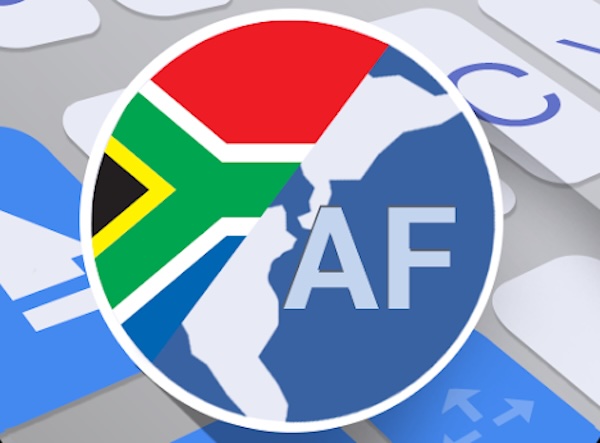
Regardless of all these realities, the dream outweighed the reality, and we proceeded with the development of the Afrikaans.ai platform with the goal to develop Afrikaans as mother tongue in the technology domain and make it accessible to its speakers.
It enables us to gain insights about the needs of users and with the help of partners in the Afrikaans landscape, create content that is relevant and easy to search for. The name, Afrikaans.ai, complements the inclusive and global approach of the .com in Afrikaans.com. For that reason, .ai in this context represents ‘Afrikaanse Intelligensie’, translated as Afrikaans Intelligence, which is exactly what this platform stands for.
What makes Afrikaans.ai different?
The fundamental difference between Afrikaans.ai and other AI platforms is that this has been developed in Afrikaans. It is free and search is unlimited. You can also navigate between two filters – one focused on world wide web searches and the other for advanced searches that are AI driven.
The wave of AI doesn’t differ much from the nature of the social media wave that hit when it emerged for the first time. Initially, it was strange, yet today nobody can imagine a world without it, especially the generations who grew up with it.
Just as social media exists out of different platforms that each serve a unique goal, the same principle is true for AI platforms that each offer a unique functionality.
There is no silver bullet, and it belongs to no one – it is for all of us to use it and integrate it within our existing marketing strategies and digital functionalities.
If we want an indigenous language to survive and grow, there is a responsibility on the stewards of that language to continually build and create in that language – in all sectors: academics, technology, arts and more.
When speakers of a language have easier access to the functionalities that are available in their mother tongue, we’ll see a decline in migrations to a second language to substitute the mother language.
If we can pray, think and dream in Afrikaans, why not also create in Afrikaans?
Clara de Wet is CEO of Uppe Marketing.
Source: Unesco, 2024. International Mother Language Day: Why multilingual education is key to intergenerational learning.