• Subscribe to our newsletter
The Media Online
  • Home
  • MOST Awards
  • News
    • Awards
    • Media Mecca
  • Print
    • Newspapers
    • Magazines
    • Publishing
  • Broadcasting
    • TV
    • Radio
    • Cinema
    • Video
  • Digital
    • Mobile
    • Online
  • Agencies
    • Advertising
    • Media agency
    • Public Relations
  • OOH
    • Events
  • Marketing
    • Thought Leaders
    • Campaigns
    • Research
    • Media Education
      • Media Mentor
  • Press Office
    • Press Office
    • TMO.Live Blog
    • Events
    • Jobs
No Result
View All Result
  • Home
  • MOST Awards
  • News
    • Awards
    • Media Mecca
  • Print
    • Newspapers
    • Magazines
    • Publishing
  • Broadcasting
    • TV
    • Radio
    • Cinema
    • Video
  • Digital
    • Mobile
    • Online
  • Agencies
    • Advertising
    • Media agency
    • Public Relations
  • OOH
    • Events
  • Marketing
    • Thought Leaders
    • Campaigns
    • Research
    • Media Education
      • Media Mentor
  • Press Office
    • Press Office
    • TMO.Live Blog
    • Events
    • Jobs
No Result
View All Result
The Media Online
No Result
View All Result
Home News

Understanding causes of echo chambers

New study explores how news consumption preferences are influenced by culture, political polarisation, and the credibility of news outlets

by TMO Contributor
November 18, 2024
in News
0 0
0
Understanding causes of echo chambers
Share on FacebookShare on Twitter

In our digital age, with easy access to a vast array of information, one would think that readers would naturally be exposed to a wide range of perspectives.

However, the opposite seems to be happening, especially in countries like the United States (US), where people often seek out news that reinforces their existing beliefs and avoid content that challenges them.

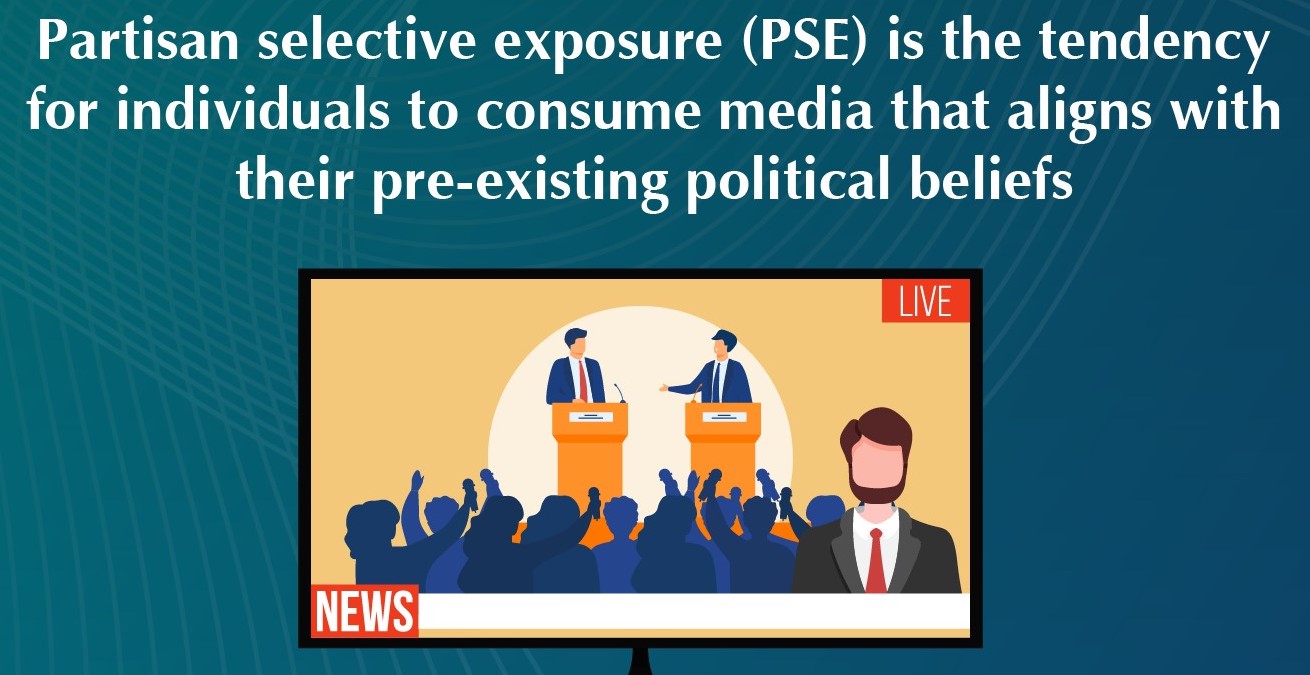
This tendency, known as partisan selective exposure, has been linked to increasing divides and tensions between different ideological groups.

But is this behaviour unique to the US, or is it a universal phenomenon driven by common psychological tendencies?
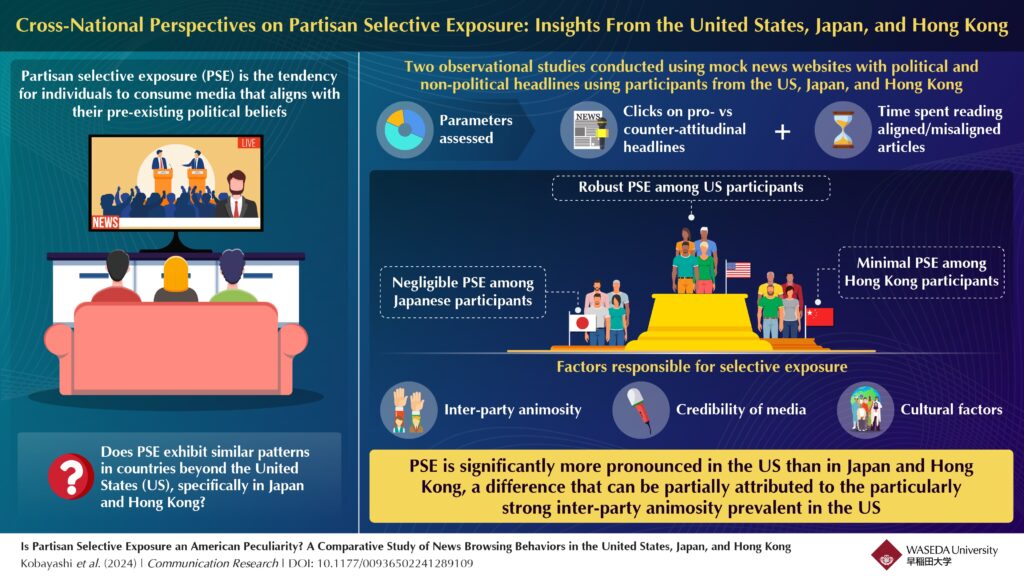
To answer this, a cross-national study was conducted led by Professor Tetsuro Kobayashi from the School of Political Science and Economics at Waseda University accompanied by Ling Liu from Waseda University, and Zhifan Zhang from Pennsylvania State University.

This study examined how news consumption differs among individuals in the US, Japan, and Hong Kong. Their work was published online on 10 October 2024, in Communication Research.

US-centric communication

Sharing their motivation for the study, Kobayashi explains, “Since political communication research is predominantly US-centric, there is a tendency to apply American findings directly to the Asian context. Our study challenges such a tendency and demonstrates the importance of conducting research that is specifically tailored to the Asian context.”

The researchers created mock news websites that presented participants with political and non-political headlines, giving them the option to select stories that either matched or contradicted with their political beliefs. They also analysed the time spent on reading those articles.

The findings revealed that while Americans were more likely to choose news supporting their views, this behaviour was less pronounced in Japan and Hong Kong.

Selective exposure

“In the US, this selective exposure is fuelled by several factors,” explains Kobayashi. “The country has a highly polarized and emotionally divided political environment, and many news outlets have clear political leanings.”

Over time, informational ‘echo chambers’ facilitated by selective exposure can intensify political differences, fuelling division and making it more difficult for people with opposing views to have meaningful conversations.

In contrast, Japan’s political climate is less polarised, and its news outlets are generally less partisan. Because these ‘echo chamber’ tendencies are weaker, opposing groups may benefit from a more balanced flow of information, fostering a political climate that is less divided.

Hong Kong presents a more complex case due to its unique political and media environment, but selective exposure there is still weaker than in the US.

Challenges assumptions

“Our research challenges the assumption that selective exposure is just a natural human tendency driven by psychology,” adds Kobayashi. “Beyond the desire to avoid cognitive dissonance, our results suggest that the media and political environment of a country play a critical role in shaping how individuals engage with news.”

This raises important questions about how to design online and offline environments to encourage people to engage with a wider range of viewpoints, which could help reduce political polarisation.

Understanding why this behaviour is more common in some countries than others can help guide efforts to improve the way people consume news. We hope this study paves the way for more advanced research tailored to Japan.


References

Authors: Tetsuro Kobayashi1, Zhifan Zhang2, and Ling Liu1

Title of original paper: Is Partisan Selective Exposure an American Peculiarity? A Comparative Study of News Browsing Behaviors in the United States, Japan, and Hong Kong

Journal: Communication Research

DOI: 10.1177/00936502241289109

Located in the heart of Tokyo, Waseda University is a leading private research university that has long been dedicated to academic excellence, innovative research, and civic engagement at both the local and global levels since 1882. The University has produced many changemakers in its history, including nine prime ministers and many leaders in business, science and technology, literature, sports, and film.

Dr. Tetsuro Kobayashi is a Professor of Political Science at Waseda University, Japan. His research focuses on political communication, political psychology, and public opinion. He earned his Ph.D. in social psychology from the University of Tokyo in 2009. Before joining Waseda University, he held positions at the National Institute of Informatics and City University of Hong Kong.



 

Tags: echo chamberHong KongJapanmedia researchnewsnews consumptionresearchsocial mediaUS

TMO Contributor

Lorem Ipsum is simply dummy text of the printing and typesetting industry. Lorem Ipsum has been the industry's standard dummy text ever since the 1500s, when an unknown printer took a galley of type and scrambled it to make a type specimen book. It has survived not only five centuries, but also the leap into electronic typesetting, remaining essentially unchanged. It was popularised in the 1960s with the release of Letraset sheets containing Lorem Ipsum passages, and more recently with desktop publishing software like Aldus PageMaker including versions of Lorem Ipsum.

Follow Us

  • twitter
  • threads
  • Trending
  • Comments
  • Latest
Awards Wrap: Radio Workshop nominated for Podcast of the Year, Bar & Beverage Awards 2023 winners announced, grab those MOST Awards tickets now

Awards Wrap: PRISM Awards honours PR professionals, Euphoria Telecom launches No Bull Prize, Red & Yellow students thrive at The Loeries

October 21, 2025
Marketing technology platforms need to balance AI with human expertise

Marketing technology platforms need to balance AI with human expertise

August 27, 2026
Who watches the watchers?

Who watches the watchers?

August 27, 2026
What happens to agency fees when AI halves the hours?

What happens to agency fees when AI halves the hours?

August 26, 2026
Entries open for the 2026 Telkom Radio Awards

Entries open for the 2026 Telkom Radio Awards

0
Turning constraints into commercial advantage in Mozambique

Turning constraints into commercial advantage in Mozambique

0
Awards Wrap: Radio Workshop nominated for Podcast of the Year, Bar & Beverage Awards 2023 winners announced, grab those MOST Awards tickets now

Awards wrap: Cape Town takes double honours at World Travel Awards Africa 2026, Apple the first inductee at One Club’s Brand Hall of Fame, finalists for the 2026 Inclusive Lens Awards

0
UNESCO study reveals risks facing South Africa’s digital creators

UNESCO study reveals risks facing South Africa’s digital creators

0
Entries open for the 2026 Telkom Radio Awards

Entries open for the 2026 Telkom Radio Awards

September 1, 2026
Engaging the ‘disengaged’

Engaging the ‘disengaged’

September 1, 2026
UNESCO study reveals risks facing South Africa’s digital creators

UNESCO study reveals risks facing South Africa’s digital creators

September 1, 2026
Does advertising still matter in the age of AI slop?

Does advertising still matter in the age of AI slop?

September 1, 2026

Recent News

Entries open for the 2026 Telkom Radio Awards

Entries open for the 2026 Telkom Radio Awards

September 1, 2026
Engaging the ‘disengaged’

Engaging the ‘disengaged’

September 1, 2026
UNESCO study reveals risks facing South Africa’s digital creators

UNESCO study reveals risks facing South Africa’s digital creators

September 1, 2026
Does advertising still matter in the age of AI slop?

Does advertising still matter in the age of AI slop?

September 1, 2026

ABOUT US

The Media Online is the definitive online point of reference for South Africa’s media industry offering relevant, focused and topical news on the media sector. We deliver up-to-date industry insights, guest columns, case studies, content from local and global contributors, news, views and interviews on a daily basis as well as providing an online home for The Media magazine’s content, which is posted on a monthly basis.

Follow Us

  • twitter
  • threads

ARENA HOLDING

Editor: Glenda Nevill
nevillg@themediaonline.co.za
Sales and Advertising:
Tarin-Lee Watts
wattst@arena.africa
Download our rate card

OUR NETWORK

TimesLIVE
Sunday Times
SowetanLIVE
BusinessLIVE
Business Day
Financial Mail
HeraldLIVE
DispatchLIVE
Wanted Online
SA Home Owner
Business Media MAGS
Arena Events

NEWSLETTER SUBSCRIPTION

 
Subscribe
  • About
  • Advertise
  • Privacy & Policy
  • Contact

Copyright © 2015 - 2026 The Media Online. All rights reserved. Part of Arena Holdings (Pty) Ltd

Welcome Back!

Login to your account below

Forgotten Password?

Retrieve your password

Please enter your username or email address to reset your password.

Log In

Add New Playlist

No Result
View All Result
  • Home
  • MOST Awards
  • News
    • Awards
    • Media Mecca
  • Print
    • Newspapers
    • Magazines
    • Publishing
  • Broadcasting
    • TV
    • Radio
    • Cinema
    • Video
  • Digital
    • Mobile
    • Online
  • Agencies
    • Advertising
    • Media agency
    • Public Relations
  • OOH
    • Events
  • Research & Education
    • Research
    • Media Education
      • Media Mentor
  • Press Office
    • Press Office
    • TMO.Live Blog
    • Events
    • Jobs

Copyright © 2015 - 2026 The Media Online. All rights reserved. Part of Arena Holdings (Pty) Ltd

Not enough quota to unlock this post
Unlock left : 0
Are you sure want to cancel subscription?