
Twenty-five years ago, in 2000, journalist Chris Louw wrote an open letter titled ‘Boetman is die bliksem in’. There is no direct translation that could convey the emotion of “die bliksem in”, but it means angry, furiously angry, almost to the point of tears. It captures frustration, disillusionment and a lack of hope for the future.
Louw vented about the past regime – the architects of apartheid ideology who sent a generation of young, white men to fight the “enemy” on the borders. Louw was part of that generation, forced to fight for an ideology imposed by people who had never been in the trenches themselves. They were puppets of politicians who thrived in the safety of their Broederbond collusions, supported from pulpits by dominees who preached everything but peace and reconciliation.
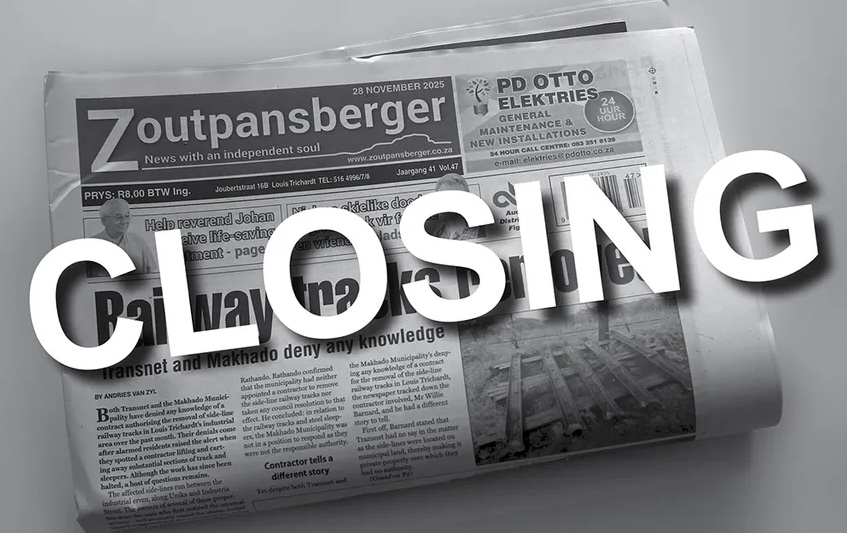
The same year Louw wrote his letter, I became owner of two local newspapers. Though they shared a footprint, they were very different – one serving the traditional (predominantly white) town community, the other a rural readership. It was difficult but rewarding. More importantly, local journalism thrived. The accolades collected over two decades were welcome, but making a difference mattered more.
For survival, I turned to fellow small, independent publishers. Most of us had fought ugly wars with the big media groups, but eventually found common ground. I made friends among these publishers, many battling to stay alive in township markets. We formed the Association of Independent Publishers (AIP), a body that would later play a crucial role in strengthening independent voices.
But darker clouds were gathering – far more menacing than big media groups. The world changed. How people communicate changed. The big technology companies showed no empathy for small publishers’ struggles. They targeted advertising, the lifeblood of small publishers, and in a calculated, systematic and ruthless manner, seized the market.
Publishers were defenceless. They started dying.
The authorities took note
The culling didn’t go unnoticed. In May 2021 the Competition Commission launched an investigation into “online markets”. In September 2023, formal terms of reference for a new investigation were published: the Media and Digital Platforms Market Inquiry (MDPMI).
Like many AIP members, we made several presentations to the Competition Commission, gathering data showing how Facebook deliberately suppresses content, how Google ignores local vernaculars and how AI-driven sites steal content and profit from it.
When the Competition Commission released its interim report in February 2025, it confirmed our complaints. The report found that platforms such as Google, Meta (owner of Facebook), X, TikTok and other global digital/AI platforms engaged in practices that distort competition. They were the bullies. Small publishers were the “casualties of war”.
The findings offered a ray of hope. Proposed remedies included financial compensation, algorithm changes and stricter rules around content distribution and monetisation for global tech platforms operating in South Africa.
On 25 November 2024, the AIP and Google launched the Digital News Transformation Fund (DNTF) as a “major South African local-news support fund”. Over three years, R114 million was made available to small publishers to help them find new revenue models in a predominantly online world.
A rescue buoy or waste of funds?
But doubts quickly surfaced. A fund manager had to be appointed because AIP couldn’t disperse the funds. Tshikululu Social Investments, seemingly the only worthwhile contender, was appointed and claimed 20% (around R7.6 million annually).
At the first meeting, AIP members were told only non-profit entities would qualify – despite probably 80% of AIP publishers operating as SMEs. After absorbing the outcry, Tshikululu back-tracked. Then publishers with “white” audiences were deemed ineligible. When it was pointed out that measuring the “whiteness” of a digital audience is impossible, the fund managers again reversed course.
At that stage some publishers simply walked away, realising it would end in disappointment.
Still, many pinned their hopes on the fund. The first DNTF call for applications attracted 164 proposals, with funding requests totalling almost R163 million.
After multiple extensions, the DNTF eventually announced on 24 November 2025 that 21 publishers would share the R10.5 million pot for the first year.
The announcement sparked industry outcry. Questions arose about “new” publishers. A big chunk of funding went to entities formed only after the Competition Commission began probing big tech players.
What became clear was that the DNTF wasn’t meant to “rescue” established small newsrooms. Instead, the goal was to “digitise” whatever media it could – guiding publishers into a world dominated by Google, Meta and others, where they become content producers for LLMs to scrape and platforms to monetise.
All funded by philanthropists, if you can find some.
For publishers struggling to survive, this causes even more anger. Having an online presence isn’t difficult or expensive. You can use an AI web builder and become an online publisher within half an hour at virtually no cost. You don’t need a multi-million rand project to be “digitised”. But it doesn’t pay any bills.
What needs rescuing is local journalism.
The toxic sludge in an ‘enshittified’ internet
In a recent BBC interview, Nobel laureate and journalist Maria Ressa talks about what she calls an information Armageddon. She describes our present as a period of “creative destruction,” where people stand “on the rubble of the world that was” because the old rules no longer work.
Ressa is a staunch critic of the “mirror of the world” that tech platforms, especially social media, hold up and calls it “toxic sludge”. The models, as she puts it, are “rewarding the worst of humanity.” Generative AI, without guardrails, has no accountability and breaks reality.
The danger Ressa highlights is that there’s little interest in developing public interest tech – a space where humans aren’t transformed into a commodity. She compares it to a dam where big tech is corrupting the water supply, quoting Cory Doctorow’s “enshittification of the internet”.
To her, the only solution lies in journalism.
“Journalists have to stand up and realize that when it is a battle for facts, journalism is activism. It’s much harder, and you need to have more courage, because we become far more vulnerable,” she said.
But Ressa warns that time is running out. Media companies might have six to eight months, perhaps a year. “The way to reclaim your rights is not to wait until you’re very weak, until your rights have been stripped, you defend them now, right?”
But we’re not protecting what we have
Closer to home, one would believe the logic is to first focus on what we have and try to protect it. In South Africa we have unbelievably talented and dedicated local journalists. In the most difficult circumstances, they continue speaking truth to power. Should these institutions not be the starting point?
Like Boetman, I am die bliksem in. When the industry needed assistance most, funds were squandered.
This December there will be no bonuses for journalists – most will simply be grateful to receive anything at all. There are no government grants, no doors to knock on for assistance. There’s simply no hope.
The DNTF reportedly received R38 million this year from Google. Based on their website, they have either R10.5 million or R10.7 million available for a first tranche. The uncertainty exists because calls for transparency go unanswered.
Even if Tshikululu claimed more than R7 million, that should leave a balance of R31 million (excluding interest, which should add another R2 million).
In April 2024 the AIP claimed to represent 147 independent community media publishers. Assuming 120 were actively publishing, if the DNTF provided an emergency stipend of R7 500 per journalist and each publisher employed two journalists, it would cost R10.8 million over six months.
Isn’t it more important to keep 120 small newsrooms alive than spending millions on pie-in- the-sky projects, Sandton-based fund managers and board expenses?
Maria Ressa puts it plainly: “[If] you can’t have journalism, you can’t have democracy. … The patterns and trends are clear. What actions are you going to take?”
I think we should all be die bliksem in when looking at what is currently happening in our media landscape.
Nat Nakasa Award winner Anton van Zyl is publisher of the Zoutpansberger and Limpopo Mirror. The newspapers, are community orientated and both have received numerous accolades during the past decade. The Limpopo Mirror is the top-selling community newspaper in the province.