I was never a particularly talented broadcaster, but I loved the 12 years I spent in a live studio environment. I’m even less talented at prompting AI to do exceptionally clever stuff. To be fair I haven’t spent 12 years trying, and I hope I won’t need to either.
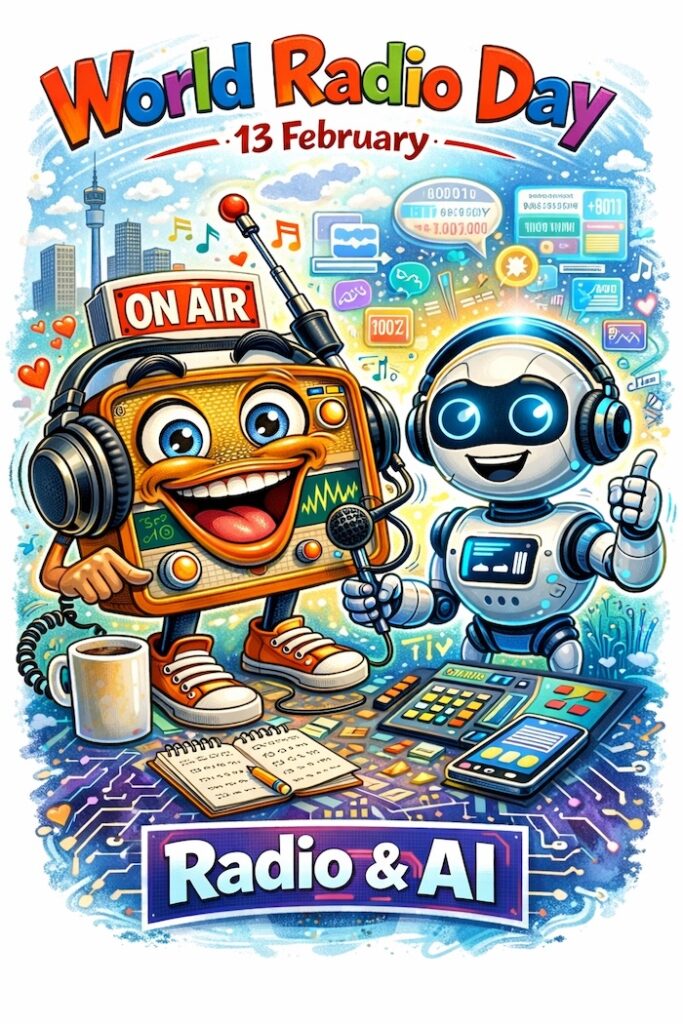
This year’s theme, Radio and AI, could not be more relevant as we take an opportunity to celebrate and thank broadcasters for the news they deliver, the voices they amplify and the stories they share.
Radio has never been afraid of technology. From transmitters to streaming apps and cart machines to digital studios, the medium has evolved without losing its soul. That soul is human connection. And now Artificial Intelligence opens a new chapter. Not just for innovation, but for deepening radio’s bond with its listeners.
AI can help us work smarter. It can analyse audience behaviour in seconds, assist with music scheduling, support newsroom research, generate transcripts and even enhance audio production.
Technology doesn’t build trust
In resource-constrained environments, particularly across Africa where many community stations operate with lean teams, AI has the potential to increase efficiency and free up time for what matters most; storytelling, investigation and community engagement.
But let’s be clear. Technology alone does not build trust. Radio broadcasters do.
Trust is earned in the early morning bulletin when a community needs verified information. It is built in the late-night talk show where a caller shares a vulnerable story. It grows when a presenter switches languages to ensure inclusivity, when a journalist verifies a fact before going on air, when a station stands firm in service of its audience. No algorithm can replicate that quality and reputation built over time.
When used ethically and responsibly, AI can become an ally in strengthening audience trust. It can support professional judgement, not replace it. It can enhance creativity, not dilute it. It can serve public interest values, not override them.
The human voice
AI is a tool, not a voice. The responsibility remains ours.
Radio’s greatest asset is still the human voice. The laugh that feels real. The pause that carries empathy. The tone that signals urgency or joy. In an age of synthetic sound and automated content, authenticity becomes even more valuable.
AI must be embraced with curiosity and caution. Innovate boldly but anchor ourselves in the principles that have sustained radio for over a century: credibility, companionship and community.
The last 367 words in 9 paragraphs were all generated from a (poor) prompt and mostly copied from UNESCO’s website with the request to write a four hundred word article.
At best the above is average. It’s not wrong or factually incorrect. There are several points which I’ve heard experts’ reference at conferences and keynotes, and they hold weight and truth.
Radio remains real
Do we celebrate World Radio Day because we’re average?
No.
Audiences come to us because we speak their language like they do. The dialect and the way people in a city use a language is unique. Nowhere in the world will you hear fluent ‘boet’ English like you do in Joburg and Joburg based stations speak like that.
In KwaZulu-Natal, there is a blend of Zulu and English that has earned its own name, “Zinglish”. It’s a nuance of geography and everyday practice that creates identity and belonging
Great radio remains real. Real people, real voices, real mistakes. Real apologies. That’s because we’re people, and that’s the point. Getting it wrong is normal, but so is apologising. Both are an opportunity of engagement (active or passive) and a way to connect authentically.
Radio isn’t 10 000 things distilled into one homogenous response, thought or concept. Radio is one response, one thought, one concept interpreted 10 000 times. The individual understanding, reaction and reply makes radio powerful and engaging.
No filter in radio
Radio is community. It is a barometer of society in good times and bad and it’s a mirror to daily life. Radio tells the stories of our people because radio is the people. Delivered as a polished product the inputs to radio remain raw.
Raw experiences, raw emotions, raw interactions and engagements that are distilled, processed and delivered in real time. There is no filter in radio to make it sound better than it is. That’s why presenters stumble, laugh, go quiet and cry. Authentic radio is created in real life, in real time.
Radio knows its role. Entertainment and information. Radio doesn’t get caught up in the side show but understands it well. From politics to technology there is always something placing the medium under pressure, but there is resilience in our simplicity.
Radio remains the perfect companion and flexible partner. Radio makes it our business to understand social platforms, trends, consumption, culture, language and money and why these are important to people. Radio is a great listener.
The AI conversation
We know that radio is trusted, it’s been a major point of our definition, and a reason audiences and advertisers still turn to us. I believe the trust conversation for radio needs to turn to a deeper understanding and education.
We need to train and guide our staff on the psychology of trust. We must implement and consider boundaries and procedures that we need to implement ethical use of AI tools.
We must ensure our staff can separate fact from fiction. Deep fakes, false facts and constantly changing consumption behaviour requires agile and skilled practitioners.
The AI conversation remains important as does the value it can add to our systems and processes. As a medium and business that embraces change there are many practitioners and organisations that are already leveraging AI to their benefit.
I think the value is in sharing knowledge, processes and systems. If AI has taught us anything, it’s that you can’t keep up. More forums, more sharing and more collective progress make for better radio.
Why do we celebrate World Radio Day? We celebrate because we are real, relevant, resilient, relatable, engaged, connected and curious. Not a(i)verage.

Tim Zunckel is an audio ambassador and lead consultant at Tuned Media.