- Human-first credibility: Audiences trust relatable creators over institutions. Prioritise visible experts and authentic voices.
- Platform-native storytelling: Adapt content style, format, and delivery for each platform instead of reposting generic content.
- Audience-led optimisation: Focus on audience needs and search intent, not algorithm chasing.
- Radical transparency: Show sources, corrections, processes and human accountability to strengthen trust signals.
- Focused authority: Build niche expertise with curated, consistent content rather than high-volume publishing.
Filipino political journalist and educator Christian Esguerra started his YouTube channel, Facts First with Christian Esguerra, out of sheer desperation. Fired from his post as broadcast anchor and managing editor after two decades as a journalist in 2021, he turned to podcasting a year later – and is not looking back.
“I realised this is something that I had been wanting since high school, to be able to be truly independent as far as news creation is concerned.”
In building his own brand from scratch, platform by platform, audience by audience, Esguerra realised a crucial distinction that captures a growing tension in modern journalism: the difference between what he calls “institutional credibility” and “individual believability” – and the overlooked art of storytelling.
Audiences putting more trust in individuals
Traditional news organisations, he argues, still possess institutional authority built over decades. But on platforms like YouTube and TikTok, audiences increasingly place their trust in individuals – creators who feel relatable, transparent, and authentic – whether or not they follow journalistic disciplines.
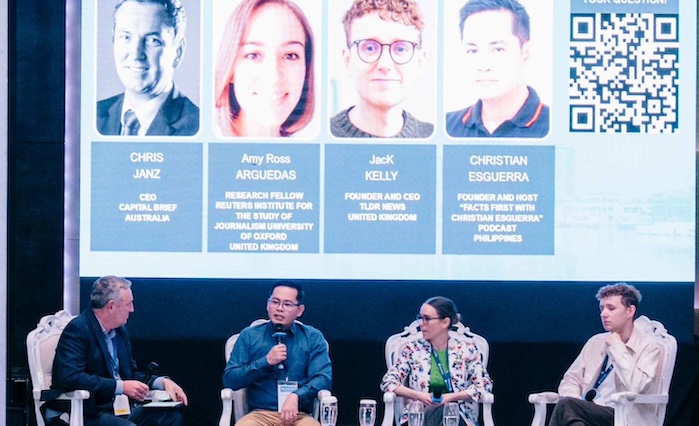
“This is a challenge: how do you shift or expand this institutional credibility, to be more believable as far as the audiences are concerned?” he asked during a plenary session at our recent Digital Media Asia conference titled: ‘Can creator collaborations unlock young audiences?’
The panel, moderated by Chris Janz of Capital Brief Australia, included Amy Ross Arguedas, research fellow at the Reuters Institute, and Jack Kelly, founder and CEO of TLDR News, who explored what it now takes to build trust, loyalty, and sustainable audiences in the creator era.
People-centric, platform-specific
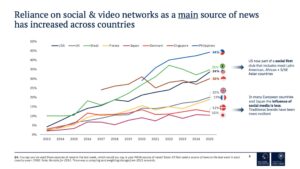
Research presented by Ross Arguedas from the Reuters report on news creators and influencers across 24 countries reflect an increasing shift from traditional media to social and video networks: 17% of people globally now use TikTok for news, while YouTube remains the world’s most important news network.
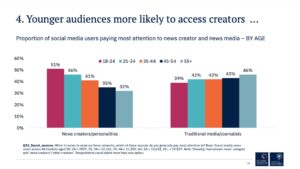
Younger audiences increasingly turn to creators over traditional media outlets.
And what audiences prefer, increasingly, is a person.
“In academia, we call it a parasocial relationship,” noted Ross Arguedas, of the one-sided but emotionally real bonds audiences form with people they encounter regularly, online or on screen.
“A lot of these platforms are designed to really lean into personalities, and people clearly do crave to have that kind of relationship, even with people that they’re getting their news from,” she added.
For Esguerra, the solution to his earlier question lies in rethinking how journalism is told. Asked which skills future journalists should develop to remain relevant in a creator driven ecosystem, his response was swift: “The skill of storytelling in the 21st Century … because journalism is storytelling.”
His criticism of the industry is blunt: many news organisations continue producing journalism in formats audiences have already moved on from. “Why not try to explore as many storytelling tools as possible?” he asked. “The platforms are there. It’s just a matter of how to capture the imagination of the audiences on those specific platforms.”
The issue, he argues, is delivery, not depth.
Customised content
Kelly, of TLDR News, agrees. Too often, he reckons, publishers obsess over algorithms instead of audiences. “Whatever your worry is about the algorithm,” Kelly said, “you should swap the word ‘algorithm’ with ‘audience,’ and you’ll get a much better answer.”
For TLDR, understanding platforms means understanding their native storytelling language– and building journalism specifically for those environments.
“We’re trying to replicate and mimic what a normal creator would do on the platform, not because we want to be normal creators, but because that’s how the platform designed to work; that’s how the audiences are used to interacting with people on the platform.
“So, to some extent understanding the platform; understanding the market; understanding the people you’re trying to reach out to that might not be young people – that might be older generations on Facebook – but understanding the platform and understanding the language of the platform is really important,” he advised.

Trusting in ‘radical transparency’
Founded as a YouTube explainer channel, TLDR News has expanded into podcasts, multiple channels, and a growing digital news business. Kelly attributes much of its audience loyalty to three principles: ‘radical transparency,’ focus, and authenticity.
“Radical transparency” takes shape in three recurring trust-building exercises: a bi-weekly podcast dedicated entirely to discussing mistakes, criticisms, and audience complaints; an annual, standalone “criticism” video, and – radically, for a news outlet and uncommon among legacy publishers – publicly shares information about its revenue streams and editorial processes.
“All of this is a risk. This is opening ourselves up to criticism. It’s allowing ourselves to be vulnerable. And I think for major news brands, that is scary, that is something they’re not used to doing,” Kelly said.

The company’s publishing strategy is similarly deliberate: Rather than flooding YouTube with clips and livestream fragments – “It’s not what YouTube is designed for; no native YouTube creator … is posting hundreds of videos a day or a week, and that’s just not the relationship the audience is used to having with creators” – TLDR maintains its focus.
“If you’re trying to develop an established creator-led, focused approach, focus is really important to you, and it allows you to develop a level of curation and trust that our audience know that even if a video isn’t on a topic they were already interested in, if we’re bringing it to them, then it’s probably something they want to click on, rather than having to filter through our content and find what they want.”

Authenticity is anchored in TLDR’s manifesto, which outlines the company’s codes, corporate guidelines for journalism, and “strict” no-AI-in-content policy.
“We think that presenting ourselves in a way that is human, authentic; that is all about the journalism, our humanity and the fact that we might make mistakes. We’re not perfect. We’re not machines.
This multi-pronged, radically transparent approach to maintaining trust reflects something many legacy organisations struggle to build intentionally: an ongoing, reciprocal relationship with audiences.
Unexpected payoffs: The print surprise
Perhaps the most unexpected result of TLDR’s growth is that one of its most successful products is not even digital.
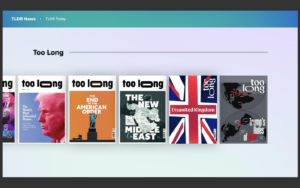
What began as an experimental print publication for fans has evolved into Too Long, a quarterly magazine that now accounts for roughly 40% of the company’s revenue. Now on its seventh issue with “about 10,000 reoccurring subscribers, and an additional few 1,000 that buy each copy individually,” each issue garners an additional 1, 500-2,00 subscribers.
Ranging in price from $14 to $32 depending on subscription package, it’s not cheap, but – “It’s definitely growing, which is why we’re projecting that it will pretty soon become the biggest part of our revenue,” confirmed Kelly.
For an industry that has spent years treating print as a declining asset, the growing success of a premium print product from a digital-native publisher is a sharp reminder that storytelling is a powerful medium – in any format, on any platform.
This storywas first published by the World Editors Forum, a leading global community of editors, which is an integral part of the World Association of News Publishers (WAN-IFRA).
Lucinda Jordaan is WAN-IFRA’s correspondent in Africa.