
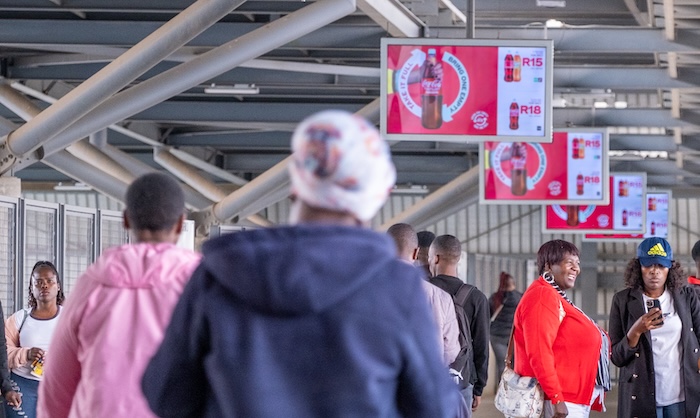
- 12.9 million commuters use South Africa’s taxi, bus and rail networks daily, spending more than an hour in these environments.
- Transit.TV puts brands in front of commuters during their daily journeys, delivering high-frequency exposure in a captive environment.
- The network runs 15-minute loops from 5am to 10pm, combining advertising with news, sport, weather, lifestyle and entertainment.
- Creative works best when designed for the environment, using strong visuals, clear messaging, captions, early hooks and bold typography.
- Transit.TV delivers 45 million+ monthly verified viewed impressions across 38 locations in eight provinces, with independently measured campaign performance. *
Every day, 12.9 million South African commuters move through taxi ranks, bus stations and train platforms: formalised, controlled environments where people wait, queue and travel. Many will spend over an hour there per day. For a good portion of that hour, they’ll be standing in front of a screen.
This is the commute: dense, daily and hard to miss. It’s where Transit.TV, a digital place-based network (DPBN), does its most important work, and where Transit Ads has built its business.
A digital place-based network is exactly what the name suggests: digital screens built around the commuter’s journey, the ranks, stations and stops people move through every day, not something someone has to seek out and watch.
The screen doesn’t need to compete for attention; it’s simply present at each point along a journey the audience is already making, for reasons that have nothing to do with the media itself.
That’s what makes it a distinct third space in the media mix, sitting alongside the rest of the plan rather than against it, and it changes what the medium can, and should, do.
Transit.TV is South Africa’s largest digital place-based network across the taxi, bus and rail environment, reaching commuters who are overwhelmingly household purchase decision-makers.
For the commuter, the value is straightforward: something informative and entertaining in what would otherwise be dead time: news, sport, weather, lifestyle and entertainment on a loop, through the parts of the day usually spent simply waiting.
For brands, those same screens offer verified, sustained, high-frequency access to an audience that is large, on the move and economically influential, not glimpsed once, but seen again and again across a single trip and across a week.
But scale and placement only get a brand halfway there. The other half is creative built specifically for this screen, in this environment, and too many brands still treat Transit.TV as an afterthought: take a 30-second TV ad, export it as-is, and hope it lands. It rarely does. Transit.TV is a fundamentally different medium, and it rewards its own creative brief.
Strong visuals. Clear message. Every time
A taxi rank, bus station or train platform is a loud, layered space: engines, hooters, vendors, conversations happening all at once. Whatever plays on screen is competing with all of it. That’s why the creative that performs best on Transit.TV leans on strong visual hierarchy, on-screen captions and motion that carries the message on its own.
Dialogue and soundtrack-led moments still work well here, they just need subtitles or captions to hold their impact in a busy, high-traffic environment. It’s a small adjustment, not a different kind of ad.
Designing for the loop, not the slot
Transit.TV’s channel runs on a 15-minute loops, repeated from 5am to 10pm daily, split evenly between curated content (news, sport, weather, lifestyle, entertainment) and advertising. Ads sit inside content commuters are already engaged with, on screens they’ll pass repeatedly across a single trip and across the week.
That’s a different viewing pattern to broadcast TV, and it rewards creative built around it rather than against it. A TV ad structured around a slow build with a payoff in the final five seconds assumes a captive, attentive viewer settled in for the duration.
A commuter glancing up from a taxi queue is working with a different set of conditions: not less engaged, just differently engaged, and creative that leads with its message, rather than saving it for an ending most viewers will catch on a later pass, tends to do well here.
Some of what we’ve learned from the creative that performs well on this screen
The strongest work tends to lead with its hook in the first few seconds: commuters glance rather than linger, and a message that’s already landed by then has room to build on itself with every repeat view.
Calls to action that appear early, not only at the end, travel further across the format’s repeat-exposure pattern: most viewers catch the spot in fragments across several passes rather than start to finish in one sitting.
Bold, high-contrast typography reads faster at a distance and in motion, which matters more here than on a screen designed to be watched up close and still.
None of these narrows creative ambition. If anything, brands and agencies who’ve engaged with it have found it opens up a different kind of craft: telling a story fast, visually, and repeatedly, to an audience that’s genuinely there, again and again.
Why the format is worth designing for properly
The scale is significant: Transit.TV delivers over 45 million* monthly verified viewed impressions across 38 locations in eight provinces, reaching commuters who spend an average of over an hour a day in these environments. Independently verified, real-time audience measurement means campaign performance is measurable and reportable.
It’s cost-efficient too: for a comparable budget targeting an economically active adult audience, Transit.TV’s high-frequency package delivers a strong cost per thousand impressions, adding incremental reach in the hours a commuter spends away from both the television and the handset.
The reach and the numbers are there. What determines whether a campaign actually lands is whether the creative was built for the screen it’s playing on.
The takeaway
Transit.TV isn’t a smaller version of television, and it isn’t traditional out-of-home either. It’s the third space in the media mix, its own environment with its own rules: silence working in its favour rather than against it, high repeat exposure, brief attention windows, and an audience that’s engaged but on the move.
As the leading digital place-based network in South Africa’s commuter environment, Transit Ads continues to invest in understanding this audience: how they move, where they wait, what holds their attention, so that the brands and agencies working with this screen aren’t guessing.
Brands that design specifically for these conditions, rather than repurposing what worked somewhere else, are the ones that get remembered on the daily commute.
* Summary created by AI
*VACs Valid at the time of going to press
Shamy Naidoo is director at Transit Ads, a leading transit media company, connecting brands with millions of commuters across taxi, bus, and rail networks nationwide. Since 2007, we have delivered impactful, data-driven media solutions that place brands at the centre of everyday movement, reaching the economically active middle market where life, ambition, and progress intersect.