

Over 60 years ago in his book Confessions of an Advertising Man, David Oglivy wrote, “The consumer is not a moron; she is your wife”.
It is only in a Trumpian dystopia that constant repetition, however irrational or untrue, could be construed as a compelling argument. In real life, the old advertising truism – nothing will destroy a bad brand faster than good advertising – holds true.
The recently published WARC Marketer’s Toolkit 2026 identifies the gap between brand and customer experience as a key trend impacting marketing effectiveness. Especially with the rising ‘enshittification’ of customer service and products – often due to gradual deterioration in the quality of a product or service – as a consequence of short-termism.
The reality gap
WARC reports that the experience gap is widening – the space between what brands promise in their communications and what customers experience. Not in the mediaverse – but in reality.
Managing the brand experience, and creating demonstrable points of positive UX differentiation, is becoming increasingly challenging. Growing global consumer dissatisfaction shows brands are struggling to meet consumer expectation.
WARC reports that 32% of customers will abandon a brand they love after just one bad CX experience (Source: PWC 2023) and 39% of brands experienced significant declines in brand equity due to poor CX (Source: Forester 2024)
When everyday touchpoints feel inconsistent with what a brand promises, customers notice.
It’s all just content
Equating the sheer volume of media exposure generated by a campaign, with providing a compelling reason for brand loyalty is, from David Ogilvy’s perspective, treating consumers as morons. So commoditised is this practice, that we no longer even refer to the products we produce as “advertisements.” It’s all just content.
And we give anyone licence to do it on our behalf and call them influencers or content creators.
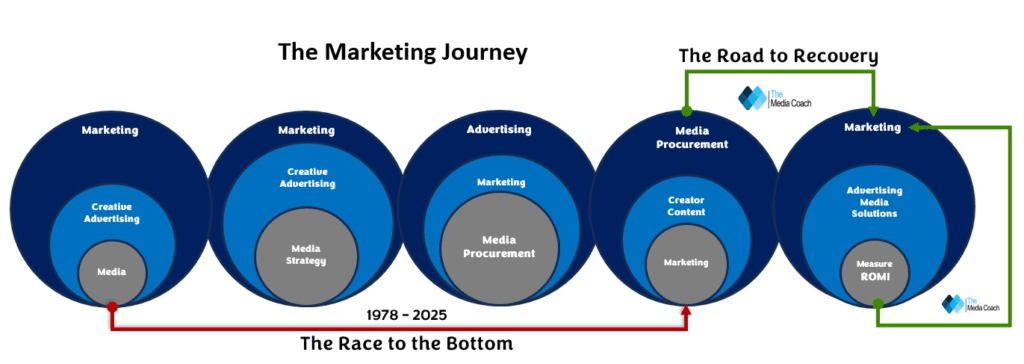
So, after a decade-long media race to the bottom, where volume of discounted media exposure and miscellaneous content is all too often reflected by procurement as return on media investment (ROMI), it is encouraging to note the growing body of measurable insights directed at optimising the balance between creative advertising and media.
World Federation of Advertisers (WFA) Project Spring 2020 reports that 92% of marketing and marketing procurement executives feel “the way marketing procurement is perceived by my organisation could be improved” and that the new emphasis on media procurement is “all about moving from what we’re buying, to what we expect what we buy to do”.
The starting point
As I reflect on my near 50-year journey in advertising and media, I have come to understand the starting point for delivering on the WFA mandate is not optimising the balance of content and media exposure. It is not about attention metrics and contextual relevance – important as these things undoubtedly are.
It is about embracing the fundamental notion that advertising and media are subsets of the broader marketing discipline.
As media specialists, if we want to shift the emphasis from the cost of the media buy to the value that the buy generates, then let us start by defining value in terms of marketing outcomes. Let’s start with a marketing-centric media brief that clearly lays out achievable and measurable objectives.
Sadly, far too many marketers who say their campaign objective is to increase brand awareness, don’t know the brand’s baseline level of awareness. So the place to start any successful media campaign is to set aside a portion of the budget – a significant portion – for measuring the outcomes.
In 2026 let’s get back to basics.
In 2026 let’s get back to marketing.

Gordon Muller is Africa’s oldest surviving media strategist. Author of Media Planning – Art or Science. Mostly harmless! Read his Khulumamedia Blog here.