
• Subscribe to our newsletter
The Media Online
  • Home
  • MOST Awards
  • News
    • Awards
    • Media Mecca
  • Print
    • Newspapers
    • Magazines
    • Publishing
  • Broadcasting
    • TV
    • Radio
    • Cinema
    • Video
  • Digital
    • Mobile
    • Online
  • Agencies
    • Advertising
    • Media agency
    • Public Relations
  • OOH
    • Events
  • Research & Education
    • Research
    • Media Education
      • Media Mentor
  • Press Office
    • Press Office
    • TMO.Live Blog
    • Events
    • Jobs
No Result
View All Result
  • Home
  • MOST Awards
  • News
    • Awards
    • Media Mecca
  • Print
    • Newspapers
    • Magazines
    • Publishing
  • Broadcasting
    • TV
    • Radio
    • Cinema
    • Video
  • Digital
    • Mobile
    • Online
  • Agencies
    • Advertising
    • Media agency
    • Public Relations
  • OOH
    • Events
  • Research & Education
    • Research
    • Media Education
      • Media Mentor
  • Press Office
    • Press Office
    • TMO.Live Blog
    • Events
    • Jobs
No Result
View All Result
The Media Online
No Result
View All Result
Home News

The enduring power of journalism in a world of more media and less freedom

A vast amount of information has not necessarily meant more reliable information.

by James Rodgers
January 19, 2026
in News
0 0
0
The enduring power of journalism in a world of more media and less freedom

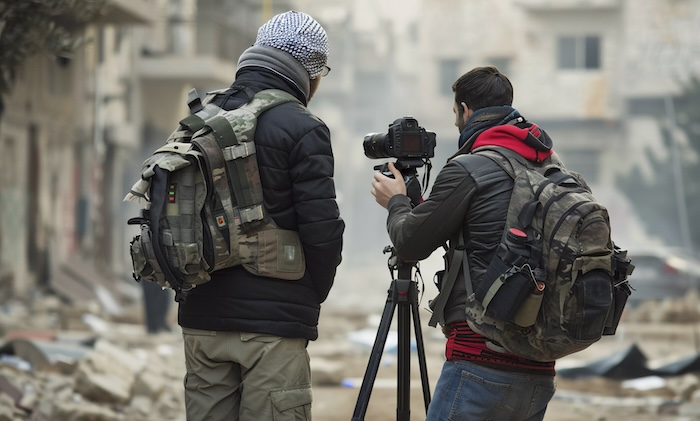
Israel has banned international journalists entering Gaza. Palestinian journalists continue, at great risk, to report from the territory/Freepik.com/AI-generated image

Share on FacebookShare on Twitter

A vast amount of information has not necessarily meant more reliable information, writes James Rodgers, a former BBC correspondent who held postings in Gaza, Moscow and Brussels

On 10 December, the year 2025 reached a murderous milestone. In 2024, the Committee to Protect Journalists (CPJ) had recorded 126 journalists and media workers killed, the highest number since the CPJ first began keeping records in 1992. In 2025, the figure was matched with three weeks of the year still to go.

One nationality, Palestinian, has paid by far the highest price. “Israel has killed almost 250 journalists since the Israel-Gaza war began in 2023,” the CPJ reported.

What does this mean for audiences’ understanding of a world where international affairs are dominated by war, the climate crisis and unpredictable politics?

As far back as the early years of the US, and through the European revolutions of the 19th centuries, information and freedom have been linked. In 1787, Thomas Jefferson wrote: “Were it left to me to decide whether we should have a government without newspapers, or newspapers without a government, I should not hesitate a moment to prefer the latter.”

Controlling the message

Today, we have access to more media than at any other time in human history. But this vast amount of information has not necessarily meant more reliable information. Governments and tech companies striving to control the message often succeed.

Israel has banned international journalists entering Gaza. Palestinian journalists continue, at great risk, to report from the territory. Russia, meanwhile, has placed restrictions on reporting its “special military operation” – in a word, war – on Ukraine.

A generation ago, when the CPJ first began keeping data on journalists’ deaths, it was different. The fall of the Berlin Wall and the end of the cold war allowed international media organisations freedom to work as never before in the former Soviet bloc.

As those countries embraced political change, they encouraged freer media to flourish within their new societies. True, these media were often influenced by political and business interests – the news media often are. But there was plurality where previously there had only been the party line.

Detained for 400 days

The 1990s, imperfect though they were as a time of press freedom, were better than what has followed since. As the media academic and former foreign correspondent Peter Greste has persuasively argued, the aftermath of 9/11 involved state power extending, “into control over information and ideas. They did that by loosening the definitions of what constituted ‘terrorism’ and ‘national security’”.

Greste’s words were informed by the price he had paid for his own journalism. In late 2013, along with two colleagues, Mohamed Fadel Fahmy and Baher Mohammad, he was detained in Egypt on terrorism charges. He spent 400 days in prison. The charges had resulted from the fact that he had spoken to the Muslim Brotherhood as part of his reporting.

“How do you accurately and fairly report on Egypt’s ongoing political struggle without talking to everyone involved?” he wrote at the time.

Information access

It is not new that governments seek to control media. What is new is that the US is so proudly among them. Jefferson would probably not like what the current US government is doing, especially its recent policy of restricting access to the Pentagon for reporters who themselves refuse restrictions on their reporting.

The words that follow Jefferson’s discussion of the relative merits of governments and newspapers are less well remembered: “But I should mean that every man should receive those papers and be capable of reading them.”

Outdated gendered language aside, that, today, is the problem. For while we have more and more media, we have far less media freedom.

In the age of mass media, news organisations have largely controlled the means of distribution. Today, the tech companies take the lead. Not everyone is receiving the “papers”. Where they are not formally censored, they are harder to find – and cost money, unlike social media content.

More cat videos and fewer questions

Algorithms may be adjusted to give us more cat videos and fewer questions. Governments and criminals place physical restrictions, up to and including death, on journalists’ work. Powerful politicians use legal action – or the threat of it – to silence trusted news organisations.

In my previous career as an international correspondent, I reported on wars in the former Soviet Union and the Middle East. In the 1990s and 2000s, journalists were often restricted by governments not wanting bad news reported – but rarely simply banned as they increasingly seem to be now.

In Gaza and in Russia, international journalists are unable to access places they need to tell the story. In both cases, courageous reporters from those countries risk danger and even death to try to tell the world what is happening.

The restrictions placed upon journalists today may mean that governments seem to be winning at the moment. Their desire to control confirms the power to challenge that journalism still holds.The Conversation


James Rodgers, Reader in International Journalism, City St George’s, University of London

This article is republished from The Conversation under a Creative Commons license. Read the original article.


Tags: impactJames Rodgersjournalismmisinformationtechnology

James Rodgers

Dr James Rodgers is Reader (Associate Professor) in International Journalism). Since September 2022, he has been the programme director of the BA Journalism, Politics and History. He teaches the MA International Journalism (International News), and the BA Journalism (Introduction to News Writing; Reporting Conflict), as well as supervising PhD students and postgraduate and undergraduate dissertations. He is the author of four books on international affairs. His latest is 'Assignment Moscow: reporting on Russia from Lenin to Putin' (I.B Tauris, 2020; new edition published by Bloomsbury in May 2023). James' next book, on Russia and the West, is due to be published in 2025 by Yale University Press. Before entering Journalism academia full time in 2010, James was a journalist for twenty years. He spent fifteen years at the BBC, completing correspondent postings in Moscow, Brussels, and Gaza, as well as numerous other assignments. These included reporting from New York and Washington after 9/11, and covering the war in Iraq in 2003 and 2004.

Follow Us

  • twitter
  • threads
  • Trending
  • Comments
  • Latest
Kelders van Geheime: The characters are here

Kelders van Geheime: The characters are here

March 22, 2024
Dissecting the LSM 7-10 market

Dissecting the LSM 7-10 market

May 17, 2023
Keri Miller sets the record straight after being axed from ECR

Keri Miller sets the record straight after being axed from ECR

April 23, 2023
Getting to know the ES SEMs 8-10 (Part 1)

Getting to know the ES SEMs 8-10 (Part 1)

February 22, 2018
Sowetan proves that sex still sells

Sowetan proves that sex still sells

105
It’s black. It’s beautiful. It’s ours.

Exclusive: Haffajee draws a line in the sand over racism

98
The Property Magazine and Media Nova go supernova

The Property Magazine and Media Nova go supernova

44
Warrant of arrest authorised for Media Nova’s Vaughan

Warrant of arrest authorised for Media Nova’s Vaughan

41
The best agencies don’t outsource their thinking

The best agencies don’t outsource their thinking

January 19, 2026
The enduring power of journalism in a world of more media and less freedom

The enduring power of journalism in a world of more media and less freedom

January 19, 2026
2026 will test South Africa’s leadership depth

2026 will test South Africa’s leadership depth

January 19, 2026
Businesses are embracing AI, but ethical blind spots are major operational risks

Businesses are embracing AI, but ethical blind spots are major operational risks

January 16, 2026

Recent News

The best agencies don’t outsource their thinking

The best agencies don’t outsource their thinking

January 19, 2026
The enduring power of journalism in a world of more media and less freedom

The enduring power of journalism in a world of more media and less freedom

January 19, 2026
2026 will test South Africa’s leadership depth

2026 will test South Africa’s leadership depth

January 19, 2026
Businesses are embracing AI, but ethical blind spots are major operational risks

Businesses are embracing AI, but ethical blind spots are major operational risks

January 16, 2026

ABOUT US

The Media Online is the definitive online point of reference for South Africa’s media industry offering relevant, focused and topical news on the media sector. We deliver up-to-date industry insights, guest columns, case studies, content from local and global contributors, news, views and interviews on a daily basis as well as providing an online home for The Media magazine’s content, which is posted on a monthly basis.

Follow Us

  • twitter
  • threads

ARENA HOLDING

Editor: Glenda Nevill
glenda.nevill@cybersmart.co.za
Sales and Advertising:
Tarin-Lee Watts
wattst@arena.africa
Download our rate card

OUR NETWORK

TimesLIVE
Sunday Times
SowetanLIVE
BusinessLIVE
Business Day
Financial Mail
HeraldLIVE
DispatchLIVE
Wanted Online
SA Home Owner
Business Media MAGS
Arena Events

NEWSLETTER SUBSCRIPTION

 
Subscribe
  • About
  • Advertise
  • Privacy & Policy
  • Contact

Copyright © 2015 - 2023 The Media Online. All rights reserved. Part of Arena Holdings (Pty) Ltd

No Result
View All Result
  • Home
  • MOST Awards
  • News
    • Awards
    • Media Mecca
  • Print
    • Newspapers
    • Magazines
    • Publishing
  • Broadcasting
    • TV
    • Radio
    • Cinema
    • Video
  • Digital
    • Mobile
    • Online
  • Agencies
    • Advertising
    • Media agency
    • Public Relations
  • OOH
    • Events
  • Research & Education
    • Research
    • Media Education
      • Media Mentor
  • Press Office
    • Press Office
    • TMO.Live Blog
    • Events
    • Jobs

Copyright © 2015 - 2023 The Media Online. All rights reserved. Part of Arena Holdings (Pty) Ltd

Welcome Back!

Login to your account below

Forgotten Password?

Retrieve your password

Please enter your username or email address to reset your password.

Log In

Add New Playlist

Are you sure want to unlock this post?
Unlock left : 0
Are you sure want to cancel subscription?