Only a few global events capture public attention like the FIFA World CupTM. For brands, such events present a unique opportunity to engage audiences, build visibility, and connect with consumers through the universal appeal of football.
At the same time, the World Cup operates within one of the most tightly controlled commercial frameworks in sport. Sponsorship rights are sold at significant value, and the exclusivity granted to official partners is actively protected.
It is important for businesses who are not sponsors but are seeking to capitalise on the excitement of the tournament to strike a careful balance, leveraging the cultural moment without crossing legal boundaries.
The core principle
The key distinction is straightforward but essential. Brands are free to market around football and the broader enthusiasm for the sport. However, they cannot market the World Cup itself unless they are an official sponsor or have obtained the necessary rights. Maintaining this distinction is central to avoiding both legal and reputational risk.
Why caution Is required
The commercial success of the World Cup depends heavily on official sponsorships. In return for their investment, sponsors receive exclusive rights to associate themselves with the event.
To protect this exclusivity, rights holders monitor marketing activity closely and enforce their rights rigorously. Campaigns that overstep the line may be challenged swiftly, often in a highly visible manner.
Consequences can include the immediate withdrawal of campaigns, legal proceedings, and reputational harm. In jurisdictions such as South Africa, additional regulatory frameworks may also apply, further restricting marketing that suggests an unauthorised association with major events.
Understanding unauthorised association
Unauthorised association arises when marketing creates the impression that a brand is linked to the World Cup, whether directly or indirectly. The assessment is not a technical legal exercise. Instead, it is based on how an ordinary consumer would interpret the message.
If the overall impression is that the brand is an official partner or sponsor, the risk of infringement is high. This type of association can arise through explicit statements, but it can also result from more subtle cues, such as the overall look and feel of a campaign, its timing, or the themes it adopts.
Common sources of risk
In practice, most problematic campaigns fall into a few recurring categories. One category involves suggesting a connection with the event, even where none exists. Another arises from the use of protected intellectual property, including event names, logos, slogans, or similar elements.
There is also the risk of so-called ambush marketing, which is a form of guerrilla marketing. Guerrilla marketing itself is a legitimate and widely accepted strategy, but ambush marketing sits at the point where such activity may or may not cross into unlawful conduct, depending on how it is executed.
In the context of major sporting events, risk most commonly arises in four ways:
- By intrusion into the event environment (for example, physical presence in or around stadiums)
- By creating an impression of association with the event or its sponsors
- By using protected intellectual property such as event marks or imagery, or
- Through jurisdiction-specific legal restrictions that regulate event-related commercial activity.
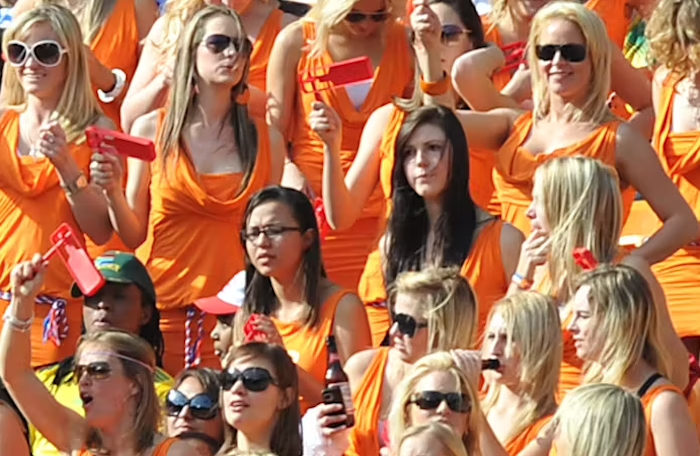
Campaigns that fall within these categories are more likely to attract scrutiny, particularly where they create an overall impression of an unauthorised commercial link to the event. A well-known example is the Bavaria Beer alleged ambush at the 2010 FIFA World CupTM.
In this case, the Bavaria brand was not an official sponsor but allegedly arranged for a group of spectators to attend a match wearing coordinated orange dresses associated with its campaign. The dresses were allegedly designed to attract attention despite the absence of prominent branding, and the group was allegedly positioned in a way that ensured visibility during the televised match.
The participants were ultimately removed from the stadium, and legal action followed against the organisers. While the campaign generated significant global publicity for the brand, it also attracted strong enforcement measures.
Increasingly, risk arises in online environments, where real-time marketing, targeted advertising, and the use of event-related hashtags can quickly create an impression of association.
Permissible marketing activity
Despite these restrictions, there remains significant scope for creative and effective marketing.
Brands may run campaigns that celebrate football as a sport and tap into the excitement surrounding major matches. The Messaging with focus on the enjoyment of the game, fan culture, or shared experiences is generally acceptable, provided that it does not reference the tournament itself.
Expressions of support for national teams are also permissible, particularly where they rely on general themes of national pride. However, care must be taken to avoid linking such support directly to the World Cup or specific fixtures.
Athlete endorsements can be effective, but they require care. Brands may feature players in campaigns, provided they avoid referring to the player’s participation in the tournament, specific matches, or opponents. However, focus should remain on the individual, not the event.
Likewise, brands may engage audiences through general football-related content, internal activations, or viewing experiences, as long as these do not suggest a commercial link to the tournament.
Prohibited marketing practices
There are clear boundaries beyond which marketing activity is likely to be considered unlawful or to attract legal challenge.
The use of official event intellectual property is strictly reserved for authorised partners. This includes the event name, logos, trophies, slogans, and other distinctive elements associated with the tournament.
Marketing should also avoid any suggestion of sponsorship, endorsement, or official affiliation. Even indirect or ambiguous wording can create a misleading impression and give rise to legal issues. Promotional activity linked to the tournament is particularly high risk.
Competitions, giveaways, or campaigns tied to matches or tournament outcomes may be interpreted as attempts to exploit the event’s commercial value. Social media presents additional challenges. The speed and visibility of online content can amplify risk, particularly where posts are linked to matches or use event-related terminology in a promotional context.
Areas requiring careful judgement
Not all situations are clear-cut. Some forms of marketing sit in a grey area and require a more nuanced assessment.
Campaigns timed to coincide with key matches, influencer activity during the tournament, and player-related content released at peak moments of public interest can all increase the risk of perceived association. In these instances, a useful guiding question is whether the campaign feels like it is attempting to benefit from the event in a manner similar to an official sponsor. If so, caution is warranted.
Insights from case law
Judicial decisions across multiple jurisdictions provide useful guidance on how courts approach unauthorised association and ambush marketing in the context of major sporting events.
In FIFA v Metcash Trading Africa (Pty) Ltd (2009), the Pretoria High Court interdicted the distribution of ‘Astor 2010’ lollipops. Although the product did not expressly refer to the FIFA World CupTM, its packaging incorporated soccer imagery and elements of the South African flag in a manner that was held to create an indirect association with the tournament.
The case demonstrates that even subtle visual cues, when viewed collectively, can result in unlawful association.
A similar emphasis on implied association appears in Australian Olympic Committee Inc v Telstra Corporation Limited [2017] FCAFC 4. In that matter, Telstra’s ‘I Go to Rio’ campaign was found to suggest a connection with the Olympic Games, despite avoiding explicit use of official Olympic branding.
The court considered the overall impression created by the campaign and concluded that it conveyed a misleading message of sponsorship or affiliation.
The principle that certain event-related wording is strictly protected is illustrated in San Francisco Arts & Athletics Inc v United States Olympic Committee 483 U.S. 522 (1987). The United States Supreme Court upheld the Olympic Committee’s right to prevent the unauthorised use of the word ‘Olympic’ in a commercial context.
This decision highlights that certain names and descriptors associated with global sporting events may be protected to a degree that prohibits their use altogether without consent.
Court interventions
Courts have also shown a willingness to intervene in high-profile ambush marketing scenarios. While some campaigns attempt to operate at the margins of legality, the consistent trend is that where the overall impression is one of commercial association with a protected event, enforcement action is likely to follow.
Taken together, these cases confirm that the legal assessment goes beyond technical wording. Courts consider the overall impression created by the marketing, including visual elements, timing, and context. Even where no explicit reference is made, liability may arise if the campaign is perceived as trading off the reputation or commercial value of the event.
Practical application
In practical terms, campaigns that focus on football in general, celebrate the sport, or engage with fans in a broad and non-specific manner are less likely to attract legal scrutiny.
Conversely, campaigns that reference the World Cup, align closely with tournament fixtures, or incorporate promotional mechanics tied to the event are more likely to be challenged.
Where uncertainty exists, seeking legal input before launch remains the most effective way to mitigate risk.
Conclusion
The World Cup offers a valuable marketing opportunity, but it must be approached with care.
The most effective campaigns are often those that embrace the spirit of football without attempting to appropriate the event itself. By remaining creative, authentic, and mindful of the legal framework, brands can successfully participate in the global conversation while avoiding unnecessary risk.
Authors: Darren Olivier, Danielle van Deventer and Mandla Ngidi from Adams and Adams.