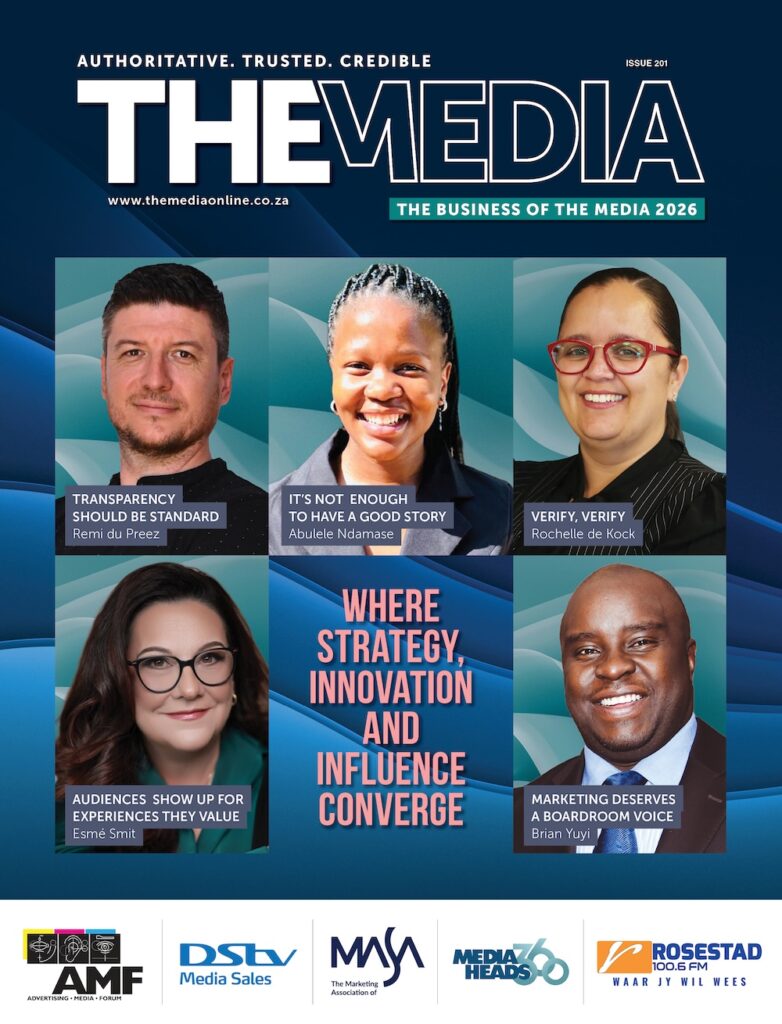

- Media fragmentation is reshaping South Africa, making relevance and engagement more important than reach.
- Commerce-led media is a major opportunity, linking advertising more directly to sales and business outcomes.
- Clients demand accountability, with greater focus on data, integration, ROI and measurable impact.
- Fragmented attention and declining trust are key threats, compounded by economic pressure and rapid AI-driven change.
- Younger audiences demand mobile-first, authentic and personalised content, accelerating creator-led and flexible media strategies. *
The South African media landscape in 2026 is defined by rapid change and increasing complexity. Audiences are more fragmented than ever, consuming content across multiple platforms and devices, often simultaneously. For brands, this means success is no longer about reach alone. Relevance, meaningful connection and engagement are becoming increasingly important.
Digital continues to dominate, particularly in South Africa’s mobile-first environment, but traditional channels remain valuable when used strategically. The real opportunity lies in integration: connecting channels to create seamless, consistent brand experiences.
There is also a growing emphasis on accountability. Clients want clear evidence of impact, increasing the role of data, analytics and technology in media planning, optimisation and measurement. The market remains resilient, however, and there is significant opportunity for brands that understand local context, embrace change and continuously adapt.
Commerce-led media creates new opportunities
Commerce-led media is one of the biggest opportunities for the industry. The market is moving away from siloed media buying towards integrated ecosystems that connect brand storytelling more directly to business outcomes.
Across Africa, there is significant potential in shopper and commerce environments, particularly as brands look for ways to influence decisions closer to the point of purchase, whether in-store, online or through mobile channels.
First-party data is becoming increasingly valuable as privacy regulations evolve. Organisations that can responsibly build and use their own data assets will be better positioned to deliver personalised experiences and create competitive advantage.
Localisation at scale is another important opportunity. Africa cannot be treated as a single market. Its diverse cultures, economies and consumer behaviours require strategies that reflect local nuances in meaningful ways.
The greatest opportunity lies in connecting media, technology, data, creativity and commerce to deliver measurable business impact.
Fragmented attention is the biggest threat
The biggest challenge facing the media industry is the growing fragmentation of attention. Consumers are exposed to more content than ever across an expanding range of platforms, making it harder for brands to cut through the noise.
Without integrated strategies, this fragmentation can lead to inefficient spending and reduced effectiveness.
Trust is another growing concern. Misinformation, low-quality content and AI-generated material are making audiences more sceptical. Brands therefore need to work harder to establish credibility, authenticity and transparency in their communications.
Economic pressure is adding another layer of complexity. With many organisations operating under constrained budgets, every marketing investment is facing greater scrutiny. Media partners are expected to demonstrate effectiveness while continuing to innovate.
The pace of technological change also presents a challenge. Businesses that fail to adapt to developments in data, AI and digital transformation risk losing relevance and competitive advantage.
Digital-led sectors continue to grow
The strongest advertising growth is coming from sectors aligned with digital adoption and changing consumer behaviour.
Retail, particularly e-commerce-enabled retail, continues to expand as consumers embrace increasingly hybrid shopping journeys. Financial services are also investing heavily in digital solutions that improve accessibility and convenience.
Telecommunications and technology remain important contributors, driven by continued demand for connectivity, devices and digital services. These sectors are naturally aligned with data-driven and performance-led marketing approaches.
Industries more exposed to economic pressure are taking a more cautious approach to media investment, with greater scrutiny around efficiency, return on investment and measurable outcomes.
Categories dependent on discretionary consumer spending are also under pressure as households become more selective with their budgets.
Overall, the strongest growth is coming from sectors that embrace digital transformation and can connect media investment directly to business performance.
Clients want integrated strategic partners
Client expectations of media partners are changing. There is a clear demand for greater accountability, integration and outcomes-focused solutions.
Every investment is expected to deliver measurable value, not only through awareness and reach but through tangible business results.
Clients increasingly want integrated thinking rather than fragmented solutions across media, creative and technology. They are looking for partners that can connect these disciplines into a unified strategy.
Data and insights are central to this relationship. Clients expect partners to go beyond reporting and provide actionable intelligence that informs decision-making and improves performance.
Speed and adaptability are equally important. In a rapidly changing market, brands need partners that can respond quickly, test and learn continuously, and optimise campaigns in real time.
The role of the media partner is therefore evolving from supplier to strategic business partner, with a greater responsibility to understand business challenges and deliver innovative solutions that create measurable impact.
Younger audiences are changing media planning
Younger audiences are fundamentally reshaping media planning. They are highly digital, mobile-first and platform-agnostic, making traditional planning models increasingly less effective.
Their behaviour is driven more by content than by channels. They move seamlessly between social platforms, streaming services and emerging digital environments, engaging with short-form, interactive and creator-led content.
This requires more flexible, content-centric planning approaches.
Authenticity is also critical. Younger consumers are more likely to engage with brands that feel genuine, culturally relevant and aligned with their values. Creators and influencers have consequently become increasingly important within the media ecosystem.
Younger audiences also expect immediacy and personalisation. Content needs to be relevant, timely and tailored to individual interests and behaviours.
Media strategies are therefore becoming more adaptive, data-led and culturally informed, with greater emphasis on storytelling, community and engagement rather than reach alone.
The future of media will depend on the ability to connect people, platforms, data, creativity and commerce in ways that are both culturally relevant and commercially effective.
* Summary created by AI
Koo Govender is a member of the Advertising Media Forum and CEO of Publicis Groupe Africa.

CLICK ON THE COVER TO READ THE BUSINESS OF THE MEDIA