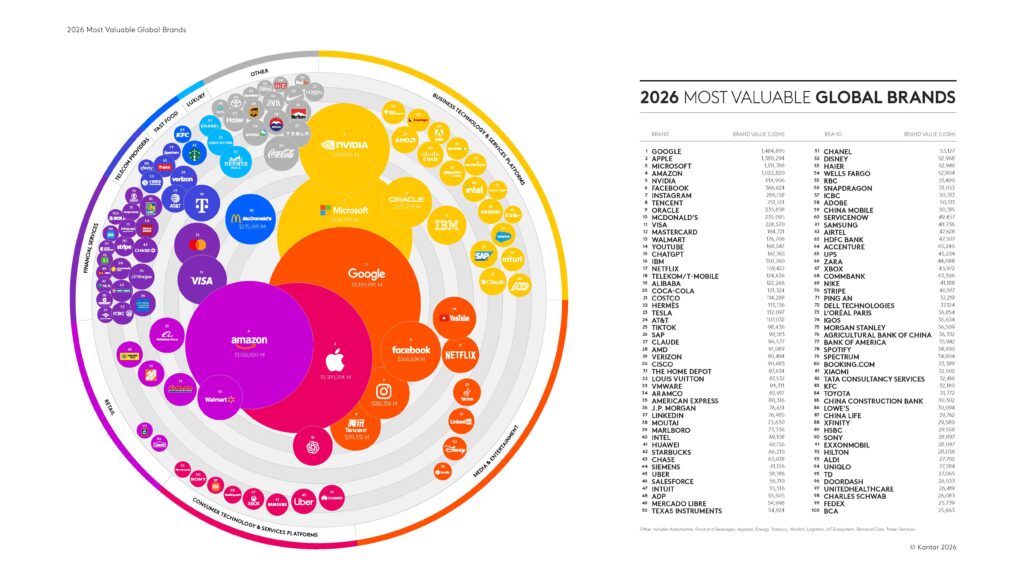
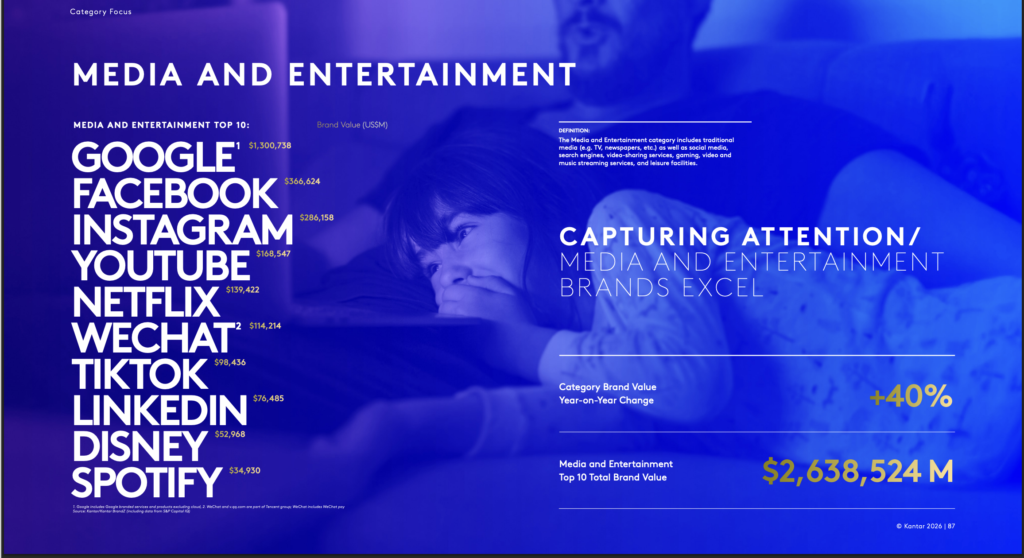
Media and entertainment giants are tightening their grip on audiences, with the world’s leading brands growing by 40% this year as the industry consolidates around a handful of dominant players.
This is the view on the sector in Kantar’s newly released global survey, The Kantar BrandZ Top 100 Most Valuable Global Brands 2026, launched on Thursday.
Despite an explosion of viewing options across streaming, social media, gaming and music, audiences are increasingly concentrating their attention on a small group of platforms.
“The era of total TV The past decade has quietly reshaped TV. As smart TVs became the norm, the distinction between broadcast and streaming all but disappeared for viewers. Today, people simply watch TV. Broadcast still delivers scale, but streaming has become part of everyday behaviour,” says Gonca Bubani, Kantar’s global media director.
“Kantar Media Reactions 2025 shows that 72% of people say they stream TV and video, compared with 65% for broadcast TV. Audiences are not just migrating for convenience,” she adds. “They are following quality. Netflix and Disney+ lead globally for preferred content according to Media Reactions, while Amazon Prime’s advertising stands out as particularly well received.”
Reshaping content and distribution
A recent Deloitte study found consumers spend more than six hours a day on entertainment, yet much of that time is focused on short-form video platforms such as YouTube, TikTok and Meta-owned apps. In China, the market is led by Douyin, Kuaishou, Xiaohongshu and WeChat.
The shift is reshaping how media companies and publishers create and distribute content. Success now depends on platform-native formats built for speed, volume and “shopability”, where video is not only entertainment, but also a direct sales tool.
At the same time, holding audience attention has become more difficult in an increasingly crowded digital environment.
Creators are now central to the media economy, often commanding greater loyalty on short-form platforms than traditional studios or movie stars and at a fraction of the cost.
Changing power dynamic
That changing power dynamic is pushing major media brands to rethink strategy and partnerships. Netflix’s multimillion-dollar, non-exclusive deal with YouTube children’s creator Ms. Rachel is one example of how legacy platforms are leaning into creator-driven audiences.
The rise of video podcasts is also emerging as a major trend, with audiences willing to spend hours watching creators and hosts in conversational formats, even as long-form traditional content struggles to retain viewers.
For advertisers, the creator economy presents both opportunity and risk. Sponsored creator content can deliver significant engagement boosts, but success remains heavily dependent on audience response and platform algorithms, making the space increasingly unpredictable for brands.
As Bubani says, “TV brands, whether rooted in broadcast or streaming, now need to think and act as total video players, supporting advertisers in a world where viewers already have.”
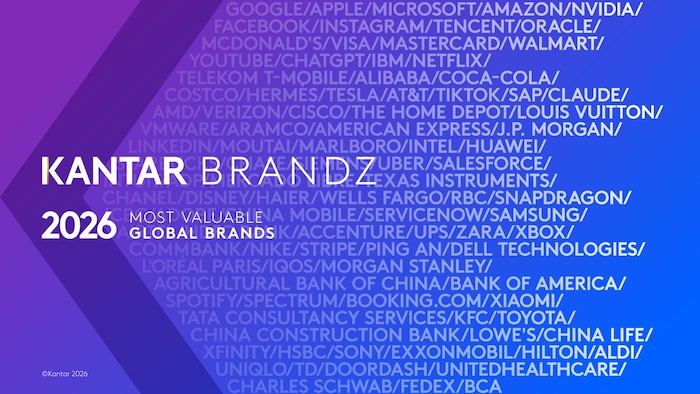
Top 100 Most Valuable Global Brands
Meanwhile, Google has dethroned Apple as the world’s most valuable brand. Kantar’s BrandZ 2026 ranking shows the brand has hit a $1.5tn brand valuation, thanks to its careful ecosystem integration of Gemini in a fragmented market.
Google’s return to number one shows that strong brands are becoming more influential, not less, in shaping people’s decision‑making, as AI increasingly determines what consumers see and choose.
The acceleration of AI has resulted in one of the most profound shifts in brand value, pushing the threshold to enter the Kantar BrandZ Top 100 Most Valuable Global Brands ranking to its highest level.