

• Subscribe to our newsletter
The Media Online
  • Home
  • MOST Awards
  • News
    • Awards
    • Media Mecca
  • Print
    • Newspapers
    • Magazines
    • Publishing
  • Broadcasting
    • TV
    • Radio
    • Cinema
    • Video
  • Digital
    • Mobile
    • Online
  • Agencies
    • Advertising
    • Media agency
    • Public Relations
  • OOH
    • Events
  • Marketing
    • Thought Leaders
    • Campaigns
    • Research
    • Media Education
      • Media Mentor
  • Press Office
    • Press Office
    • TMO.Live Blog
    • Events
    • Jobs
No Result
View All Result
  • Home
  • MOST Awards
  • News
    • Awards
    • Media Mecca
  • Print
    • Newspapers
    • Magazines
    • Publishing
  • Broadcasting
    • TV
    • Radio
    • Cinema
    • Video
  • Digital
    • Mobile
    • Online
  • Agencies
    • Advertising
    • Media agency
    • Public Relations
  • OOH
    • Events
  • Marketing
    • Thought Leaders
    • Campaigns
    • Research
    • Media Education
      • Media Mentor
  • Press Office
    • Press Office
    • TMO.Live Blog
    • Events
    • Jobs
No Result
View All Result
The Media Online
No Result
View All Result
Home Advertising

Tech giants need to take more responsibility for the advertising that makes them billions

by Sarah Glozer
December 18, 2018
in Advertising
0 0
0
Tech giants need to take more responsibility for the advertising that makes them billions

Photo: Shutterstock

Share on FacebookShare on Twitter
Last week I was followed around the Internet by a pair of shoes. I had looked at them online as a gift for my father-in-law, but he didn’t like them, and neither did I. Yet no matter what site I visited, there they were, staring at me in their full moccasin glory.

Digital advertising can be really annoying, but it can also be dangerous. It has recently been accused of perpetuating fake news, funding child abuse and interfering with democracy.

Facebook, which makes most of its $US40 billion a year revenue from digital advertising, has been in the firing line, but many other businesses across the digital advertising supply chain are now feeling the pinch.

It is not surprising then, that the Advertising Standards Authority (ASA) has taken steps to toughen up regulation, or that new government legislation is being considered.

These developments are hoping to offer a much needed safety net for the digital advertising industry, often described as the “Wild West” – a murky, lawless place where anything goes. Yet, digital advertising is probably a safer place to focus marketing spend now more than ever. A booming “ad verification” industry is instilling trust back into the complex digital supply chain by ensuring that adverts are correctly placed and targeted.

Self-regulation is also gathering pace. The Internet Advertising Bureau now offers Gold Standard certification to firms striving for positive and safe digital advertising experiences, while the launch of a media industry coalition demonstrates collaborative efforts to increase transparency and accountability.

These developments are welcome and they are working. But their focus on brand safety overlooks some bigger questions.

Be careful what you click for

First, there is the politicisation of advertising placement. For the brand of moccasins which stalked me online, it probably makes sense for their adverts not to appear next to toxic hate speech on YouTube. But what about next to a news article about alleged animal cruelty in the leather supply chain? Where would you draw the line?

Brands make these decisions constantly, through a complex process in which adverts are placed (or not) based on their association with “good” or “bad” key words used in websites and articles.

In the responsive digital world we live in, every user experience is truly unique. What I see online is different to what you see. We can never truly know what strategy lies behind the adverts we are shown.

Second, what is the societal cost of brands steering away from important subjects including race and religion through advertising placement decisions?

For example, an article about fashion in 2018 is a much safer place for the moccasins brand to advertise alongside, compared to the article on animal cruelty. The message to the digital platform? Content which is pedestrian, not polarising, pays. This brings powerful ramifications for democracy and freedom of speech. If content that doesn’t meet brand tolerance tests is not commercially attractive, are particular narratives suppressed?

It is exactly this point that leads many to question the sustainability of digital advertising. Indeed, Facebook is experimenting with ad-free subscription. Maybe content that brands consider “unsafe” will get pushed further behind pay walls.

Finally, in the increasingly automated world of targeted marketing, algorithms are not good at spotting context.

Said shoe brand might, therefore, choose not to be associated with content it considers inappropriate – such as commentary on “animal cruelty”. But algorithms cannot always differentiate content in a meaningful way. Is all content about “animals” problematic?

When outcomes are unknown, brands will opt for the safest and potentially most sanitised option. This may mean that algorithms shift from being neutral tools to value-laden ones.

Worryingly, the only real way to overcome this algorithmic bias is for real live humans to verify content. We are now seeing an increasing number of “commercial content moderators” doing our online dirty work by policing social media sites and removing harmful and distressing imagery.
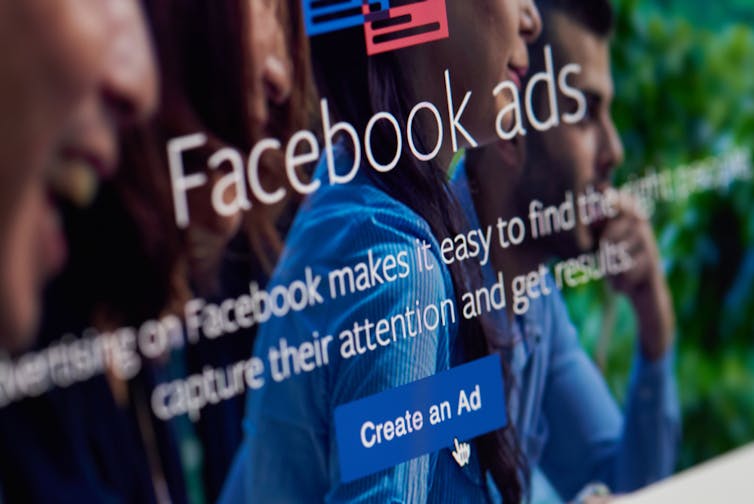
Facebook friends.
Shutterstock

Often poorly paid – and walking the “safe” and “unsafe” tightrope in a matter of seconds – what these people see can lead to serious psychological repercussions. The human toll of the safety drive should not be underestimated.

Big tech, big responsibility

All of this raises serious questions about the role of marketing in society, and the ethics of big tech. For many, self-regulation is not enough. Politicians have called on brands to curtail commercial relations with the tech giants to address safety concerns in their platforms.

I agree. We have to push every organisation along the digital supply chain harder. The DARE approach I advocate (Digital Advertising Responsibility and Ethics) focuses less on demonising and more on humanising business. It advocates two vital actions.

Firstly, promoting the work of industry ethical game changers who are encouraging a new definition of responsibility – the Financial Times, for example, who stepped away from Facebook following controversial identity checks on advertisers (a move Facebook is now reconsidering), or Nestlé, which is looking into funding sustainable cocoa sourcing through ethical ad buying.

Other brands, such as Vodafone, are moving digital advertising in-house to have more control. Such examples demonstrate the trust deficit currently operating within the digital advertising industry.

Secondly, we need a bigger role for ethics in the digital supply chain. Ethics begin where the law ends, considering the right or wrong in any decision. Ethical thinking requires constant reflection in a changing digital landscape, rather than rules-based compliance. Yet while many advocate a code of ethics for the tech profession, I believe the key to to moving the field forward will come through education, open discussion and individual reflection.

It is only by making progress in these directions that we will be able to shift away from the murky culture that currently dominates the filtering of the online world. It’s not about sticking the boot into big tech. More the moccasin.The Conversation


Sarah Glozer, Senior Lecturer in Marketing, Business & Society, University of Bath

This article is republished from The Conversation under a Creative Commons license. Read the original article.



 

Tags: advertisingbrand safetydigital advertisingdigital advertising ethicsdigital advertising placementethical advertisingFacebookSarah Glozersocial media

Sarah Glozer

I am interested in the relationship between business and society, particularly in a digital context. My current research projects relate to exploring themes of corporate social responsibility (CSR), dialogue and communication studies, ethical markets and consumption, organisational legitimacy and social media marketing. I am active on Twitter (@Sarah_CSR). Sarah Glozer is Deputy Director for the Centre for Business, Organisations and Society (CBOS) at the School of Management at The University of Bath. Prior to joining Bath, she worked in the School of Management at Royal Holloway, University of London and she where obtained her PhD from the International Centre of Corporate Social Responsibility (ICCSR) at Nottingham University Business School. She is keen to continue to collaborate with industry. Prior to her academic career she worked in a variety of commercial and sustainability focussed roles at Cadbury.

Follow Us

  • twitter
  • threads
  • Trending
  • Comments
  • Latest
Awards Wrap: Radio Workshop nominated for Podcast of the Year, Bar & Beverage Awards 2023 winners announced, grab those MOST Awards tickets now

Awards Wrap: PRISM Awards honours PR professionals, Euphoria Telecom launches No Bull Prize, Red & Yellow students thrive at The Loeries

October 21, 2025
Marketing technology platforms need to balance AI with human expertise

Marketing technology platforms need to balance AI with human expertise

August 27, 2026
Who watches the watchers?

Who watches the watchers?

August 27, 2026
What happens to agency fees when AI halves the hours?

What happens to agency fees when AI halves the hours?

August 26, 2026
Entries open for the 2026 Telkom Radio Awards

Entries open for the 2026 Telkom Radio Awards

0
Turning constraints into commercial advantage in Mozambique

Turning constraints into commercial advantage in Mozambique

0
Awards Wrap: Radio Workshop nominated for Podcast of the Year, Bar & Beverage Awards 2023 winners announced, grab those MOST Awards tickets now

Awards wrap: Cape Town takes double honours at World Travel Awards Africa 2026, Apple the first inductee at One Club’s Brand Hall of Fame, finalists for the 2026 Inclusive Lens Awards

0
UNESCO study reveals risks facing South Africa’s digital creators

UNESCO study reveals risks facing South Africa’s digital creators

0
Entries open for the 2026 Telkom Radio Awards

Entries open for the 2026 Telkom Radio Awards

September 1, 2026
Engaging the ‘disengaged’

Engaging the ‘disengaged’

September 1, 2026
UNESCO study reveals risks facing South Africa’s digital creators

UNESCO study reveals risks facing South Africa’s digital creators

September 1, 2026
Does advertising still matter in the age of AI slop?

Does advertising still matter in the age of AI slop?

September 1, 2026

Recent News

Entries open for the 2026 Telkom Radio Awards

Entries open for the 2026 Telkom Radio Awards

September 1, 2026
Engaging the ‘disengaged’

Engaging the ‘disengaged’

September 1, 2026
UNESCO study reveals risks facing South Africa’s digital creators

UNESCO study reveals risks facing South Africa’s digital creators

September 1, 2026
Does advertising still matter in the age of AI slop?

Does advertising still matter in the age of AI slop?

September 1, 2026

ABOUT US

The Media Online is the definitive online point of reference for South Africa’s media industry offering relevant, focused and topical news on the media sector. We deliver up-to-date industry insights, guest columns, case studies, content from local and global contributors, news, views and interviews on a daily basis as well as providing an online home for The Media magazine’s content, which is posted on a monthly basis.

Follow Us

  • twitter
  • threads

ARENA HOLDING

Editor: Glenda Nevill
nevillg@themediaonline.co.za
Sales and Advertising:
Tarin-Lee Watts
wattst@arena.africa
Download our rate card

OUR NETWORK

TimesLIVE
Sunday Times
SowetanLIVE
BusinessLIVE
Business Day
Financial Mail
HeraldLIVE
DispatchLIVE
Wanted Online
SA Home Owner
Business Media MAGS
Arena Events

NEWSLETTER SUBSCRIPTION

 
Subscribe
  • About
  • Advertise
  • Privacy & Policy
  • Contact

Copyright © 2015 - 2026 The Media Online. All rights reserved. Part of Arena Holdings (Pty) Ltd

Welcome Back!

Login to your account below

Forgotten Password?

Retrieve your password

Please enter your username or email address to reset your password.

Log In

Add New Playlist

No Result
View All Result
  • Home
  • MOST Awards
  • News
    • Awards
    • Media Mecca
  • Print
    • Newspapers
    • Magazines
    • Publishing
  • Broadcasting
    • TV
    • Radio
    • Cinema
    • Video
  • Digital
    • Mobile
    • Online
  • Agencies
    • Advertising
    • Media agency
    • Public Relations
  • OOH
    • Events
  • Research & Education
    • Research
    • Media Education
      • Media Mentor
  • Press Office
    • Press Office
    • TMO.Live Blog
    • Events
    • Jobs

Copyright © 2015 - 2026 The Media Online. All rights reserved. Part of Arena Holdings (Pty) Ltd

Not enough quota to unlock this post
Unlock left : 0
Are you sure want to cancel subscription?