South Africa’s FIFA World Cup 2026 media coverage fell by almost 45% after Bafana Bafana’s Round-of-32 exit, underlining how national relevance, rather than the scale of the tournament, drove local media attention.
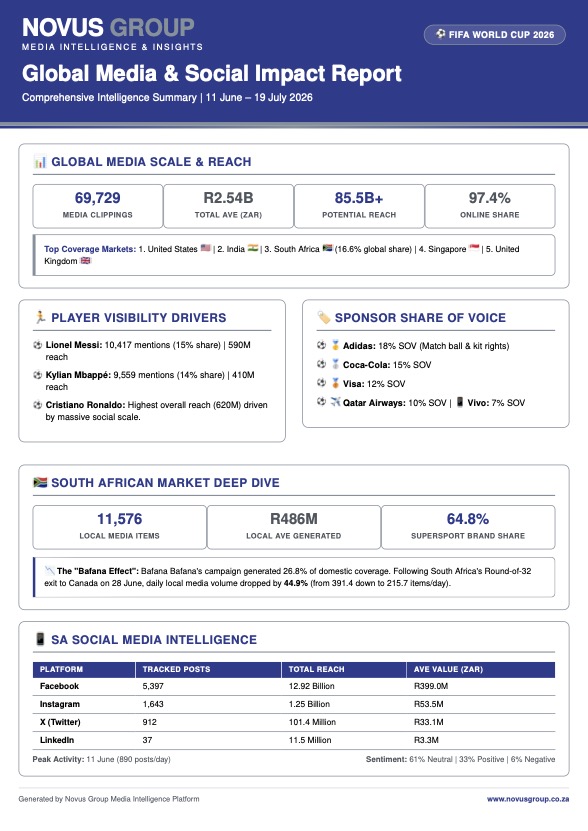
According to the Novus Group FIFA World Cup 2026 Statistical Media Coverage Report, average daily traditional media coverage declined by 44.9% after South Africa lost to Canada on 28 June, even though the tournament continued for another three weeks.
The report tracked media coverage between 11 June and 19 July, analysing how the expanded 48-team tournament was reported globally and in South Africa.
Globally, the tournament generated 69,729 traditional media items, with an advertising value equivalent (AVE) of R2.54 billion and a potential audience reach exceeding 85.5 billion. South Africa contributed 11,576 media items, accounting for 16.6% of global coverage and ranking third behind the United States and India.
“The tournament had strong global appeal, but South African coverage was closely tied to Bafana Bafana’s progress,” said Joe Hamman, director at Novus Group.
Balanced media mix
“Interest rose through the group stage and around the knockout match against Canada. Once the national team was out, the volume dropped substantially, even though the tournament continued for another three weeks.”
While online publishing dominated globally, accounting for 97.4% of coverage, South Africa recorded a more balanced media mix. Online media contributed 84.2% of local coverage, while print represented 10.8% and broadcast 5.1%, highlighting the continued role of traditional media in amplifying the national team’s World Cup campaign.
The report found that match results and team performances accounted for 42.6% of global media coverage, with attention peaking around the Argentina-Spain final on 19 July.
Individual players also generated significant media attention regardless of team performance. Lionel Messi topped player mentions with 10 417 media items, followed by Kylian Mbappé with 9,559. Cristiano Ronaldo ranked behind both in total mentions but achieved the highest potential audience reach at 620 million, compared with Messi’s 590 million, illustrating that media volume and audience reach do not necessarily align.
Standout social media stories
One of the tournament’s standout social media stories came from Cabo Verde goalkeeper Vozinha, whose Instagram following surged from around 50 000 to several million within 24 hours after his seven-save performance against Spain.
The report also found that off-field issues contributed to sustained media interest. FIFA President Gianni Infantino attracted coverage over visa management and defended the tournament’s ticket pricing amid concerns about affordability and accessibility, ensuring governance and commercial issues remained part of the broader World Cup conversation.
“Fixtures are only one part of what sustains attention around a major tournament,” Hamman said. “National identity shapes local interest, while individual personalities can build their own media momentum. Off-field issues also become part of how the tournament is understood and discussed.”
Novus Group cautioned against interpreting headline social media reach figures at face value. The report’s cumulative social reach of 14.3 billion represents audience potential based largely on follower counts rather than verified impressions or engagement, with just three major accounts contributing approximately 56% of the tracked reach.
Evaluating coverage
The findings suggest brands, sponsors and rights holders should evaluate tournament performance using a combination of coverage volume, local relevance, player influence, audience amplification and sentiment, rather than relying on a single metric.
The report concludes that while the FIFA World Cup generated enormous global attention, South African media interest remained firmly tied to Bafana Bafana’s fortunes, with the team’s exit reshaping the domestic media landscape almost immediately.
Novus Group has made a one-page infographic summarising the report’s findings available for download. The full FIFA World Cup 2026 Statistical Media Coverage Report, which includes detailed media analysis, audience metrics and performance data, is available for purchase.