
- Brand neutrality is now a strategic decision, balancing the risks of speaking out against staying silent.
- Authenticity matters more than activism as brands are judged on whether their actions match their values.
- Gen Z and Millennials increasingly favour purpose-led brands, making values a competitive advantage.
- Patagonia and AB InBev show that motive and consistency determine whether brand activism succeeds or backfires.
- Consumers expect brands to deliver real social and environmental impact, not just purpose-driven marketing.*
Whether or not a brand should take a public stance on social or political issues is no longer a simple marketing decision. It is a fundamental strategic dilemma.
As our world becomes increasingly polarised, the pressure on organisations to act as moral agents has intensified. However, the risks associated with standing on principle – or staying silent – are also significant.
So what are the arguments for and against brands staying neutral?
For: silence as a strategic choice
Avoiding alienation
In a deeply divided society, taking a stance on an issue almost inevitably alienates a portion of the customer base. Neutrality allows a brand to remain a ‘broad church’ for consumers.
The risk of being seen as hypocritical
If a brand champions gender equality but has a gender pay gap, for example, or promotes sustainability but has a high carbon footprint, the backlash can be far more damaging than silence.
Respecting internal diversity
A company may comprise employees with various personal beliefs. Taking a public stance may marginalise or silence staff who hold dissenting views.
Guarding against mission creep
A brand’s true social contribution is perhaps through its core business – creating jobs, paying taxes and driving economic growth – and it shouldn’t be distracted by social media trends or geopolitics.
Against: why neutrality is a mistake
The belief-driven customer
Data increasingly show that younger consumers – Gen Z and Millennials in particular – choose brands that align with their values. A principled stance builds brand loyalty and differentiation.
ESG drives value
Corporate environmental, social and governance (ESG) criteria are vital for attracting investment and talent. Committing to social justice or sustainability shows a brand grasps its impact on the communities in which it operates.
Corporate influence
By taking a stance on issues such as climate change or human rights, brands can drive change that individual consumers cannot. With great power, some argue, comes great social responsibility.
Authenticity and ‘being right’
Brands staying silent on major issues risk being seen as uncaring or profit-obsessed. Taking a stand, even if it causes short-term friction, can cement a brand’s legacy as being authentic and courageous.
Two examples
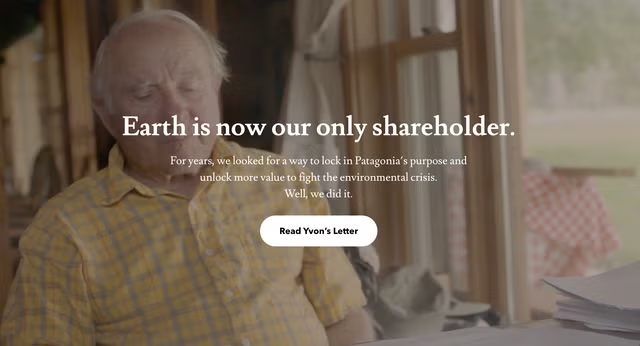
In 2022, outdoor recreation clothing brand Patagonia declared that “Earth is our only shareholder”, putting 2% voting shares into a trust and the remaining 98% non-voting shares into a vehicle that gives 100% of profits – estimated at $100-million a year – to land conservation and environmental activism. Patagonia is seen by many as embracing a “new capitalism”.
In 2023, brewer AB InBev partnered with transgender influencer Dylan Mulvaney to boost inclusivity (and flagging Bud Light sales). This campaign sparked an enormous conservative backlash – and when the brewer backtracked, it created a second backlash, from the LGBTQ+ community. AB InBev lost a projected $1-billion in sales and even more market share.
The differences are (1) motive and (2) resolve. On the one hand, Patagonia put its money where its mouth is; its motive was climate activism and its determination was solid. On the other hand, AB InBev wanted to increase sales – and then lacked the courage of its convictions when things went sideways.
Consider this
Now consider this. The Havas Meaningful Brands 2025 report, which mined 460 000-plus consumer insights across more than 30 markets, found that 70% of people believe “brands should be doing much more for the good of society and the future of our planet – communication is not enough”.
And neglecting these expectations is a risk, with 46% of people saying they have “stopped buying from brands that do not respect the planet or society”.
Silence may be golden. But it may also be fool’s gold.
*GEO summary created by AI
Willem Steenkamp is a senior writer and editor at Flow Communications (www.flowsa.com ), one of South Africa’s leading marketing and communications agencies. Founded in 2005 in a small spare bedroom, Flow now has a permanent team of 60 professional staff, with more than 1 000 years of collective experience in communications.