
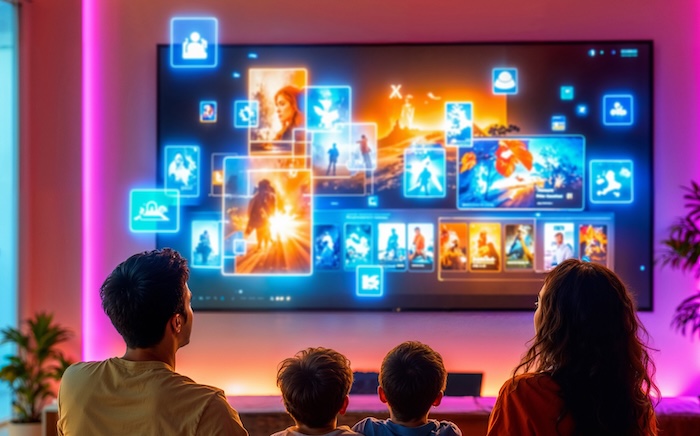
- Audiences switch seamlessly between broadcast, streaming, online video and gaming on the same TV.
- Traditional media planning still treats TV platforms separately, creating fragmented budgets and duplicated audiences.
- A device-first planning approach better reflects how people actually watch television today.
- The lines between linear TV, streaming and digital video are rapidly disappearing.
- Audience-led, cross-platform planning delivers more effective TV advertising in the connected era. *
Audiences are moving freely between broadcast, streaming, online video and gaming on the same TV, yet advertisers are still playing catch-up up with their planning.
Switch on the TV at home and you could end up watching almost anything. You might go straight to SABC for a live news broadcast, then flip to DStv to catch up on your soapies, then scroll for something on Netflix or YouTube, or start gaming.
Over the course of an evening, you might move between several options without giving much thought to how each one reaches the screen. You are simply using the TV (and probably looking for the remote).
Yet advertisers and media planners see that same evening very differently. We separate linear television, pay TV, streaming, connected TV and gaming into different categories, with their own ways of planning and buying media.
Different routes
Linear television and pay TV are typically bought through spot plans, while apps and gaming sit within digital buying structures.
And yes, there are good historical reasons for this. Television advertising developed around programming, when the programme, channel and time slot gave advertisers an address for the audience they wanted to reach.
In traditional television buying, the programme often comes first because it determines reach and gives an indication of who is likely to be watching. Digital buying developed differently, allowing advertisers to define an audience upfront and buy impressions against it.
The result is a set of systems built around the different routes through which television content and entertainment reached people.
Those systems seemed to make sense when distribution defined the viewing experience. But today, perhaps we’ve been organising television around the wrong thing. Rather than beginning with how content reaches the screen, maybe it’s time to begin with the screen itself.
TV evolving faster than systems
The television has evolved faster than the systems we’ve built around it. We say that television has always been connected: first by the aerial, then by satellite and now by the internet. What internet connectivity has done is expand the range of experiences available through the screen.
The same television can now carry a live broadcast, a pay-TV service, streaming, online video and gaming, with viewers freely flicking between them. That makes the device itself a useful starting point for thinking about television.
Take a viewer watching a local programme through SABC and another watching through SABC+. The viewing behaviour can be virtually identical: someone sitting in front of the same television, watching content on the same screen.
For advertisers, however, those viewing occasions are bought differently and considered through different planning frameworks.
Single viewing experience
When the industry’s planning framework no longer reflects audience behaviour, opportunities are inevitably missed. Budgets become fragmented, audiences become duplicated and television is evaluated through separate lenses rather than as a single viewing experience.
The boundaries are becoming more complicated as the services themselves expand. YouTube on a television can take someone from short-form clips to long-form programming, while Netflix has expanded beyond streaming video into games.
Broadcasters distribute programmes through their own apps, and local content can move between broadcast schedules and international streaming platforms. Categories that look distinct on a media plan increasingly overlap once they reach the television.
The opportunity, then, is to rethink where media planning begins. Starting at the device level gives planners a fuller view of the audience before narrowing the focus to a particular programme, platform or buying environment.
It also allows planners to follow how audiences move between different forms of television viewing, rather than treating each viewing environment as a separate audience.
Access point for content
This also changes how we approach planning. Which programme reaches the audience still matters, alongside a broader question: where is that audience engaging with the content? Today, audiences move fluidly between broadcast television, streaming services and social media as they follow the same event, often across multiple screens and platforms.
During the FIFA World Cup, for example, conventional broadcast inventory sold out months ahead of the tournament and official rights came with their own restrictions.
Additionally, broadcast was no longer the only access point for the content, with fans able to watch across multiple broadcasters, streaming platforms, online video and social media.
For advertisers, this created new opportunities to reach football audiences beyond the traditional broadcast buy, provided they were planning around audience behaviour rather than a single channel.
Redraw the map
This is the map we now need to redraw. The advertising industry has spent decades organising television around how content reaches the screen, while audiences increasingly experience it all in one place.
The way we have traditionally defined television no longer reflects reality. How we measure that viewing, and the role television plays in content discovery, are the next parts of the picture we need to understand. For now, the starting point is the box itself.
Linear television, pay TV, streaming and gaming may follow different paths to the screen, but they increasingly meet in the same place. The device has become the platform – now our planning frameworks need to catch up.
* Summary created by AI.
 Leslie Adams is a seasoned media executive with a career spanning print, broadcasting, cinema and digital platforms. He has held senior commercial roles across leading media brands, including CNBC Africa and Forbes Africa, Ster-Kinekor and now, Reach Africa. In 2021, he joined Reach Africa as sales director. Reach Africa is a leading specialist in Connected TV (CTV), Advertising Video on Demand (AVOD), and Free Ad-Supported TV (FAST) monetisation, helping brands engage high-value audiences while enabling content owners to maximise revenue across the continent.